
The opening of the Arizona State Museum at Rio Nuevo is three years away, optimistically, but its oldest artifact has already been moved.
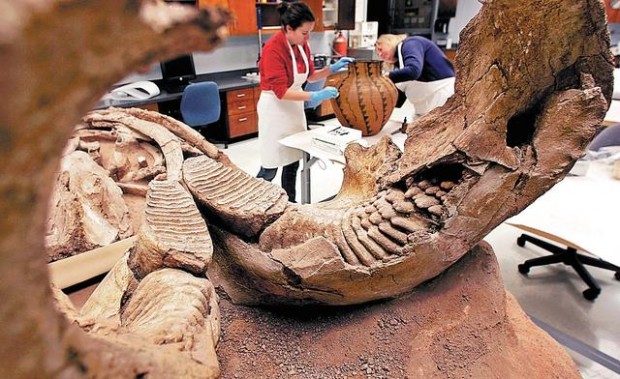
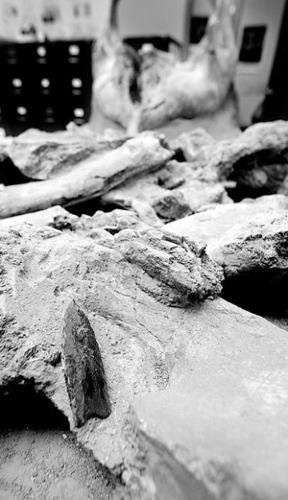
A cache of mammoth bones, containing the spear points of the migrant Clovis-era hunters who slew the beast 13,000 years ago, made its way last Friday from the museum's venerable building on the south side of the UA Mall to its conservation laboratory on the north side of the mall.
The display was wrapped, loaded on a cart and pushed very carefully up ramps, down Park Avenue and over elevator thresholds, said conservator Nancy Odegaard.
These fragile bones, from the era in which the first appearance of humans in our region was documented, will now be carefully dismantled from their plaster base.
They will be cleaned and stabilized by a materials scientist and remounted to become the starting point for a journey that will take visitors along a path that traces the many human migrations that created the Arizona in which we live.
People are also reading…
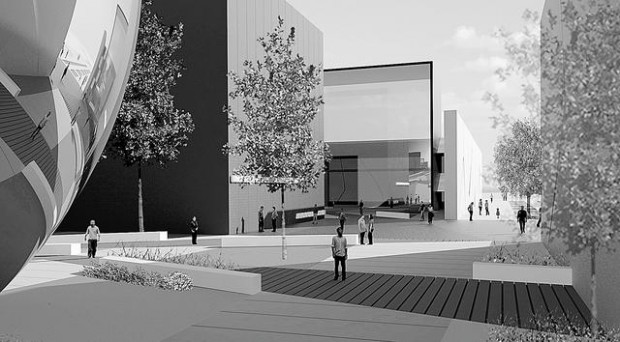
On Wednesday, museum officials unveiled plans for the new museum, which will share a building with the University of Arizona Science Center and join a cluster of cultural attractions at the city's Rio Nuevo site, west of Downtown, along the Santa Cruz River.
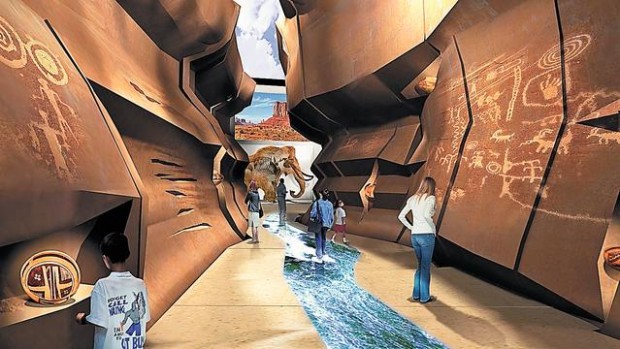
Visitors will enter the museum's side of the building through a stylized slot canyon, complete with projections of a changing sky overhead and a running stream under their feet.
They will walk back through time as projections on the canyon walls change from landscapes with junked cars and grafitti to pictographs by earlier rock artists.
Then visitors will encounter that mammoth hunt of 13,000 years ago and begin a journey into the present, above a trench that will detail the discoveries of archaeologists who compiled the historical record of the comings and goings of man in Arizona.
For E. Charles Adams, curator of the "Journeys of our Ancestors" exhibit, it is an opportunity for him and his fellow anthropologists at the Arizona State Museum to distill a lifetime of work into a series of stories, aided by the latest audio-visual technology and backed by a Web database that will allow you to make your visit as deep or as shallow as you wish.
Exhibit designer Ralph Appelbaum said he wants the technology to enhance but not overwhelm the museum experience, and he wants to make use of the gadgets visitors carry into the museum.
You might learn more about a displayed artifact, for example, by using your own cell phone to hear the voice of its discoverer. "This is my favorite object. I found it on a sunny day in ..."
Adams, asked in an interview Wednesday to name his favorite discovery, picked a kiva at Homolovi Ruins, now a state park, where he spent 25 years digging into the story of a civilization that was once assumed to have vanished.
He and other anthropologists now agree that people from those settlements along the Little Colorado River, near present-day Winslow, moved north onto the Hopi mesas.
He had picked the site almost at random, in an area that had been vandalized. He found a kiva with two perfectly preserved murals.
One wall is a panorama of the San Francisco Peaks near Flagstaff, visible to the west from the site. Another wall depicts the Hopi buttes to the north.
The murals, created about A.D. 1375, are marked in places.
Hopi elders helped him understand the meaning, he said. It was the domain of the "sun chief," and the markings probably indicated the positions of the sun on important days when the priest might tell the people to plant the corn or gather provisions for winter.
A representation of that particular kiva may not make it into the exhibit, Adams said, and if it did, he would want a Hopi explaining its meaning.
Decisions about what to include continue, but a committee of anthropologists working with the exhibit designer has identified the major themes. More than 200 artifacts have already been through the conservation lab in preparation, said Odegaard.
Under the museum's three-year strategic plan, everyone is working on Rio Nuevo at some level, Adams said.
The migration stories will explore why people moved over the centuries — for water, for shelter, to escape enemies or to live by a good golf course.
The exhibit will detail the migration of Spaniards up from Mexico, and the Apache and Navajo down from Canada.
Aided by archaeological discoveries made during the museum's 115-year history, it will detail the migration of Mormons and Chinese, and the continuing migration of Mexicans.
Along the way, visitors will learn how archaeologists work, from digging to highly specialized dating techniques, and use a virtual lab to do their own explorations.
Adams said the museum also anticipates creating an interactive video space where visitors can tell their own migration stories — "some kind of YouTube, MySpace kind of thing — How I came to Arizona."
A second permanent exhibit, "Our Lands, Our Lives," will tell the stories of all Arizona's native tribes, grouped into four regions — plateau, desert, mountain and Colorado River.
The important thing, said Appelbaum during a December visit to Tucson, is to tell stories.
Adams said anthropologists have learned over the years that those stories must be a collaboration between the scientists and the descendants of the people they study.
Living with the Hopi taught him more than digging up the settlements of their ancestors, Adams said.
Whenever, possible, he said, the stories will be told in the voices of the descendants.
Exhibit planner Rick Sobel, project director for Ralph Appelbaum Associates, said Wednesday that the museum will be designed to be both a cultural destination for travelers and a place where area residents will want to make return visits.
In addition to two permanent exhibits, "Journeys of Our Ancestors" and "Our Lands, Our Lives," the museum will include a giant "cache" of objects from the museum's collections. It will have a small theater and a gallery that will change exhibits every six months.
Adams said the permanent exhibits can be changed as well, particularly the audio-visual components.
Across a courtyard entrance shared by the museum and the Science Center, stories of the past will give way to discoveries of the future.
The Science Center is planning to employ a variety of high-tech gadgets to involve visitors in the many scientific explorations of the university.
DID YOU KNOW
The Arizona State Museum predates the state. It was established in 1893 as the Arizona Territorial Museum.
It is housed in two stately brick buildings just inside the Main Gate of the University of Arizona.
The north building, completed in 1927, is the former UA library. The Anthropology Building on the south was completed in 1935. Both structures were designed by noted Tucson architect Roy Place.
The museum is a repository for more than 150,000 artifacts, including the world's largest collection of Southwest Indian pottery (20,000 specimens).
Sources: Arizona State Museum and "A Guide to Tucson Architecture" by Anne M. Nequette and R. Brooks Jeffery