

Dave Newman e-mailed a village in Ghana last week to offer advice about water pumps.
The last part of a water-distribution project undertaken by Newman and fellow members of the UA's chapter of Engineers Without Borders ended last May. But their desire to ensure 10,000 people continue to have clean water remains.
Newman, who managed the project for the University of Arizona's student group, said it now provides clean water to Ghanaians in 30 communities.
The organization focuses on sustainable projects across the world that are community-driven and keep communities in charge.
After officially forming in 2005, UA's student chapter competed against other student chapters to win its first project: assisting the people of Mafi-Zongo, Ghana. There are hundreds of chapters, yet many have not had a chance work on an active project, Newman said.
People are also reading…
Because it aims to support community ambition, Engineers Without Borders' project model doesn't promote forced assistance. Instead, it lets projects come to it, Newman said.
"You want villagers to say: 'We want clean water. How do you help us get that?' " he said.
In this case, the villagers and a nongovernmental organization in the area approached Engineers Without Borders USA, the chapter's parent group, looking for technical advice: Their filter was clogged and didn't distribute enough clean water.
With such a large population to assist, the scope of the project was huge, Newman said. But the filter wasn't the only problem. The group needed to be sure the village was actively involved. Development projects in the area had failed more often than they'd succeeded, he said.
Members of the community had relied on other organizations to provide water and weren't yet ready to make the change on their own, Newman explained.
The UA group took two assessment trips in 2005 and 2006 to gauge community involvement and collect enough data, as well as determine the root of the filter's clog: inadequately pretreated source water.
The group's design was eventually approved in 2007, but it took two years to collect the necessary funds, Newman said. The team raised about $88,000, 42 percent of which came through the SaddleBrooke Rotary Club.
Newman said numbers fluctuated, but the group consisted of 15 traveling members and roughly 30 who supported the project in other ways.
Aside from funding, keeping members to see a project all the way through is one of the biggest challenges because students graduate and move on, he said.
The group completed the project in 2009 and watched over it for a year. The result is a pretreatment facility that puts out up to 250 cubic meters of water daily, or a little more than 60,000 gallons.
But the group's work didn't end with the pretreatment facility. The local women's health committee said it wanted to improve not only water, but health care, too. The closest hospital was 45 minutes away and there were no ambulances.
Feeling empowered by the water project, the committee approached the village chief to create a health-care center from a never-used building, Newman said. The villagers, without the help of UA's chapter, completed the project on their own.
Villagers now pay the center for diagnoses and medicines, Newman said, and the money replenishes supplies and trains technicians in fields such as midwifery - a big step in a country where the infant mortality rate is nearly eight times what it is in the United States.
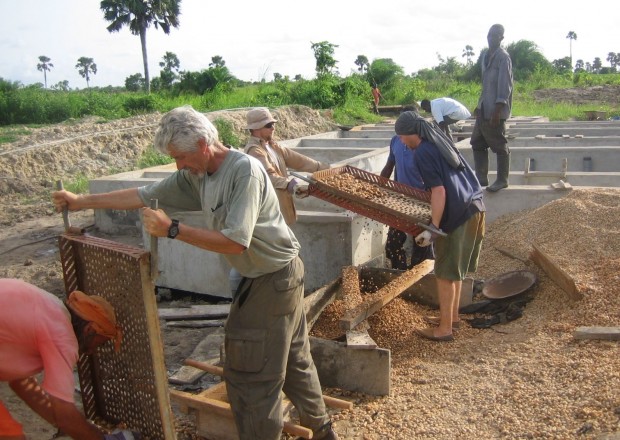
The production of locally sourced aggregate for concrete is another project offshoot from which the village now benefits, instead of buying expensive material four hours away near Ghana's capital, Newman said.
Engineers Without Borders has moved on to its next project, too. Members are working on rainwater harvesting in Mandoli, Mali - a remote community where water resources are limited.
Mali project manager Patrick Mette said the first part of the assignment -fixing a broken water pump in August - was highly collaborative. The group linked up with a team from the University of California-Santa Barbara, an area Peace Corps volunteer and African Sky, an area nonprofit that promotes sustainable development.
Mette said that while his group is bringing technical expertise, area groups are helping the UA's chapter get an insider's look.
"Since they're in the country, they have a better understanding of what needs to happen to make an impact," he said.
In a developed country where "sustainable development" is sometimes no more than a buzzword, the group makes students really consider the various components of societal support, said Sean Dessureault, the UA chapter co-founder and former professional mentor.
Dessureault said students are hungry to work on projects and are learning how to back communities socially, economically, environmentally and administratively.
Current professional mentor Joel Cuello agrees. Cuello, a professor of biosystems engineering, said he's pleased students work on projects that actually assist communities.
"It's an excellent opportunity for them to learn about needs that are relevant to engineering in the developing world," he said.
"On the other side, people get tangible, real benefits from this cooperation with the students. It's a win-win for both students and the whole world."
About Engineers Without Borders
• UA's chapter began in 2005.
• The group includes undergrad and graduate students, as well as professors and area professionals.
• There are 250 chapters in the United States, and the group has international chapters, too.
• To learn more about the local group, go to www.ewb-ua.org or e-mail the group at ewb.arizona@gmail.com
Contact NASA Space Grant intern Victoria Blute at vblute@azstarnet.com


