

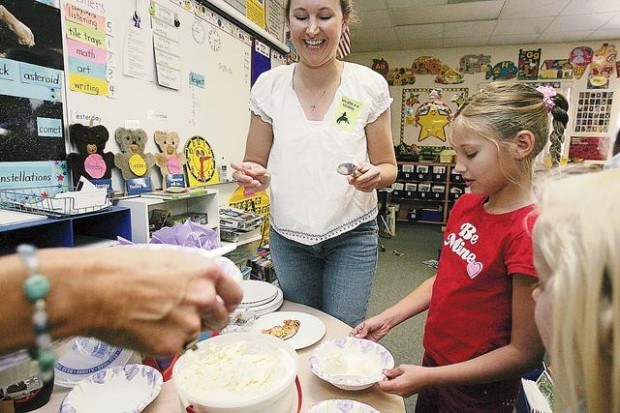
Hunched over gooey gobs of chocolate syrup and vanilla ice cream, brothers Conner and Ben McNitt laugh, joke and stuff their faces.
The Wilson K-8 students anticipated the ice cream social all day. But it likely will be the last time their stomachs will be filled with cool chocolatey goodness while they're at school.
As part of the No Child Left Behind Act, the federal government is requiring every school district in the country to shape up its nutrition standards for all K-12 students by July 1, as a way to encourage healthier lifestyles in an increasingly obese nation. Students with specific dietary and physical needs are exempt.
The federal mandate, passed by Congress in 2004, addresses everything from what kids eat and drink at lunch to how much recess and physical education they need.
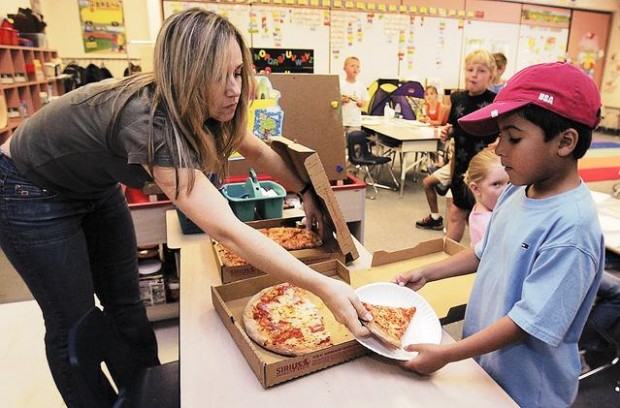
Its food-safety policies also prohibit any foods not made in a licensed kitchen, with ingredients clearly labeled. That means no more homemade cupcakes, cookies or cake on birthdays. Vending machines will get an extreme makeover, too, losing greasy chips and sugary drinks in favor of bottled water and granola bars. And "food as reward," such as ice cream socials or pizza parties, also is banned.
People are also reading…
The federal government only made guidelines for schools to follow, so the the Arizona School Boards Association has sent a draft policy to every district. Some districts, such as Amphitheater and Sunnyside, have approved that policy with little change. Others are adjusting some of the language still.
The new policies aren't completely radical in Tucson. Some school districts already have hired food-service providers to make healthy lunches. Others have been promoting more exercise during the day for years. But complying with the new mandates still has irked some educators — and parents — who want to keep their time-honored traditions.
As Amphi Board President Kent Barrabee put it: "The party's over."
"Legislative overkill"
As research shows that one in three American children is overweight, some say the new policy is long overdue. But others still say it's too much.
Barrabee wants to keep kids safe at school, but, "I fear this may be legislative overkill."
Other educators agree, including Wilson K-8 School first-grade teachers Anelle Thompson and Ruthann Smithrud. They worry the new policy will affect classroom learning.
Thompson uses Froot Loops to help teach students math concepts involving patterns. The kids get to eat the cereal, too. She chuckled at the thought of using bran flakes instead.
"It's not going to be as fun for them," she said of next year's students.
Ben McNitt, 12, and his brother Conner, 9, who are finishing sixth and fourth grades at Wilson, were more direct.
"They should stop taking away stuff and start getting some athletics," Ben said.
Conner said that ever since he started at Wilson, he's looked forward to middle school and buying food from the snack bar.
"Now, by the time I get there, they might only be allowed to serve rice cakes," he said.
State education Web sites across the country are full of information for schools to use as they draft their regulations. In Las Vegas, which recently was named by Men's Fitness magazine as one of the country's fattest cities, the Clark County School District has been soda- and candy-bar-free for two years, and the idea of healthier choices is gaining acceptance.
"It's not as bad as it was two years ago," said Karen Vogel, district director of food services. "But you'll always find some students who'll complain. By the time our middle-school kids get to high school, we hope they will accept it as a way of life."
Implementation problems
Finding exercise time for students has been another point of contention.
Ever since state legislators proposed 90 minutes of P.E. a week in December, schools have tried to find ways to fit more play time into an already busy day. But the federal policy suggests 150 to 200 minutes per week. About half of the time would be for health classes, the rest for P.E. or recess.
"It takes a big chunk out of the academic time," said Gene Repola, Sunnyside's assistant superintendent for operations. "But it's fair."
Districts also are searching to find the money to make their plans work, as no federal funds are included in the policy.
"I know that we're going to spend more money on food (services), and prices for lunches will be raised, because those healthy things cost more," said Rosemary McCain, director of community services for the Vail Unified School District.
Repola said Sierra Middle School has piloted a healthy-lunch program this year and students slowly have gotten used to turkey sandwiches and baked chicken.
"We don't want to just educate them academically," he said. "We want them to be physically and mentally ready to go."
Tyler Benson, 10, a fourth-grader at Wilson K-8, said he will try to eat the healthier offerings on next year's lunch menu.
His mother is dubious.
"If I'm not there to harp on him, he won't touch the vegetables," Shelly Benson said. "I can't imagine what he'll eat."
School vending machines can be removed, she said. But dropping cupcakes and class parties?
"They can't be kids anymore," she said.
Forbidden foods, nutrition rules
A sampling of what's banned
Chips and crackers: Are prohibited if they're deep-fried and/or exceed nutrition standards (see below). A portion cannot exceed 1.5 ounces.
French fries and other potato products: Are prohibited if the final preparation method is deep-frying.
Baked goods: Muffins, sweet rolls, doughnuts, pastries, cookies, bars and brownies must meet all nutrition standards.* A portion of muffins, sweet rolls, doughnuts or pastries cannot exceed 3 ounces. A portion of cookies, bars or brownies cannot exceed 2 ounces.
Milk: Cannot exceed 2 percent milk fat. Flavored milk cannot contain more than 4 grams of sugar per ounce. Portion size cannot exceed 12 ounces.
Juice: In K-5, it must contain 100 percent fruit or vegetable juice, and a portion cannot exceed 8 ounces. In grades 6-8, it must contain at least 50 percent juice and no added sugar, with nutrient values equal to 100 percent fruit juice. The portion size cannot exceed 12 ounces.
Carbonated beverages: Prohibited.
Sports drinks: All isotonic sports drinks and electrolyte replacement drinks, such as Gatorade, are prohibited in elementary school. They can be served in middle school in portions of 12 ounces or less.
Individual food items should meet these standards:
No more than 35 percent of total calories are from fat. This doesn't apply to nuts or seeds. In middle and high schools, it doesn't apply to seeds, eggs, cheese packaged for individual sale, fruits, legumes and vegetables that have not been deep-fried.
No more than 10 percent of total calories are from saturated fat. In middle and high school, it doesn't apply to eggs or cheese packaged for individual sale.
No more than 35 percent of total weight comes from sugar. This does not apply to fruits or vegetables.
No more than 400 calories per individual food item.
Prepackaged items must be in their original packaging.
Go to the Arizona Department of Education's Web site at www.ade.state.az.us and click "Arizona Nutrition Standards."