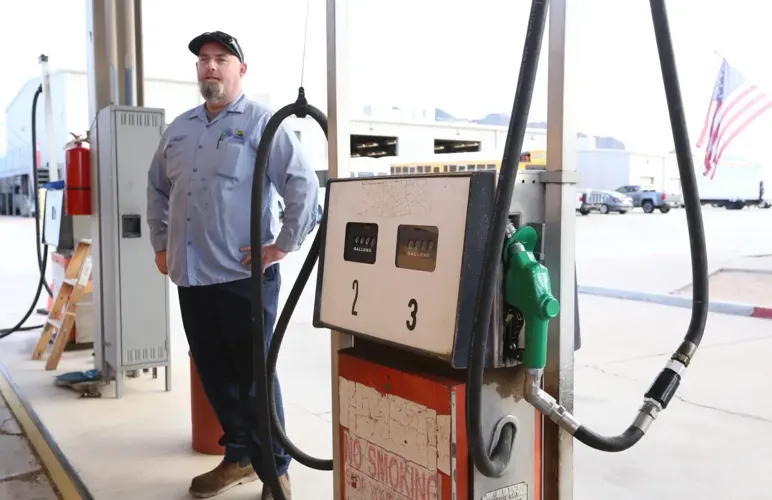
CAVE CREEK — On a typical early weekday morning, the bus lot at Cave Creek Unified School District comes to life with drivers positioning their vehicles at diesel fuel pumps and patiently waiting for the 100-gallon tanks to fill up enough to complete their daily route.
These days, that fill-up is impacting not only the bus ride but the entire district.
Pumping diesel into school buses, analyzing their routes and managing budgets is a regular part of Ken Doss’ 9-to-5 job as the fleet supervisor for the district northeast of Phoenix. Managing these budgets has become increasingly difficult for Doss with the spike in diesel fuel prices.
According to the AAA, one year ago the national average price of diesel was $3.69 per gallon; last week it sat at $6.32.

Managing budgets has become increasingly difficult for district officials, including Cave Creek Unified School District bus fleet supervisor Ken Doss, due to rising diesel costs.
After 13 years on the job, Doss has witnessed firsthand the effects of higher diesel prices on school budgets, faculty and students. In a typical month, Doss places an order for 7,000 gallons of diesel to keep the 24-bus fleet on the road.
People are also reading…
On average, bus drivers are filling up twice a week, sometimes three, Doss said. But for drivers that pick up students in the Valley of the Sun’s outskirts, such as Rio Verde or toward Fountain Hills, filling up daily is required.
The increased costs stem from the ongoing Iran war that has hindered supply chains across West Asia and slowed traffic in the Strait of Hormuz — a critical passageway that carries one-fifth of the world’s oil and liquefied natural gas supply, according to reporting by the Associated Press.
Doss said the rising diesel prices have already greatly affected the district. To manage transportation costs, the district is combining routes, trying to be more efficient.
“It’s caused us to really look at every little detail of routes,” Doss said. “It has us look at tracking, so we track all the buses through GPS … So we’re watching all the mileages. So if there’s a route that we know we can combine and bring that mileage down, we’re definitely doing it.”
Doss said the district has also attempted to take more gasoline-powered buses out that get about 14 miles per gallon compared to the five miles per gallon from the diesel buses.
Another way Doss is making fuel more efficient is by focusing on bus maintenance, like being more aggressive with things such as air filter changes, he said.
The price increase effects aren’t only seen on the managerial side. Bus drivers have also noticed the changes. Janelle Brabec, a lead bus driver and trip coordinator for the district, has been in the transportation industry for eight years.
Brabec’s route requires a fill-up about every three days. In case there is an emergency, drivers don’t let the fuel fall below half a tank. Brabec said the significantly higher diesel costs affect any kind of trip, whether it is transporting students to class or athletes to an event.
“I don’t know that it affects my day-to-day because we have to pick up kids,” Brabec said. “So it more affects our bottom line more than it does our daily job.”

Most school districts in Arizona are facing added pressures due to increased diesel costs, says Jim Migliorino, executive director and chief financial officer for the Arizona Association of School Business Officials. The exception includes some that have opted for alternative fuel options but the vast majority of districts have some form of diesel fleet.
If the costs grow beyond the allotted transportation budget, it could potentially affect the drivers. Brabec said higher fuel prices cut down the ability for the district to raise their pay and attract new drivers.
Jim Migliorino, the executive director and chief financial officer for the Arizona Association of School Business Officials, said most districts in Arizona are facing added pressures due to increased costs. The exception includes some that have opted for alternative fuel options, but the vast majority of districts have some form of diesel fleet.
In terms of budget, there is not much flexibility for districts when fuel costs exceed the budgeted amount. Most districts have a contingency fund, which they will likely pull from first. If that’s not enough, the district would then move on to other efficiencies or savings that they can implement to cover the increased cost, Migliorino said.
“The fuel cost could be great enough, as we have seen it for the start of the school year, to be greater than the contingency. And then the district has a legal obligation to spend no more than the budget capacity that they have authorization to do,” Migliorino said. “So they could have to forgo an expense to be able to afford the increased fuel cost.”
Doss said the fuel cost for the fiscal year is a set amount and not something they can change, which is why it’s important to track information and be efficient. Working for a different district a few years ago, Doss witnessed high fuel prices lead to the cancellation of summer field trips entirely.
“Currently here, it’s definitely made us look at things differently,” Doss said. “We’ve actually raised our prices on what we bill the schools for field trips to mitigate some of that fuel cost. So it’s a big difference.”
Doss said they are still able to run all their sport routes, which some neighboring districts aren’t currently able to do.
“We do whatever we can to facilitate the kids and make sure they’re going to events, they’re going to field trips, ” Doss said. “A lot of other districts have really cracked down on field trips. We’re still doing them, so we make it work.”