PHOENIX — Top Republican lawmakers are trying to block voters from being told that if they approve Proposition 145, a ballot measure billed as protecting voucher funds for children from military families, they actually would kill another measure aimed at broader reforms of Empowerment Scholarship Accounts.
In a new lawsuit, House Speaker Steve Montenegro and Senate President Warren Petersen contend that the language that Democratic Attorney General Kris Mayes has approved to appear on the actual ballots to explain the measure is skewed in a way to convince people to vote against it.
That's because the verbiage crafted by Mayes tells voters that if they approve Proposition 145, it would entirely "nullify''“ any other law approved by voters, even at the same election, that affects the voucher funds. And that would void all of Proposition 212, the Protect Education, Accountability Act — and not just the parts about military families but the entire package of limits on how voucher dollars could be spent and even an income cap on eligibility.
People are also reading…
But even as they were adopting it, supporters of Prop 145 made it clear they not only knew the effect on Prop 212 but publicly acknowledged that it was designed to kill it -- even if voters approve it in November. Yet the new lawsuit seeks to deny that information to voters.
Central to all this has been the effort by Republicans to block a public vote on Prop 212 and its list of changes ranging from who can get vouchers and how the money can be spent.
At one point, Montenegro sought a deal with the Arizona Education Association, offering to kill another GOP ballot measure aimed at union organizing if voucher foes would abandon their initiative.

Montenegro
That fell through.
So Republicans crafted Prop 145 to put a provision in the Arizona Constitution to override any future ballot measure that would allow the state to "sweep'' voucher funds that military families were not using for K-12 education but instead banking for college. There is an anti-banking provision in Prop 212 that applies to all recipients of universal vouchers.
But lawmakers specifically worded their plan to say that any other voter-approved measure that affects those banked voucher funds for military families would be voided entirely if Prop 145 is passed, not just the sections dealing with those banked funds.
Put another way, voter approval of Prop 145, crafted as a constitutional amendment, would override voter approval of Prop 212. And that's what Mayes wants to tell voters -- and what GOP leaders do not want on the ballot.
It is within the purview of the majority of lawmakers to decide what they want to put to voters.
At the same time, however, Arizona law requires the attorney general to prepare a short description of each ballot measure, language that actually appears on the ballots themselves. It is supposed to explain the "essential changes in existing law should the measure receive a majority of votes'' as well as the effect of a "yes'' and a "no'' vote.
What Mayes crafted does spell out the "sweeping'' provision. But it also proposes to tell voters that approval of Prop 145 would "nullify all parts of any law that would sweep such funds, including unrelated provisions of those laws.''

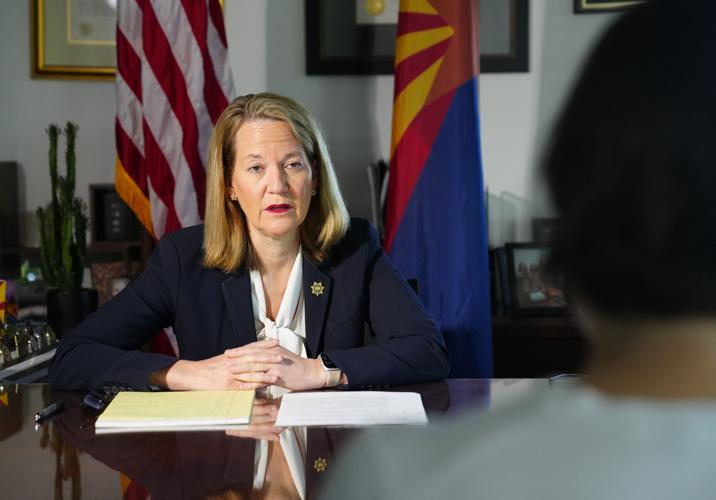
Attorney General Kris Mayes
Attorney Joseph Kanefield, representing the GOP leaders, wants Maricopa County Superior Court Judge Joseph Kreamer to strip that language from the ballot.
Kanefield does not dispute that Prop 145 has a provision which says if any other measure is approved that would take away voucher funds from military families -- including at the same election -- it would void that other measure entirely, even the parts having nothing to do with military families.
But he is telling Kreamer it is wrong -- and illegal -- for Mayes to tell voters about the effect on any such other measure when explaining the effects of Prop 145.
Kanefield said that ballot language is designed solely to explain the effect of voter approval on existing law. But he pointed out that Prop 212 is not existing law and may not even qualify for the ballot due to a challenge to the signatures.
"The attorney general's supposition that a provision in Prop 145 might ultimately 'nullify' Prop 212 is speculation and commentary which does not adequately describe changes to 'existing' scholarship law that would occur if Prop 145 is approved by voters,'' Kanefield told the judge.
But proponents of Prop 145 actually conceded publicly last month, even as they were adopting it in the last hours of the legislative session, that it was crafted in a way to kill all of Prop 212 even if voters approve it.
Matt Beinberg of the pro-voucher Goldwater Institute told lawmakers when they were debating the measure that they need to address "threats'' to the military families.
"There is a current ballot measure being proposed to attack the scholarship funds and confiscate the scholarship funds of children, including military families, done willfully so,'' he said. "This would become the law of Arizona and any other measure that would conflict with it would be struck down.''
Peter Gentala, president of the Center for Arizona Policy, which also supports vouchers, also told lawmakers that if both were to pass, Prop 212 "would be void.''
And Senate Majority Leader John Kavanagh said the decision to put Prop 145 on the ballot was the direct result of the failure to reach a deal with the AEA that would have killed the voucher reform measure.
"That's the reason why we're running this,'' said the Fountain Hills Republican.
Mayes, for her part, is defending the verbiage.
"The ballot language in question appropriately and accurately describes the initiative referred by the legislature, as required by law,'' said Richie Taylor, her spokesman. "It gives voters clear information needed to understand what the impact would be if it is passed.''
No date has been set for a hearing.
This is actually the third lawsuit filed over the issue of vouchers and what will be on the ballot.
At a hearing Friday, a lawyer for the Protect Education, Accountability Act argued that Prop 145 itself is illegal and a vote on it should not be allowed.
Attorney Nick Ansel said that putting the protection for military families into the same take-it-or-leave-it measure with overriding Prop 212 violates constitutional requirements that all ballot proposals deal with a single subject. And he told Judge Kreamer, who is also handling that case, that combining the two issues is intentionally deceptive to voters.
But Kory Langhofer, representing GOP leaders, countered that all the provisions — including the poison pill — fit within a single subject because both parts deal with education funding for kids from military families. Kreamer has yet to rule on that issue.
Separately, Langhofer has filed suit on behalf of the Goldwater Institute to keep Prop 212 off the ballot entirely.
He contends many of the paid circulators used by initiative supporters were not legally qualified, some because they failed to register with the Secretary of State's Office and others because they had been convicted of certain crimes. That, Langhofer said, makes the signatures they collected invalid, leaving supporters short of the 255,949 that need to be found valid to put the issue to voters.

Backers of the Protect Education initiative, which would make changes to Arizona's school voucher system, load up a truck with boxes of petitions. They submitted more than 400,000 signatures to try to get the measure on the November ballot.
A hearing on that case is set for this week.
Howard Fischer is a veteran journalist who has been reporting since 1970 and covering state politics and the Legislature since 1982. Follow him on X, formerly known as Twitter, Bluesky, and Threads at @azcapmedia or email azcapmedia@gmail.com.