Beggars can be choosers.
That’s the attitude I see in Tucson-area public officials as they try to address our increasingly apparent economic malaise.
If you haven’t felt the economic drag yourself, you’ll see it in the numbers.

In the face of worrisome local economic indicators, Tucson and Pima County are far from showing desperation. In fact, they are being choosy as they recalibrate our economic-development efforts.
The population has shrunk slightly in Tucson proper — a bad economic sign, because thriving cities naturally grow. The number of people employed in metro Tucson dropped by around 21,000 over the last year. Tucson’s sales tax collections peaked in fiscal year 2024, dropped in 2025, and probably dropped in 2026, the fiscal year that ended June 30, the city projected.
All those figures speak of a metro area in economic need, which could spark some desperation in local leaders. Not here, though.
People are also reading…
Tucson and Pima County, far from showing desperation, are being choosy as they recalibrate our economic development efforts. The city decided last year they don’t want data centers, and the county is considering a moratorium this year. Some officials sniff at “extractive” industries like mining, and the city council recently showed some distaste for the missile-making company, Raytheon, that is the backbone of our economy.
On Aug. 18, the Tucson City Council considered a 297-acre land-transfer deal for Raytheon, a deal begun decades before that would have cost around $6.5 million to escape. Council Member Miranda Schubert raised the awkward question, especially relevant after the Iran war, of how tightly we embrace manufacturing weapons of war.
“Tucson can benefit enormously from Raytheon’s presence,” she said. “And we can also wrestle honestly with what it means for our community to benefit economically from the production of weapons.”
Before the council approved the transfer by a 4-2 vote, Mayor Regina Romero and Vice Mayor Lane Santa Cruz noted the city’s effort to bring more sustainable and ethically comfortable industries to town.
Santa Cruz wondered aloud, “How do we have an economic development strategy that’s moving away from the business of war and extraction and bringing in more life-affirming industries into the city of Tucson?"
Romero noted that after rejecting the Project Blue data center plan last year, the city talked about shifting economic development policy to match the values of the council and the community.
“There is a way to move in the direction of sustainable, long-term, high-wage jobs that are necessary to continue prosperity in our community. We can’t just continue saying no. We’ve got to be able to find, with the input of our community, the ability to create high-paying jobs with sustainability in mind.”

Mayor Regina Romero, right, and Vice Mayor Lane Santa Cruz have discussed the city’s effort to bring more sustainable and ethically comfortable industries to town.
Developing a 'green economy'
Romero and the city’s new Office of Community and Economic Impact are drawing on her experience at a Bloomberg-Harvard seminar earlier this year to steer Tucson in a new direction.
This high-minded approach is reflected in a study that came out last week and in the city-county prosperity initiative. The Urban Institute researched Tucson’s potential as a center of what it calls the “sustainable and resilient economy” — in essence the “green economy.”
The idea is not just to protect Tucson from its hotter future, but to help the city become a center for this sort of business. Industries like decarbonization and weatherization, water resource management, clean energy development and resilience professional services could flourish here and employ more Tucsonans than they do already, the report suggests.
“Rather than anchoring an economic development strategy around narrow definitions of the ‘green economy’ or a single ‘clean industry,’ leaders can focus on strengthening the broader ecosystem in which sustainable and resilient sectors operate, and allow the market to respond to demand as it rises,” the report concludes.
But we already know this is a politically vulnerable area. The Biden-era Inflation Reduction Act promised booming growth in this area, with federal support, and it was beginning when the Trump-era Congress undid much of that legislation. The development of the American Battery Factory near Tucson International Airport, announced with fanfare during the Biden era, has been stalled as the act’s demise and tariffs took effect.
The city-county “prosperity initiative” aims to reduce intergenerational poverty mostly by addressing the personal and economic needs of poor Tucson-area residents. It emphasizes long-term programs such as expanding early childhood education, easing access to family planning services, offering health insurance assistance as well as some work-related programs such as job training and small business assistance.
In other words, it takes a social-service-oriented approach to breaking poverty and achieving prosperity.
Culture of business lacking
It is in some ways refreshing to see different approaches to economic development and prosperity. The old model of begging and bribing big companies to put a huge plant in your community often proves unproductive over the long run.
And of course, we don’t want to invite a company in again, as we did with Project Blue, only to see the public rise up against it.
But what I find missing in the approach advocated by city and county officials is much fluency in the language and culture of business, which after all will be the provider of these jobs the governments are seeking. When I asked him about the prosperity initiative, Pima County supervisor Steve Christy, the board’s only Republican, also had noticed that.
“It sounds flowery and the frills that go with it,” said Christy, who owned an auto dealership before winning election to the board. “It needs to be brought to brass tacks, which is making sure that those who provide the prosperity, or the pathway to prosperity, are nurtured the most.”
He’s talking about people who do business, not social work.
Christy is also opposed to focusing on the traditional recruitment of outside companies and wants to see more support of existing local companies. That’s something he and the Democrats may largely agree on, at least conceptually. It doesn’t always happen in real life, though.
When I spoke with local restaurateur Grant Krueger, he noted that it can still be very difficult and time-consuming to get permits from the city, as he experienced with the opening of his new Block A restaurant downtown. A city troubleshooter helped him get it done, but it shouldn’t take that, he said, because it discourages less-experienced business owners from even trying.
“This should be pretty easy, and it really was tough for us,” he said.

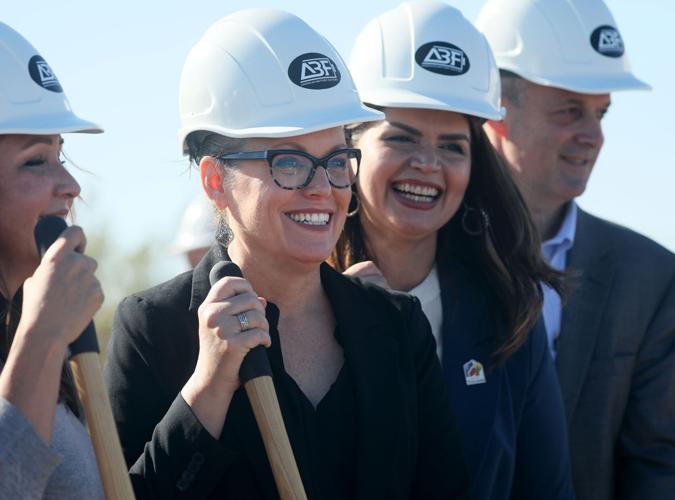
Arizona Gov. Katie Hobbs joined Mayor Regina Romero and other local leaders in October 2023 during a groundbreaking ceremony for the American Battery Factory. However, its expected development near Tucson International Airport has been dormant since the demise of the Biden-era Inflation Reduction Act.
Gritty work needed for local prosperity
The emphasis on local small business is justified, but it does miss something important — big corporations often offer better compensation and opportunities than our cherished small ones do.
Nigel Brooks, a Ward 3 resident who has been working on regional economic development, has had positions as a high-ranking executive in corporate America and also owned a small local business, a coffee shop. The advantages of big corporations, he said, are:
• They can pay more in salary, profit sharing, bonuses, benefits and other compensation
• They offer career opportunities for promotion or moving into a different discipline
• They provide opportunities for mentoring by more experienced people
• They offer more access to peers with similar experiences to share and develop ideas
It would be folly to think that simply supporting our local coffee shops, insurance agents, auto mechanics and graphic designers is going to do much to improve the Tucson area’s economy. We need access to outside money.
In that sense, the ongoing courting of Taiwan for links to the semiconductor industry makes a lot of sense as the industry booms in the Phoenix area. Romero traveled to Taiwan earlier this year, and another Arizona delegation, including Tucsonans such as county supervisor Matt Heinz, is there this weekend.
On Tuesday, the county board approved housing a new alliance between a Taiwanese university, the University of Arizona, and Pima County at the Roy Place building on North Stone Avenue in downtown Tucson. The Arizona-Taiwan Talent & Innovation Hub, as the project is known, intends to focus on workforce development, academic exchange and research, among other things.
It’s a start, with a mammoth industry that we would be lucky to get a piece of. And it’s a welcome sign that local officials aren’t putting all their hopes on becoming a hub of sustainability, or other ethically ideal industries, and small local businesses.
Reigniting our economy is gritty work that may require compromises and being a little less choosy to achieve the prosperity everyone wants.
Contact columnist Tim Steller at tsteller@tucson.com or 520-807-7789. On Bluesky: @timsteller.bsky.social

Tim Steller
Columnist


 Tim Steller’s column: Tucson transit finally getting safety upgrades