Every time I write about Tucson’s streetcar, someone reminds me that there is a whole segment of Tucson society that views it as a costly plaything and a flop.
"It's an expensive toy, not a serious transportation system,” one man commented to me on Facebook after I posted about the streetcar recently. “Great for getting back to campus without a DUI after a night drinking downtown.”

Arizona Daily Star columnist Tim Steller
I forget about that perspective because I know from interviews, personal use and familial experience that the streetcar long ago became indispensable daily transit for one key group: Students and employees at the U of A. It's also served as a focus of real-estate development along the route, which reinforced the streetcar’s usage by the UA community.
Even now, 13 years after the streetcar’s founding, not everyone knows that, apparently.
People are also reading…
But the truth is, the streetcar has been central to life decisions made by people like Zhiyuan Ji, who is a research faculty member in astronomy at the U of A and lives in one of those new apartment buildings downtown. I rode with him on his daily streetcar ride to work last week.
“For me, it’s really useful,” he told me.
It’s allowed him to live in Tucson without owning a car. The whole time he’s lived in Tucson, almost four years, the streetcar has also been free, which started during the pandemic in 2020 and, controversially, continues now, subsidized by the city of Tucson.
It’s also been daily transportation for Loren Winder, a UA senior I met at the same stop. She previously lived north of campus and drove.
“It’s nice not to have to deal with the Campbell traffic,” she said.
The stats bear out how much the streetcar functions as U of A transit. In April, the last full month of classes on campus, Sun Link reported 139,672 riders, about 6,348 per weekday. In June, the first full month after classes ended, ridership was down to 52,635, or about 2,393 per weekday.
Both of these figures, by the way, were well down from the same month in 2025.

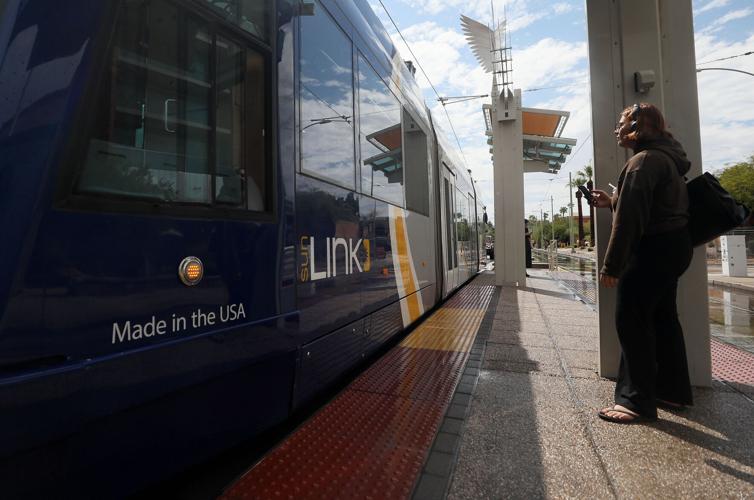
A rider waits for the Sun Link streetcar to stop along Second Street on the campus of the University of Arizona.
Inconsistent wait times
Knowing how it’s regularly used, I was interested when the management of our transit system invited local media to view the Aug. 18 reintroduction of Streetcar 105, which had been damaged in a collision with another streetcar a year before. Since that August 2025 collision, service was not as frequent because five streetcars were operating instead of six.
That may explain the drop in ridership during the 2025-26 school year. In March, for example, there was a nearly 22% decline in ridership from March 2025.
The general manager of Sun Tran and Sun Link, Mikel Oglesby, explained Aug. 18 that the return of Streetcar 105 would allow there to be six operating cars, instead of the five that had been operating in its absence. That should have reduced wait times to every 10-12 minutes during the normal daytime operating period.
But soon after the announcement, I found out wait times hadn’t gone down as expected.
On Monday, Aug. 21, I had taken the bus downtown, gone to our office, then wanted to get back to Ronstadt Transit Center to catch another bus. I was on North Bonita Avenue at the time, and the Transit app told me to leave that minute to get to the streetcar stop next to Mercado San Agustin and catch it immediately to reach Ronstadt.
I packed up quickly and strided out of the office, but I found myself waiting about 20 minutes before the first streetcar came. Then the driver got off and announced the streetcar would be leaving in seven minutes.
This was not service you can depend on, or that had been promised.
I checked around and found that that week, the first week of classes at the University of Arizona, service had been extremely variable. People like Winder and Ji, the UA student and the researcher, told me it was reliable enough, with wait times of 15-20 minutes at most.
But I did some crowd-sourced checking on social media and found that people on campus saw wait times of 30 minutes or more during the first week of school, the same week the repaired streetcar had come online.
Staffing level slows service
So what gives? Didn’t the miraculous and cheap — $75,000 — repair of Streetcar 105 fix things?
No, it turns out, because there was another problem: Labor.
“While we now have the vehicles available to provide that service, current operator staffing levels have temporarily limited our ability to consistently put all six streetcars into service,” Sun Link and Sun Tran spokeswoman Cindy Glysson said by email.
“We had anticipated covering some of the current staffing gap through available overtime while we continued recruiting additional operators. That overtime coverage has not been sufficient to fill all of the open work.”
In the meantime, a bus labeled a streetcar “connector” has been running, filling in the gap among streetcars and reducing wait times. It can’t cover the whole streetcar route, but travels the important stretch between downtown and the U of A.
It’s disappointing we’re not yet back down to 10-12 minutes between streetcars, but I can’t imagine it will take too long to hire a new operator. It’s important to get back to six vehicles operating, because the streetcar is serious transit for people at or near the University of Arizona.
This is not some sort of anomaly, as that one segment of Tucson society seems to think. In August I was in Toronto, a massive city with robust public transit. It has not only a large bus system, subway and light rail, but also a streetcar network that serves just the broader downtown area and waterfront.
Tucson’s streetcar also serves a similarly central area and has a limited reach. For it to fulfill its potential as serious transit, and bounce back from last year’s drop in ridership, though, it has to give reliable, rapid service.
Contact columnist Tim Steller at tsteller@tucson.com or 520-807-7789. On Bluesky: @timsteller.bsky.social

Tim Steller
Columnist


 Tim Steller’s column: Tucson bar killings spur accusation, introspection