It is midmorning at Red Water Pond Road, on a day when late summer slips into early autumn.
The sky is a cloudless, brilliant blue. A breath of breeze picks up wisps of dust from the dry hills dotted with pinon and juniper that surround the forlorn little cluster of empty houses.
No birdsong is carried on the breeze, no thrum of grasshoppers, no squeals of children at play.

Almost 40 years after mining stopped and about 20 years after a sustained multiagency cleanup initiative began, almost no actual cleaning has occurred.
Six-foot fencing topped with barbed wire borders the area on three sides.
Signs emblazoned with the universal symbol for radioactivity tell why:
Danger. Do Not Enter. Abandoned Uranium Mine Site.
A warning is also written in Navajo: Ba’ha’dzid – Doo Ko’ne’na’adaa’da.
Unsafe area
People are also reading…
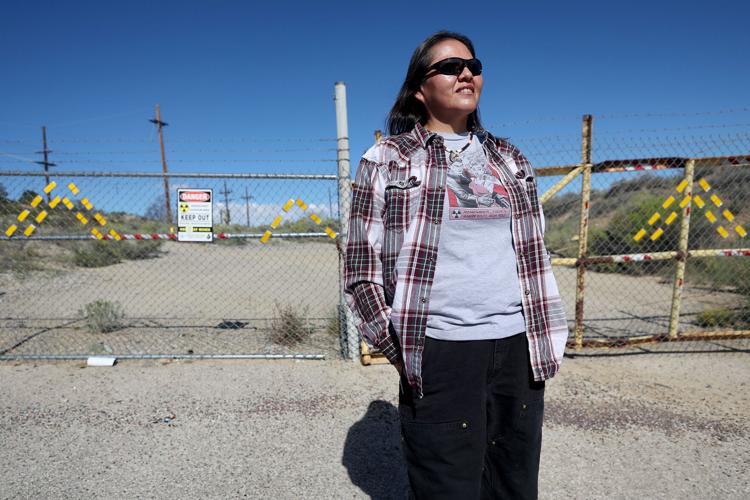
Teracita Keyanna gets out of the truck — a slim woman in her 40s, stylish sunglasses defending against that piercing sky. She stands and listens.
The silence is so total that it shouts. It is stitched into the sun-bleached tapestry of this day and this place. Silence and stillness dissolve into each other. No engines running, no one hammering down a few roof shingles, no one cutting weeds or sweeping porches, no laundry hanging on the line waiting for that little breeze.

Teracita Keyanna stands at the entrance to the abandoned Northeast Church Rock mine site, now owned by General Electric, on Sept. 9. Keyanna says the area is a popular spot for people to come and drink. The fence is the only thing between them and a huge pile of radioactive mining waste.
In her heart, in her memory, Red Water Pond Road is different.
There’s music — a radio, turned up loud, and through open windows the sound of pots banging in the kitchen as her grandmother makes dinner for her and for any other kids the village may send her way this afternoon. Friends call out to her, to each other.
A starter whines and a truck motor catches and roars — maybe one of her aunts on the way to the store in Gallup, or somebody headed to one of the mines. She runs down the dirt road for the joy of it.
Now, standing in the stillness, her eyes are suddenly wet. Someday, she thinks. Someday this place can be like that again, the way she remembers it.
But when?
The only answer is silence.
A town surrounded by waste
The little hamlet of Red Water Pond Road suffers from what the scientists call “proximity” — nearness to two large abandoned uranium mine sites and two enormous piles of contaminated waste rock from those mining operations.
From 1967 to 1982, the Northeast Church Rock Mine produced about 3.5 million tons of uranium ore, the second-largest production of any mine on the Navajo Nation.
In the process, it accumulated more than 1.4 million tons of mining waste — about a million cubic yards — much of it rock that is uranium-bearing, but not at a level then deemed economical to mill.
When the federal government’s current initiative to clean up abandoned uranium mines on Navajo lands began in 2008, the Northeast Church Rock Mine was considered the highest-priority cleanup — No. 1 of 523 abandoned uranium sites on and adjacent to the Navajo Nation — because of its size, gamma radiation readings and its proximity to the Red Water Pond Road community.
In the government agencies’ first five-year plan, released in 2009, the cleanup was scheduled to be completed by 2011.
Now, almost two decades after the hearings, this top-priority cleanup has not actually started.
The EPA has performed three “time-critical removal” actions on Northeast Church Rock over the years. Each has involved taking contaminated dirt from close to the community — about 200,000 tons in all — and moving it to the large waste pile on the mine site. The most recent effort, on a hill just above the town, was suspended when community members pointed out that burial sites were located there.
Ultimately, after years of assessments, it was decided to move almost all of the 1.4 million tons of waste less than a mile down the road to the former United Nuclear uranium milling site. There, it will be placed on top of an existing repository where waste from the mill has been buried.
The highest-concentration radioactive waste will be trucked to the active uranium mill at White Mesa, Utah.
In a July 2025 update, the EPA said it expected the Northeast Church Rock cleanup, once started, to take four years.
A month later, in August 2025, the agency and the U.S. Justice Department and the Navajo Nation announced that a cleanup agreement, called a consent decree, had been reached.
The $63 million cleanup, the news release said, would take “more than a decade” to complete.
Asked which cleanup-time estimate was accurate, EPA declined to respond.
This is the way of the process: Words pile up against more words. Years pass. The waste piles remain.
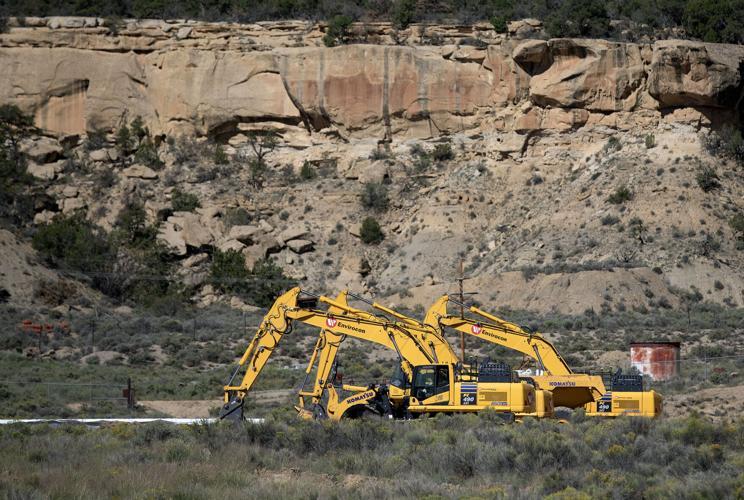
In the year since the consent decree was signed, clearing the way for work to begin, there has been no visible sign of progress other than the stationing of two earthmoving machines at the mill site.
The first stage of the cleanup will be the creation of a haul road from the waste site to the disposal area, but that has not yet started.
In July, the EPA held a groundbreaking ceremony in front of the earthmoving machines.
The administrators of EPA Regions 6 and 9, Scott Mason and Mike Martucci, attended.
"This is really the definition of cooperative federalism," Mason declared.
"This is part of our Superfund Season of Cleanups," Martucci pronounced.
No dirt has been moved yet.
The Quivira Mines, just to the east, were operated by Kerr-McGee from 1974 to 1986, producing about 1.3 million tons of uranium ore. About 1 million cubic yards of waste material is scheduled to be removed in a cleanup paid for by the Tronox settlement announced in 2014.
After years of study, EPA and the Navajo Nation announced the selection of a Quivira cleanup action. Under the plan, the waste would be trucked 44 miles to the Red Rocks Landfill near Thoreau, N.M. That disposal facility is still in the permitting process, facing some regional pushback.
For the time being, the waste pile remains, right across from Bradley and Grace Henio’s front yard. There have been efforts to vegetate the waste pile, but it is still vulnerable to the windstorms that frequently sweep through the area, and to the visible erosion of watercourses through the pile’s steep sides.
Bradley and Grace are the only Red Water Pond Road community residents who have refused to leave.
“If I die here, I die here,” Bradley Henio, a 33-year Army veteran, said.
“We’ve put too much into our house to walk away from it,” Grace Henio adds.
Many of those who have moved away regret doing so.

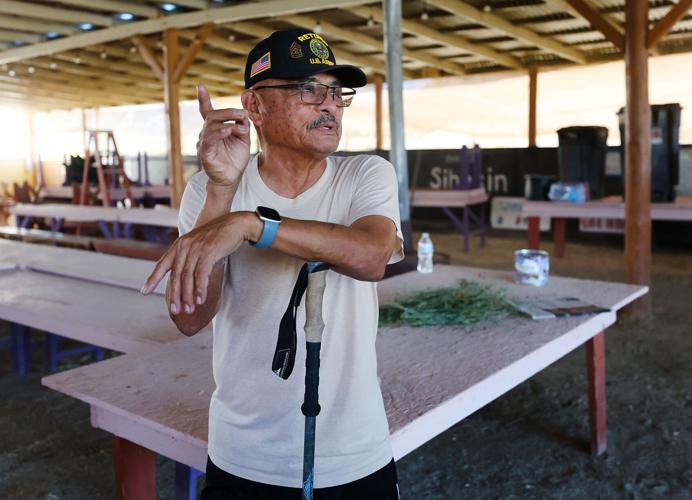
On Sept. 9, Bradley Henio stands inside the Red Water Pond Road community center he built near his home in the New Mexico community. Henio lives between two abandoned uranium mining sites, Quivira Mines and Northeast Church Rock Mine.
Missing the community
Edith Hood, 75, Grace Henio’s sister and Terry Keyanna’s aunt, is one. She lives in Gallup now, but she misses the community and the place terribly, and visits Bradley and Grace frequently. She has vowed to move back.
For years, Edith has been a community leader.
When she was a child, her family had a band of sheep. “I was the sheep herder,” she says.
As a young woman, she was one of the few females to work underground in a mine. She worked for Kerr-McGee at Quivira, taking readings with a device called a neutron probe. It was a long tube that she would insert into freshly blasted piles of rock to read the grade of the ore. Of course, what she was reading was radiation, which she was not told and could not have comprehended at the time.

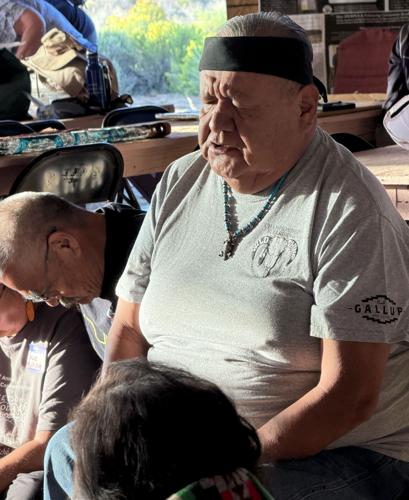
Edith Hood speaks to marchers gathered at the mill site on the 47th annual commemoration of the tailings spill at the Church Rock Mill, July 18.
Since, she has suffered from both lymphoma and breast cancer.
In 2007, she traveled to Washington, D.C., and testified in the Waxman hearings. Studying the nuclear issue, she has also visited Hiroshima and Nagasaki.
She only accepted the government’s offer of a house in Gallup for the sake of her grandchildren. Now, she is waiting for something to happen with the two mine cleanups, so she can go home.
“It gets to be a bit much, living in town,” she says. “I can’t get used to it.”
“It’s been so long,” she said. “So many agencies and so much government involved. It seems like after every five-year plan, they make a new plan. It was 10 years ago when they moved most people out of here, and they said it might take 10 more years, but now they haven’t even started.”
They want the waste gone
The Red Water Pond Road community members are almost all related to each other in some way. Edith and Grace are sisters, and they had seven other siblings. Now, there are five. One, their sister Ellen, died in August after suffering from dementia — which some believe is connected to long-term exposure to uranium.
The community members share a familial trait: They are determined, and they want their tiny corner of the great Navajo Nation cleaned up.
Every year, the Red Water Pond Road Community Association holds an observance to remember one of the worst — and least-known — environmental disasters in this country’s history.
Tailings dam gives way
At about 5:30 a.m. on July 16, 1979, the tailings dam at the United Nuclear Corporation uranium mill, less than a mile down the road from the Northeast Church Rock and Quivira mines, failed.
Cracks in the dam had been seen and reported as early as December of 1977, and the company tried to seal the cracks, which continued to form, but did little else. Milling operations continued, producing about 4,000 tons of tailings per day. The tailings pond behind the dam was filled past its designed capacity.
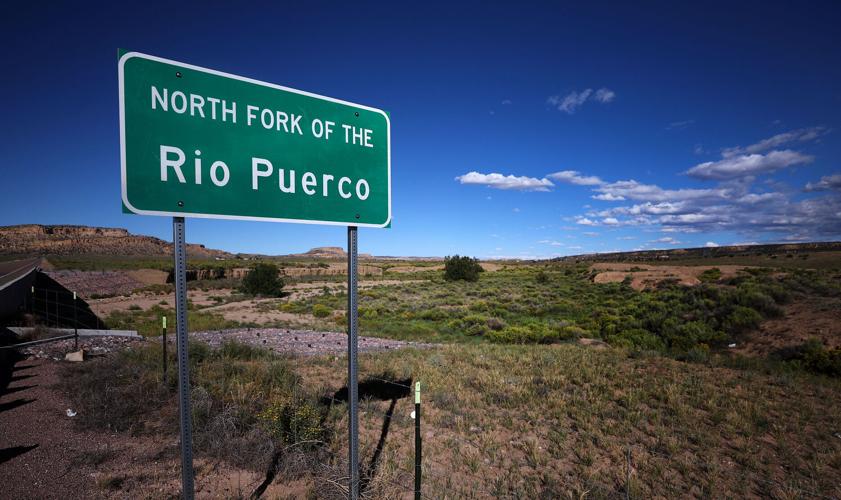
When the dam failed, it did so spectacularly. The built-up pressure from tailings blew a 20-foot-wide breach in the dam, sending more than a thousand tons of radioactive solid waste and 94 million gallons of radioactive tailings slurry into Pipeline Arroyo and from there into the North Fork of the Puerco River. Downstream it roared, carrying radioactive uranium, thorium, radium and polonium along with a host of other heavy metals in a mixture with a ph similar to that of battery acid. It flowed past Gallup and on southward and westward into Arizona.

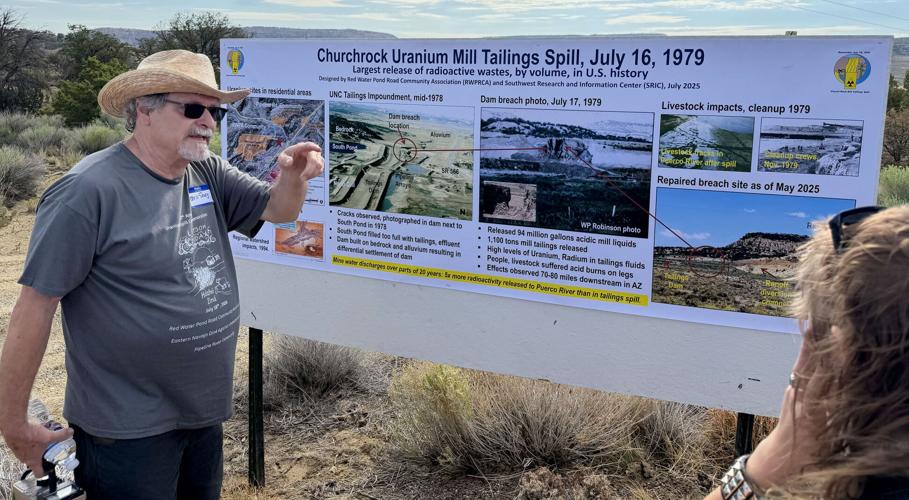
In 1979, the Church Rock uranium mill was the site of the largest uranium spill of radioactive waste in United States history. The dam at United Nuclear Corporation's tailings pond breached and spilled more than 1,100 tons of solid radioactive mill waste and 94 million gallons of acidic, radioactive tailings slurry into the Puerco River.
It is the largest release of radioactive material in U.S. history, far exceeding what was released at Three Mile Island, the famous nuclear-plant accident in Pennsylvania that had happened just four months earlier.
The Navajo Nation asked then-New Mexico Gov. Bruce King to seek a federal disaster declaration.
He refused.
Within a few months, United Nuclear was back in the business of milling uranium at the site. The spill’s effects, combined with the results of ongoing mining and milling, left groundwater contaminated, and radioactive solids were dispersed along the waterway.
47th annual spill observance
This year’s spill observance — “we’re not celebrating, we’re remembering” — was the 47th.
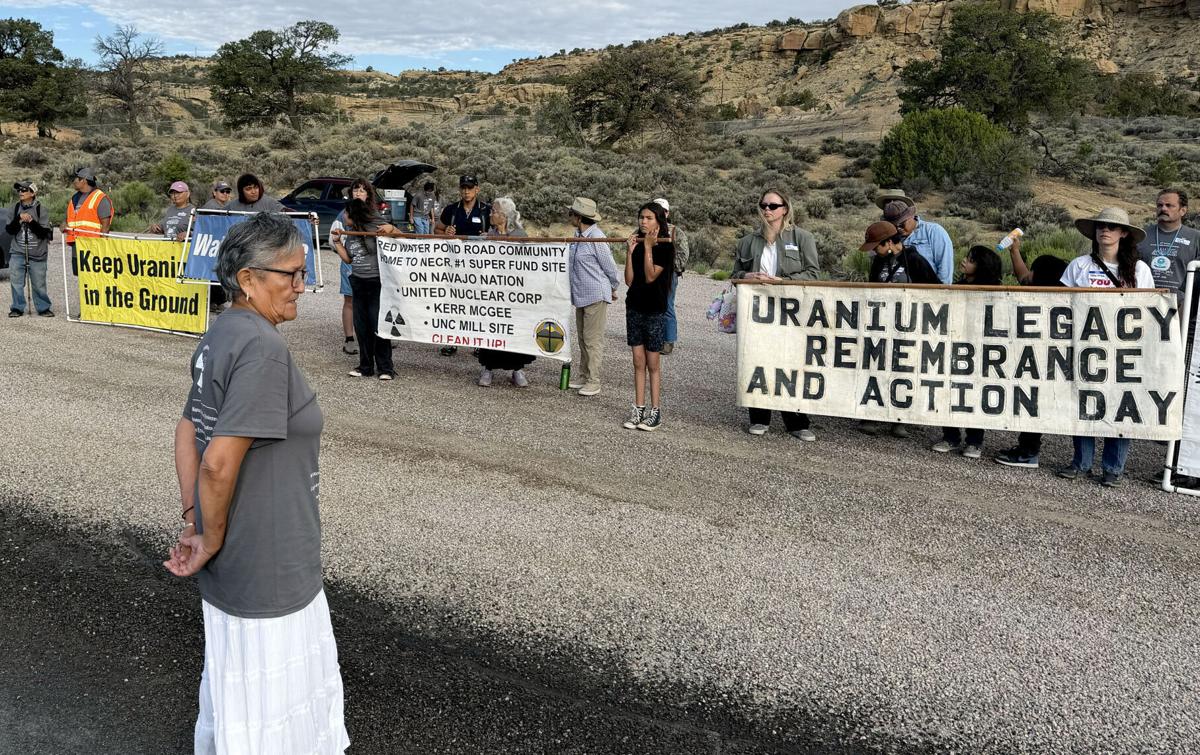
It took place, like many previously, at the Red Water Pond Road Community Center Bradley Henio built a few dozen yards from his house. A blue enamel coffee pot sat on a grate in a crackling bonfire. The doors at the east end of the big wood-frame structure were thrown open to allow the sunrise to creep into the dark expanse inside.

Davidson Kee James, a Navajo Ha’ataali, or spiritual guide, chants an opening prayer at the 47th annual remembrance of the Church Rock tailings spill. The observance took place on July 18.
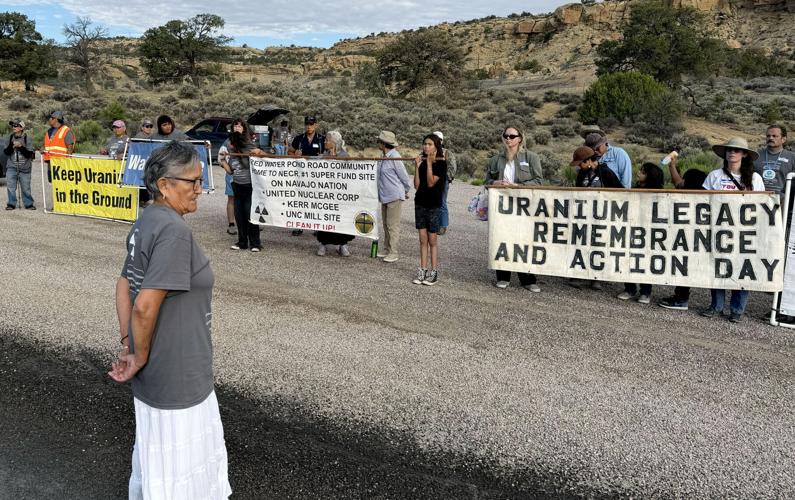
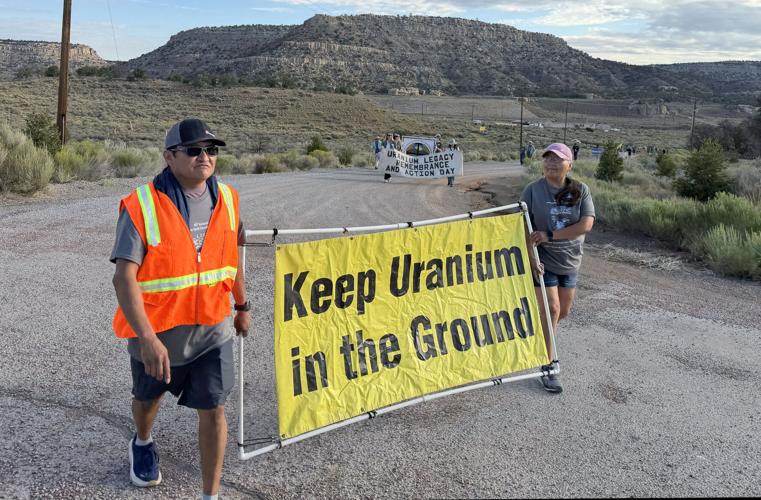
The early-arriving observants gathered in a circle as Davidson Kee James, an elder and ha’ataali, or spiritual guide, chanted an opening prayer. After breakfast was served, the people gathered and marched to the mill site, carrying signs (“Keep Uranium in the Ground,” “Water is Life,” “Uranium Legacy Remembrance and Action Day”). There, Community Association leaders, including Edith Hood and her brother, Larry King, spoke to those assembled.
King spoke at length about the day of the spill. He was working for United Nuclear and had pointed out the cracks in the dam.
Chris Shuey, a public-health expert and advocate who has been a leader in the effort to clean up the uranium sites for the past 45 years, interrupted King briefly to ask that parents move several little children playing quietly in the ditch bordering State Highway 566 in front of the mill.
He pointed to the radiation meter he carried.
“It’s too hot, right there,” he said. “They shouldn’t play there.”
On the trek back to the community center, where more speakers would present to the gathered participants, Edith Hood sighed.
“Fewer people than last year,” she said.

Tony Hood, foreground, leads the way as marchers at the 47th annual commemoration of the 1979 Church Rock tailings spill walk to the abandoned United Nuclear mill site.
'We were all exposed'
As Terry Keyanna gazed across the little valley toward the house where she grew up, she spoke about a family’s history of activism.
“Our family was here a hundred years ago, before they started the exploratory drilling,” she said. “When it was happening, my great-grandmother, Bessie Duncan, knew there were strangers coming into the community and she didn’t want that. She noticed that they had put survey stakes out, and her way of activism was pulling them out of the ground.
“And then my grandmother, Katherine Duncan, would go to the chapter house meetings and speak against having the mining industry coming into the community.
“Nobody listened back then. Nobody cared. Nobody. There was no EPA. There was really nothing that could be done, and you know, the Navajo Nation probably made some money off that.
“And so for our community, we feel like the Navajo Nation should be one of the responsible parties as well. But they don’t want to be held accountable.”

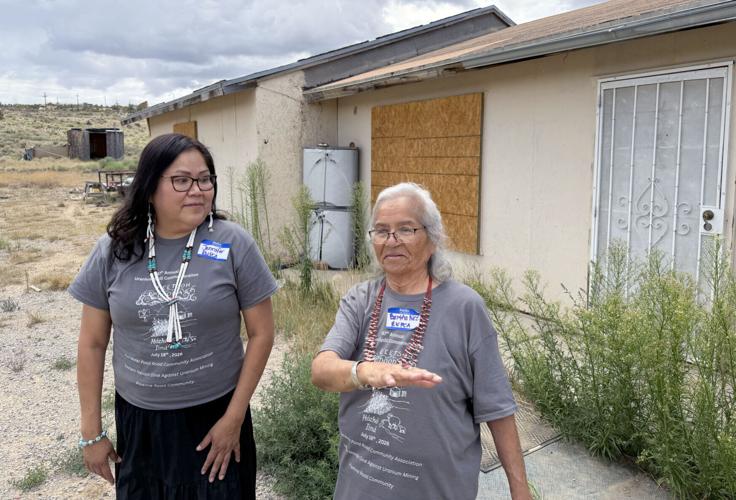
Jennifer Nez, left, and Bertha Nez talk in front of Bertha's home, where Jennifer grew up. It's now boarded up because most community members were relocated to avoid exposure to toxic mine waste.
Keyanna lists the first names of her uncles who worked at the mines: Tony. Jack. Peterson. “They are dealing with health effects now,” she said.
“Part of what’s hard on the community now is that we were all exposed … whether we worked there or not.
“We were all exposed, no matter what we did.”
She remembers running down the dirt roads. “I used to run on this road that went all the way from our home almost by the United Nuclear office, and then I would turn around and go back. And the gravel road that leads up to the highway.
“I didn’t know that it was very, very hot. I guess they used some waste rock from the mine for the roadbed, and all those years I never knew that I was running on, you know, a hot road.”
Mysterious skin condition
Keyanna and her daughter both have a skin condition she blames on uranium exposure.
“I get to the point where I have something under my skin, and if I can’t get it out, I’ll take an X-Acto knife and just cut a little X on myself just to get it, to extract it. It’s like a little white ball. I don’t know exactly what it is. I’ve never been to a dermatologist.
“My youngest daughter, when she was born, we were still living here, and she started developing nodules beneath her skin, near lymph node areas, so we took her to the dermatologist. She’s gone under the knife four times to remove them.”
Keyanna was mostly raised by her grandmother, Katherine Duncan. “But really, you know, I was kind of like the village child. Like sometimes she’d say, ‘Go to your aunt’s house,’ or ‘Go to your uncle’s house for dinner.’ You know they say it takes a village to raise a child. With me it really did.”

While the miners didn’t know anything about the unseen dangers of uranium mining, the mining companies certainly did.
Keyanna went to college at Southwestern Indian Polytechnic Institute, but life, marriage and family intervened before she finished. Now, balancing motherhood and work, she is determined to finish her double major in environmental studies and geospatial information technology. She’s hoping to be able to do that online.
She is determined to keep up her family’s fight for the cleanup, for the sake of Red Water Pond Road and as an example to her children.
She’s quietly proud that she’s a published author, having co-authored a published academic paper titled “What is Restorative Justice after the Church Rock Uranium Spill?” with Shuey and several other co-authors.
Before getting back in the truck, she takes one more look at the empty house where she grew up.
“I miss how quiet it is here. You can actually hear nature.”

Public health expert Chris Shuey of the Southwest Research and Information Center describes the Church Rock tailings spill to attendees at the 47th annual remembrance of the spill, July 18.
She looks away. “You know, it was a good place to grow up.
“And it can be, again. I mean honestly, once we get everybody back home, I feel this is going to be a community again.”
But that must wait on two cleanups that haven’t even started yet.
“When I think about that,” Keyanna says, “My optimistic side says maybe 12 or 15 years.
“My realist side says it won’t be until 20 years or more from now, when I’m the elder and my kids are in the position I’m in now.
“But we will be back.”