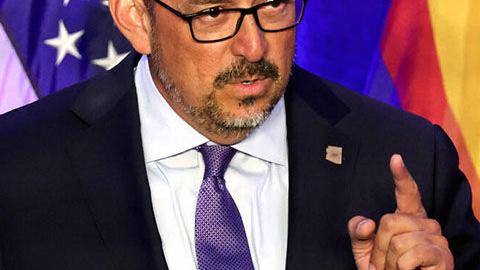
PHOENIX — A Tempe city councilman is making a last-ditch effort to keep a measure seeking to make multiple changes in state election laws off the ballot.
Randy Keating is telling the Arizona Supreme Court that there's nothing inherently wrong with any of the various provisions of Proposition 144. In fact, he said, each may have merits, though he made it clear he is opposed to one section that would require everyone to provide identification before casting a ballot, including those who vote by mail.
Keating said, though, that those provisions cannot legally be put into a single ballot measure, forcing voters to approve the entire package because they happen to like one or more sections even though they are opposed to others. Instead, he said, each of the five key provisions should be offered to voters on their own.
But Kory Langhofer, in a legal filing for top Republican legislative leaders, said each of them relate in some form to "election integrity.''
People are also reading…
He acknowledged Keating's argument that each of the provisions could stand separately on their own and could have been presented to voters as five separate ballot measures. But Langhofer told the justices that doesn't mean they cannot be put into a single take-it-or-leave-it proposition for voters to decide.
Keating lost the first round of the battle when Maricopa County Superior Court Judge Adele Ponce accepted Langhofer's argument that all the provisions are "topically related'' to the issue of election integrity. Now, the last word belongs to the Supreme Court.
There's a lot in the package.
One section spells out what already is in Arizona law: only citizens may register and vote in Arizona elections. A closely related provision says state elections shall be decided solely by the vote of eligible citizen voters.
Another seeks to prohibit foreign nationals from spending money to influence Arizona elections.
There also is something that directs each county to ensure that people who drop off their ballots on election day have the option of having them immediately tabulated there — versus sent elsewhere for later processing — by providing identification.
And there is the language for "valid government-issued proof of identity'' before casting a ballot, "whether voting in person or by any other method.''
It also would put a provision in the Arizona Constitution spelling out that lawmakers or voters can enact future election laws if they are "rationally connected to a legitimate state interest,'' something defined to include timely and accurate results, election security and "preserving public confidence in the integrity of elections.''
"Any of these proposals may be valid — even laudable — as its own amendment,'' wrote attorney Daniel Arellano on behalf of Keating. "But they cannot be bundled into the same up-or-down vote.''
Consider the provision on who can pay for political ads.
"Whether foreign nationals can give or spend money to fund Arizona campaigns has no facial relationship to who may vote, what kind of identification is necessary to vote, how votes are counted, or how legislative power concerning elections is exercised,'' Arellano said. "Barring foreign nationals from influencing Arizona elections does not logically imply, say, counting ballots faster.''
Langhofer, however, said what Keating claims about the requirement to have each issue presented to voters separately is not what the Arizona Constitution requires.
"The Separate Amendment Rule requires the consistent provisions of an amendment to be sufficiently related to a common purpose or principle that the proposal can be said to constitute a consistent and workable whole on the general topic embraced,'' he told the justices. And Langhofer said that's precisely what is occurring here.
"Every provision of HCR 2001 (the legislative name for the package before it was designated Proposition 144) bears a direct and immediate nexus to one specific topic: Arizona's public elections,'' he said.
"Every component of HCR 2001 concerns the administration of elections for public office in Arizona,'' Langhofer said. And he said what connects it is the goal of "enhancing the security of Arizona elections.''
For example, he said, there's the provision to allow those who drop off their early ballots on Election Day to have them tabulated, in real time, on site. That, said Langhofer, eliminates the possibility a ballot could be lost or spoiled before it is counted which "enhances public confidence in the accuracy of election results.''
Similarly, he said that limits on who can financially influence elections is closely tied to "democratic legitimacy and election integrity.''
Ditto, Langhofer said, provisions limiting voting to citizens. And he said that's also linked to "empowering the legislature to buttress these safeguards.''
The justices don't have a lot of time to consider the issues: Maricopa County officials have filed paperwork with the court saying that they intend to start printing ballots by Aug. 20 and need a decision by then.
Howard Fischer is a veteran journalist who has been reporting since 1970 and covering state politics and the Legislature since 1982. Follow him on X, formerly known as Twitter, Bluesky, and Threads at @azcapmedia or email azcapmedia@gmail.com.