NASA astronauts Butch Wilmore and Suni Williams aren't the first to run late in space, and their 9½-month mission on the International Space Station falls short of any endurance record.
Still, never before has a quick trip morphed into such a long haul.
The pair launched last June on a test flight of Boeing's new Starliner crew capsule, figuring to be gone eight days. By the time they splashed down earlier this month with SpaceX, they'd spent 286 days off the planet — 36 times longer than anticipated.

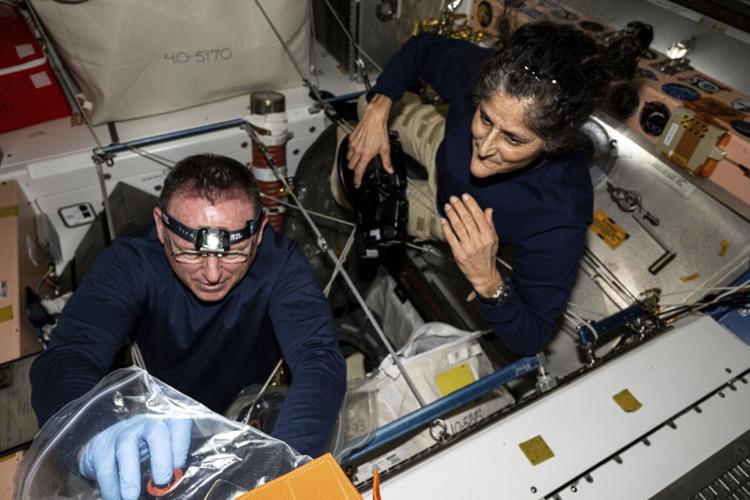
NASA astronauts Butch Wilmore, left, and Suni Williams inspect safety hardware Aug. 9 aboard the International Space Station.
"If you look at it mathematically, by percentage of the original planned mission, this is the largest percentage extension," NASA's space operations chief Ken Bowersox said.
A former astronaut, Bowersox saw his own space station mission abruptly prolonged. He was up there with Don Pettit, who's currently aboard the orbiting lab, when shuttle Columbia broke apart during reentry in 2003, killing all seven on board and grounding the shuttle fleet for more than two years.
People are also reading…
"The reasons were terrible that we stayed longer on our mission," said Bowersox, whose planned four-month stay clocked in at more than five months.
Here's a look at some others who found themselves stuck in space — by choice or not — along with some cool spaceflight statistics.

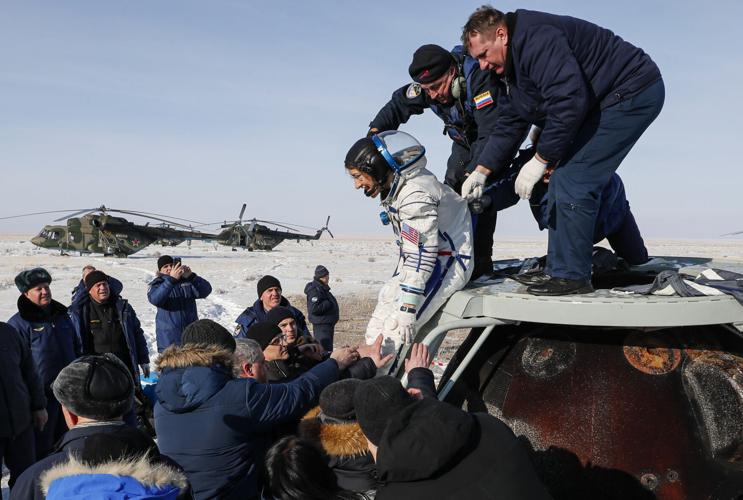
Rescue team members help NASA astronaut Frank Rubio get out of a Russian Soyuz MS-23 space capsule Sept. 27, 2023, shortly after it landed near Zhezkazgan, Kazakhstan.
Longest spaceflights
Russian cosmonaut Valery Polyakov spent 14½ months aboard the Mir space station in the mid-1990s. He volunteered for it. As a physician, he wanted to observe the changes in the human body and mind after a prolonged period of weightlessness. His 437-day spaceflight remains a world record. Polyakov died in 2022 at age 80.
NASA astronaut Frank Rubio saw his mission doubled in length — from 6 months to 12 months — after his assigned Russian Soyuz capsule took a micrometeorite hit while docked to the space station and leaked all its coolant. A replacement capsule was launched to bring Rubio and his two Russian crewmates home in 2023. His 371-day spaceflight is the longest by an American.

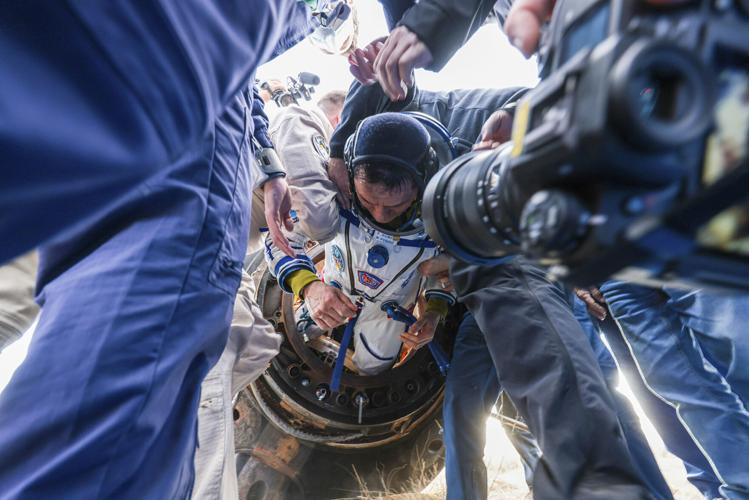
A Russian space agency rescue team help U.S. astronaut Christina Koch get out of a Russian Soyuz MS-13 space capsule shortly after it landed Feb. 6, 2020, near Zhezkazgan, Kazakhstan. Koch wrapped up a 328-day mission on her first flight into space.
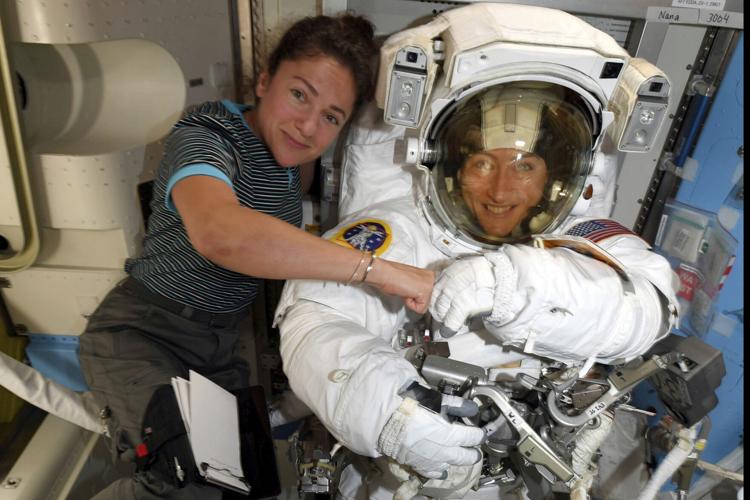
NASA's Christina Koch holds the title of longest spaceflight by a woman, with her 328-day space station mission in 2019 and 2020. During that same flight, she performed the first all-female spacewalk alongside Jessica Meir. Koch is assigned to NASA's first Artemis crew, which will fly around the moon and back as early as next year.

Astronauts Jessica Meir, left, and Christina Koch pose for a photo, released Oct. 4, 2019, on the International Space Station.
Most experience in space
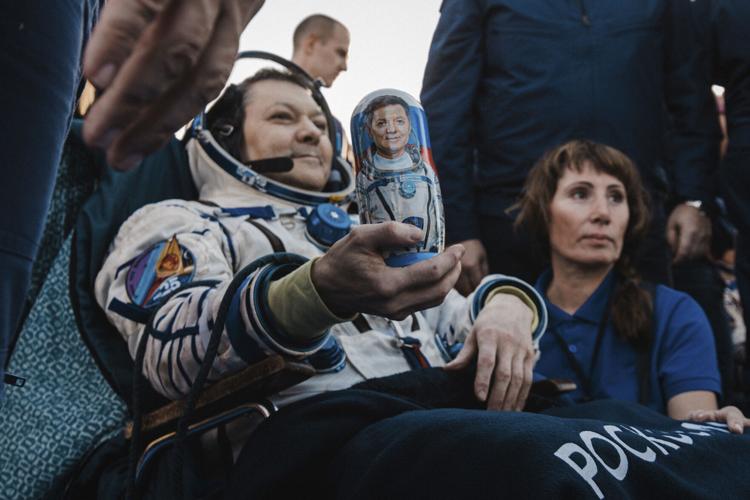
Russian Oleg Kononenko last year became the first person to crack 1,000 days in space over the course of a career. By the time he returned from the space station last fall, he'd logged an incredible 1,111 days aloft over five spaceflights — a combined total of more than three years.
Former NASA astronaut Peggy Whitson is America's most experienced space flier with 675 days over three long station stints and one short private trip for Axiom Space. She's due to lead another Axiom crew to the space station later this spring. Because of her delayed homecoming, Williams moved into the No. 2 spot with 608 days in space over three missions.

Roscosmos cosmonaut Oleg Kononenko holds a Russian traditional Matryoshka doll depicting him Sept. 23, 2024, shortly after the landing of a Russian Soyuz MS-25 space capsule near Zhezkazgan, Kazakhstan.
Spacewalking records
Williams became the most experienced female spacewalker in the world, thanks to her prolonged mission. She ventured out twice this year for station repairs and maintenance, bringing her spacewalking career total to 62 hours. Over three space station missions, she performed nine spacewalks, one less than Whitson. Whitson's spacewalks were shorter, totaling 60 hours.

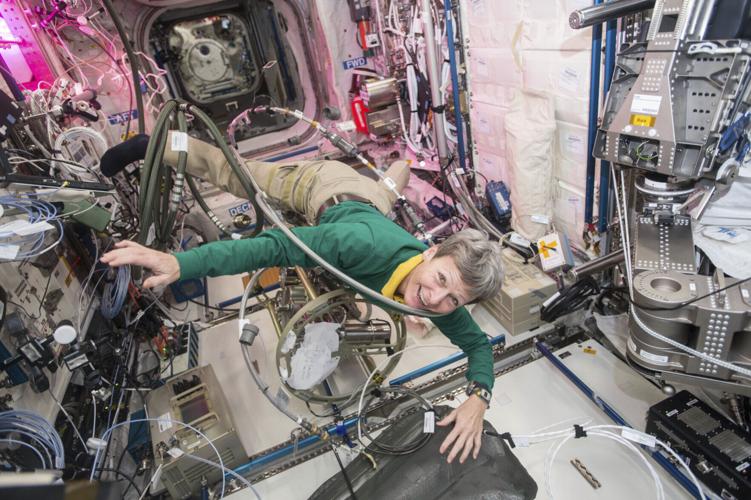
Astronaut Peggy Whitson floats through a tangle of cables Dec. 8, 2016, inside the Columbus module aboard the International Space Station.
Retired Russian cosmonaut Anatoly Solovyev holds the overall record, with 16 spacewalks totaling about 80 hours. NASA's spacewalking champ is retired astronaut Michael Lopez-Alegria with 10 spacewalks for a total of 67 hours.
Cosmic firsts

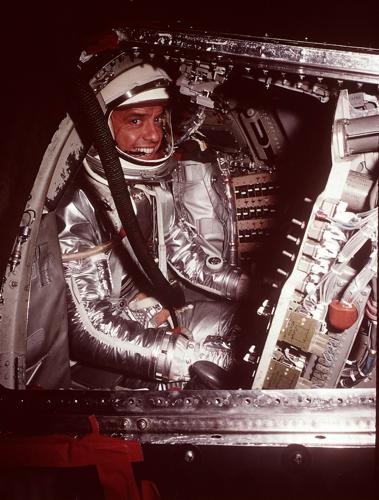
Astronaut Alan Shepard Jr., America's first man in space, poses in 1961 in the Mercury spacecraft.
The first person in space was the Soviet Union's Yuri Gagarin on April 12, 1961. The first American, Mercury astronaut Alan Shepard, followed on May 5, 1961.
The first woman in space was the Soviet Union's Valentina Tereshkova in 1963. Sally Ride became the first American woman in space in 1983.

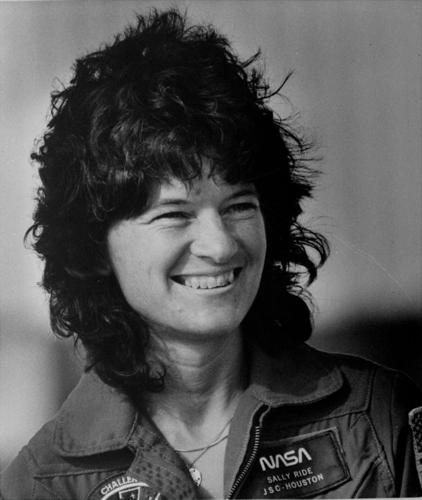
Sally Ride, America's first woman to travel into space, is seen after leaving her jet June 16, 1983, at Kennedy Space Center, Fla.
Of those four, only Tereshkova is still alive.
NASA's first year-in-space astronaut was Scott Kelly; he logged 340 days at the space station in 2015 and 2016. His identical twin brother, U.S. Sen. Mark Kelly of Arizona, also served as a NASA astronaut on short shuttle flights.
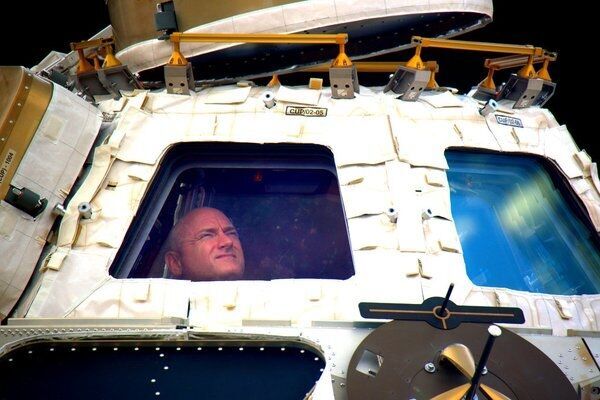
Astronaut Scott Kelly looks out of the cupola of the International Space Station.
Number of space travelers
A NASA tally shows 721 people have flown in space, including tourists on short hops and military X-15 pilots. Of that total, 102 are women.
NASA counts 47 on its active astronaut list. Twenty are women. That doesn't include several astronauts who moved over to management roles at the space agency.
SpaceX launches rescue mission for NASA astronauts stuck at space station

A SpaceX Falcon 9 rocket, with a crew of two astronauts, lifts off from launch pad 40 at the Cape Canaveral Space Force Station Saturday, Sept. 28, 2024, in Cape Canaveral, Fla. (AP Photo/Chris O'Meara)

NASA astronaut Nick Hague, left, and Roscosmos cosmonaut Aleksandr Gorbunov, left, gives a thumbs up as they leave the Operations and Checkout Building on their way to Launch Complex 40 for a mission to the International Space Station Saturday, Sept. 28, 2024 at Cape Canaveral, Fla., (AP Photo/John Raoux)

NASA astronaut Nick Hague, right, and Roscosmos cosmonaut Aleksandr Gorbunov leave the Operations and Checkout building for a trip to the launch pad 40 Saturday, Sept. 28, 2024, at the Kennedy Space Center in Cape Canaveral, Fla. (AP Photo/Chris O'Meara)

NASA astronaut Nick Hague, right, talks to his family members as Roscosmos cosmonaut Aleksandr Gorbunov looks on after leaving the Operations and Checkout building for a trip to the launch pad 40 Saturday, Sept. 28, 2024, at the Kennedy Space Center in Cape Canaveral, Fla. Two astronauts are beginning a mission to the International Space Station. (AP Photo/Chris O'Meara)

In this image from video provided by NASA, Roscosmos cosmonaut Aleksandr Gorbunov, left, and astronaut Nick Hague travel inside a SpaceX capsule en route to the International Space Station after launching from the Kennedy Space Center in Cape Canaveral, Fla., Saturday, Sept. 28, 2024. (NASA via AP)

A SpaceX Falcon 9 rocket, with a crew of two astronauts, lifts off from launch pad 40 at the Cape Canaveral Space Force Station Saturday, Sept. 28, 2024, in Cape Canaveral, Fla. (AP Photo/Chris O'Meara)

A SpaceX Falcon 9 rocket, with a crew of two astronauts, lifts off from launch pad 40 at the Cape Canaveral Space Force Station in Cape Canaveral, Fla., Saturday, Sept. 28, 2024. (AP Photo/Chris O'Meara)

A SpaceX Falcon 9 rocket with a crew of two lifts off from launch pad 40 at the Cape Canaveral Space Force Station Saturday, Sept. 28, 2024 at Cape Canaveral, Fla. (AP Photo/John Raoux)

The Falcon 9's first stage booster returns to Landing Zone 1 at the Cape Canaveral Space Force Station Saturday, Sept. 28, 2024 at Cape Canaveral, Fla. (AP Photo/John Raoux)

A SpaceX Falcon 9 rocket with a crew of two lifts off from launch pad 40 at the Cape Canaveral Space Force Station Saturday, Sept. 28, 2024 at Cape Canaveral, Fla. (AP Photo/John Raoux)

A SpaceX Falcon 9 rocket, with a crew of two astronauts, lifts off from launch pad 40 at the Cape Canaveral Space Force Station in Cape Canaveral, Fla., Saturday, Sept. 28, 2024. (AP Photo/Chris O'Meara)