NCAA Tournament expansion has been lambasted by everyone except the executives running college basketball. Even prominent coaches hate the move to a 76-team field, with Gonzaga’s Mark Few telling CBS Sports recently that he’s “adamantly opposed. It's totally unnecessary.”
But the deal became official Thursday, forced upon the sport by the ACC and Big 12 and, in particular, the Big Ten and SEC. So let’s examine how a move orchestrated by the industry's big boys will affect the little guys.
Specifically, we're wondering how many of the eight additional bids will be awarded to the 286 Division I teams from outside the power conferences.
To schools in the new Pac-12 and reconstructed Mountain West.
To the Gonzaga-less West Coast Conference.
To the Missouri Valley, Atlantic Sun and Horizon League.
People are also reading…
Now, to be clear: All 32 conferences will have a guaranteed berth in March Madness for their champions. The revised bracket will feature 32 automatic qualifiers and 44 at-large teams.
(The new Pac-12 comes online in the fall and will increase the number of automatic bids from 31 to 32.)
The eight new bids will be assigned to at-large teams chosen by the selection committee. But the process, with its heavy reliance on schedule strength and quality wins, tilts heavily in favor of the ACC, Big 12, Big Ten and SEC, which have the financial resources to effectively game the system.
Those conferences accounted for 84% of the at-large bids in the 2026 event (31 of 37).
Will they gobble all eight of the additional spots?
West Coast Conference commissioner Stu Jackson, a member of the selection committee, believes fans should “view it positively.”
“Expansion provides increased opportunities for all institutions, including the western region conferences,” he told the Hotline on Friday.
“The data says that in any given year, with the additional eight spots, the WCC has the opportunity to potentially get one or two of those spots.”
Same goes for the Pac-12 and Mountain West. In terms of March Madness access, the three post-realignment conferences have more similarities than differences: Each is guaranteed one bid and hopes to produce two or three at-large teams, as well.
The data suggests at least one, and perhaps two of eight new at-large bids will be awarded to teams outside the power leagues.
“The notion that only power conference teams were on the bubble of the 68-team tournament in my two years (on the committee) is simply not the case,” Jackson said.
Every year, the NCAA releases the list of First Four Out — the quartet of teams that just missed the cut for the at-large field.
In 2026, only one of the First Four Out teams was from outside the power conferences: San Diego State. But Jackson indicated that New Mexico likely would have made the field with a 76-team bracket, meaning the Lobos were part of the First Eight Out.

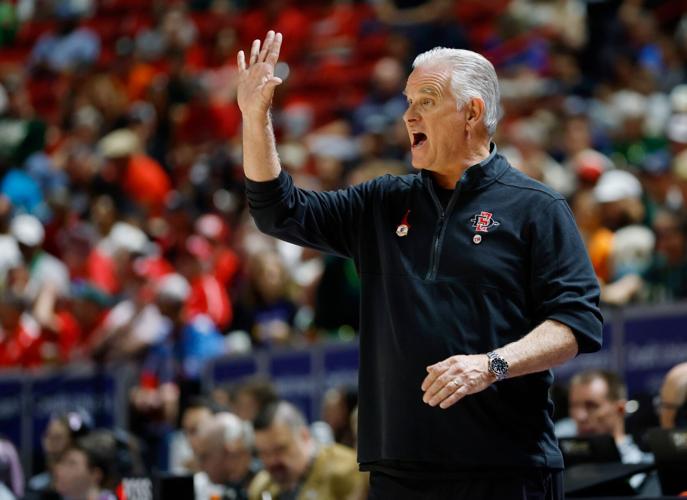
San Diego State coach Brian Dutcher calls a play against Colorado State in the quarterfinals of the Mountain West Conference basketball tournament at the Thomas & Mack Center on March 12, 2026, in Las Vegas, NV.
What about prior tournaments? David Worlock, NCAA director of media coordination/statistics, told the Hotline this week that the selection committee does not reveal the First Eight Out, only the First Four. But on the social media platform X, he offered a glimpse into relevant recent history.
There have been 15 tournaments since the First Four was created, meaning 60 teams have fallen into the First Four Out category.
According to Worlock, 22 were from outside the power conferences, with 12 leagues represented. The American and Mountain West had four each, followed by the Atlantic 10 with three. (We are counting the Big East, which includes Connecticut, Villanova and St. John's, as a power conference.)
That’s 37% of First Four Out teams over 15 tournaments. If that holds in the expansion era, three of the eight additional bids, on average, would be allocated to teams outside the ACC, Big 12, Big East, Big Ten and SEC.
However, realignment seemingly has changed the calculus. Our best guess: Two of the eight additional bids await the little guys.
For the rebuilt Pac-12, that could mean a third or fourth participant.
For the new editions of the WCC and Mountain West, that could mean a second or third.
But for all three conferences, an extra bid would result in more cash.
The NCAA has secured $131 million in new revenue for the next six years, ensuring that the eight additional games will carry the same unit value that currently exists (about $2 million per team over a six-year payout period).
The impact is best expressed with an example.
Let’s say San Diego State, one of the First Four Out teams in the 2026 tournament, makes an expanded tournament through the at-large pool and receives one of the last No. 11 seeds.
The Aztecs would play another No. 11 seed in the new opening round — it would likely be a power conference team with more than 10 losses — with the winner advancing to face a No. 6 seed in the first round.
A victory for the Aztecs in the opening round would result in a unit worth $2 million, with the potential to continue accumulating units by winning games in the main bracket.
Of course, the situation isn’t great for the mid-majors teams that qualify by winning their conference tournaments.
The additional at-large teams will receive No. 11 and 12 seeds, thereby bumping down by one seed line the teams that used to hold those positions.
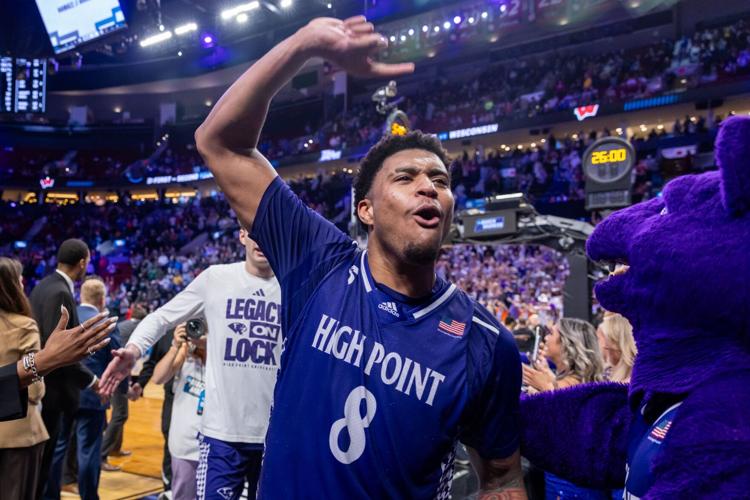
High Point, a No. 12 seed that upset Wisconsin in March, likely would have been a No. 13 seed under the new system and therefore faced a tougher first-round opponent.

High Point forward Owen Aquino (8) celebrates heading back to the locker room after the No. 12 seed Panthers upset the No. 5 seed Wisconsin Badgers, 83-82, during the first round of the NCAA Tournament at Moda Center in Portland on March 19, 2026.
All in all, tournament expansion seemingly will confer incremental opportunities for one or two teams annually from outside the power conferences.
The true beneficiaries, of course, are the big boys.


 With NCAA tourney expansion, Tucson should serve as 2nd opening round site | Michael Lev