Oregon State athletic director Scott Barnes doesn’t have grand plans to celebrate the Pac-12’s official return July 1. After all, his school has been a member of the conference for more than a century.
People are also reading…
But Barnes will acknowledge the moment with quiet appreciation and, perhaps, a deep sense of accomplishment. Nobody is more responsible for plotting and executing the Pac-12’s survival plan during those 14 calamitous months in which Oregon State and Washington State were adrift and alone.
“It’s super gratifying to have been a part of, and to see what will unfold in the future,” Barnes said last week. “Especially coming from where we stood that summer.”
Where Barnes stood in late July 2023 was the bank of the Teton River in eastern Idaho. He had just finished a stellar day of trout fishing when cell service returned, and his phone flooded with messages.
Colorado had received approval from its governing board to leave for the Big 12, turning a fragile situation into something more ominous for the Pac-12.
USC and UCLA had announced a year earlier that they would depart for the Big Ten. The 10 remaining members stuck together, hoping then-commissioner George Kliavkoff would secure a workable media rights agreement. But after 13 long, frustrating months, the Buffaloes lost faith.

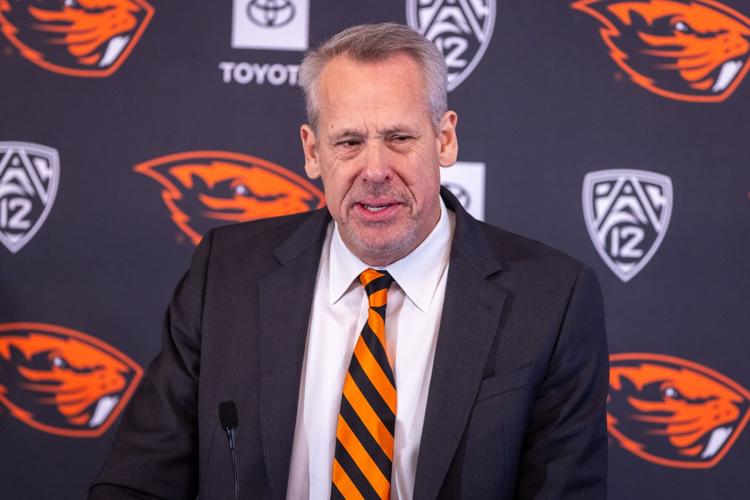
Oregon State Athletic Director Scott Barnes speaks as the Beavers introduce new head football coach JaMarcus Shephard at Reser Stadium in Corvallis on Dec. 2, 2025.
“We still felt we could keep it together,” Barnes said. “We had a play-and-play option with Colorado leaving. We had a good plan. But we couldn’t have another defection.”
The conference didn’t have another defection. It had seven.
On the morning of Aug. 4, after Kliavkoff's media rights deal failed to impress, Washington and Oregon bolted for the Big Ten.
Later that day, Arizona, Arizona State and Utah headed to the Big 12.
That left four schools, but it was really just two. Stanford and Cal had no intention of staying and eventually fled for the ACC, leaving the Beavers and Cougars to either rebuild the conference or turn out the lights.
“You have to tell 550 student-athletes that they have nowhere to play, no media deal, no revenue and no postseason,” Barnes recalled.
The same conversation unfolded in Pullman.
“It was a 100% fire drill,” said Pat Chun, who was Washington State’s athletic director at the time (and is now at Washington).

Then Washington State University Athletic Director Pat Chun poses for a portrait in the Seattle Times photo studio Nov. 21, 2023, in Seattle.
“We knew we needed to make something work and you’re just trying to figure out the best next step because there is no such thing as the long term in college sports.”
The weeks immediately following the implosion featured a barrage of discussions with Stanford and Cal, as the Bay Area schools plotted their next move.
“We understood Stanford had other options,” Barnes said. “And we were not their first choice.”
The Beavers and Cougars pursued membership in the power conferences and quickly realized all doors were closed — not because of their on-field performance but, rather, remote geography and limited media value.
Where could they turn for help with the salvage operation? Not to Kliavkoff, whose credibility was shot.
“For the conference office, we were not their focus,” Barnes said. “Pat and I became the de facto commissioners for several months.”
With substantial help from their presidents, Oregon State’s Jayathi Murthy and Washington State’s Kirk Schulz, who has since retired, Barnes and Chun began to sift through the carnage and map a future.
They spoke every day, often more than once — "more than we spoke to our wives," Barnes quipped.
They retained Dean Jordan, a highly respected media rights executive from The Team (formerly Wasserman Media), to assist with a TV package.
They sought counsel from Oliver Luck, the former NCAA executive vice president and Big 12 athletic director (West Virginia) who had contacts throughout the industry.
They reached out to the Mountain West about a football scheduling arrangement.

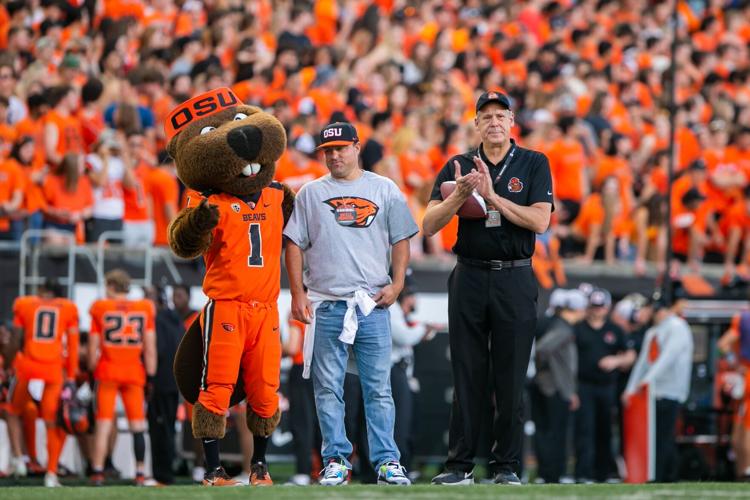
Oregon State Athletic Director Scott Barnes, right, with Benny the Beaver and 10 Barrel co-founder and OSU alumnus Chris Cox, center, as the Beavers face the Washington State Cougars in a Pac-12 college football game at Reser Stadium in Corvallis, Oregon on Saturday, Oct. 15, 2022.
And together with Murthy and Schulz (and the schools’ attorneys), they took the 10 departing schools to court over control of the conference and hundreds of millions in Pac-12 assets.
All the while, Barnes was recovering from a heart attack suffered six months earlier.
“My respect for Scott could not be greater,” Chun said. “The situation took a toll on all of us and he was coming off that health issue. But no matter when I called, he would pick up. It could have been 7 a.m. or 7 p.m. He was always there. He really, really cared about making it work.”
Early in the process, Barnes and Chun considered a merger with the Mountain West. Commissioner Gloria Nevarez and then-New Mexico president Garnett Stokes visited Corvallis and Pullman and expressed interest in “rethinking” what a western-based conference could look like, Chun recalled.
But the relationship quickly devolved as the Beavers and Cougars felt Nevarez pushed too hard with the 2024 football scheduling partnership, which eventually became the subject of an antitrust lawsuit due to the poaching penalty provision.
Discussions about a basketball scheduling arrangement were anything but smooth.
Also, the Beavers and Cougars suspected the Mountain West of attempting to divide and conquer by negotiating membership invitations with each school individually.
At that point, they opted to partner with the West Coast Conference in 12 sports, including basketball and decided that rebuilding the Pac-12 was the best path forward.
Something else changed in the winter of 2023-24: Barnes and Chun began to trust Pac-12 deputy commissioner Teresa Gould.
“People were leaving, people were looking for jobs,” Chun said of the conference office. “But Teresa only cared about helping the two schools. You could see her true character.”
By the end of February, the two presidents, Murthy and Schulz, had negotiated Kliavkoff’s severance agreement and appointed Gould as his replacement.
A few weeks later, Chun accepted an offer to become Washington’s athletic director.
Instead of Barnes and Chun serving as de facto commissioners, Gould settled into her role and moved in lockstep with Barnes.
Any thought of merging with the Mountain West had been fully dismissed.
The focus turned to expansion.
“We wanted to be selective,” Barnes said. “You don’t want to attempt to solve short-term operational issues without considering long-term value. We didn’t want to settle.”
Officially, the Pac-12 added Boise State, Colorado State, Fresno State and San Diego State on Sept. 12, 2024, but “we had plenty of assurances” prior to that point, Barnes noted.
Utah State came aboard two weeks later, and Gonzaga followed on Oct. 1 after Gould flew to Spokane and spent a day hammering out an agreement with the Zags. (Gould was not available for comment for this article because of her travel schedule.)
Nine months later, in the summer of 2025, the Pac-12 added Texas State as the eighth football-playing member and signed media rights deals with CBS, The CW and USA Network, ensuring the 110-year-old conference would live for at least five more.
What the 2030s will bring, nobody knows.
The future of college sports is playing out in district courts across the land and on Capitol Hill, where a groundbreaking bill is winding through the Senate with the potential to freeze conference realignment, spark another wave or lead to the formation of a super league.
“I was standing in the press box at Cal looking out over the San Francisco Bay,” Barnes said, referring to OSU's game in Berkeley in October 2024. “And I turned around and looked at the field, and it said ‘ACC.’
“Now, what sense does that make for the long-term stability of college athletics? We need to recalibrate.”
Barnes was scheduled to retire in late August, but the date was recently changed to July 5 after the Beavers named his successor, Kevin Griffin.
He will serve as senior advisor to the athletic department for another year, providing a front-row view of the rebuilt Pac-12’s inaugural season of competition — a season many didn’t think was possible following the devastation that unfolded in the summer of 2023.
“The end of the previous iteration of the Pac-12 is a cautionary tale of failed leadership and external forces,” Chun said. “But it’s not one chapter. It’s a novel.
“The conference has some of the best brands in the Group of Six. Washington State and Oregon State are positioned as well as they could be on July 1, given the circumstances, to determine what’s next. They have their futures in their hands. And that’s what they wanted.”