
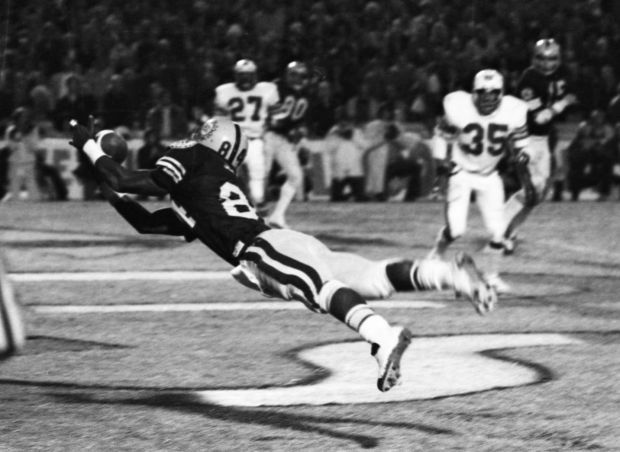
Sun Devil fans cling to “The 1975 Catch,” “The 1992 Run,” and “The 1968 Ultimatum.”
Wildcat faithful insist “The 1986 Pick,” “The 1995 Sack” and “The 1961 Zigzag” are the most enduring plays of the Territorial Cup.
ASU fans believe “The Game” was 1975.
Arizona backers can’t decide. To them, “The Game” was 1982, 1985 or 1986. Multiple choice.
The common thread is that none of The Plays of the Century have happened this century. The Territorial Cup has been dreadfully lacking in historic relevance.
No one has put a “The” before an Arizona-ASU football game since before most of those playing in Friday’s game were born.
Since 1991, the Territorial Cup has been won 12 times by teams without winning records. Over those years, the Sun Devils have won it at 5-5, 5-5, 5-5, 5-5, 4-7, 5-5 and 5-6. The Wildcats have won with records of 5-5, 5-5, 4-6, 2-8 and 2-8.
People are also reading…
Between 1995 and 2010, the game failed to sell out eight times.
This time, the game is sold out. This time,“The” applies. Both teams are simultaneously ranked for the first time since 1986. Both remain in contention for a conference championship for the first time since 1975.
Has it been that long?
At 7:30 p.m., on Saturday, Nov. 29, 1975, a chilly night that followed two rainy days, 9-1 Arizona and 10-0 ASU arrived in Sun Devil Stadium for what would become their Game of the Century.
ASU coach Frank Kush was the most famous man in Arizona, or, if not, right there with Barry Goldwater. In Tucson, he was Public Enemy No. 1, the most feared man in Tucson since Pancho Villa.
His Sun Devils owned the Wildcats, 9-1, dating to the mid ’60s.
The game was not televised. Exactly 7,913 tickets were sold to watch a closed-circuit broadcast of the game at McKale Center and at ASU’s Activity Center.
ASU won 24-21, clinching a berth in the Fiesta Bowl against mighty Nebraska. No. 12 Arizona was not offered a bowl bid.
The game’s two defining plays remain hotly controversial. Arizona receiver Scott Piper caught a 77-yard touchdown pass in the first half that would have given the Wildcats a 14-3 lead.
The field judge ruled him to be offside.
“When I did see the film, a few months after the game, it was clear to me that I was lined up correctly onside,” Piper told me Monday. “The ref appeared to throw the flag after I had made the catch 5 yards down field, almost as an afterthought.”
The game forever changed.
Moments before halftime, ASU receiver John Jefferson raced past UA cornerback Mike Battles, open by about 4 yards, and made a full-out dive in an attempt to catch a pass from Dennis Sproul.
Jefferson appeared to both juggle the ball and land out of bounds, or near the end line, feet from where the ASU band was preparing to take the field. It was ruled a touchdown. Arizona led 14-10. Momentum shifted.
“There was no TV review then, no appeal,” UA coach Jim Young told me. “Years later, when Jefferson was coaching at Kansas, I ran into him. I asked him about the catch. He smiled and said, ‘I’ve said all I’m going to say about that play.’ ”
The ’75 game will forever live in mystery because of two calls, both of which went against Arizona, both adding to the rivalry’s lore.
Over the years, the UA more than gave its fans closure. In 1982, it knocked a 9-1 Sun Devil team out of the Rose Bowl, a riveting 28-18 game in which lineman Joe Drake tackled Sun Devil runners for two safeties.
And, of course, the scene was repeated in 1985 when Arizona again knocked ASU out of the Rose Bowl, a rousing comeback as Byron Evans and Dana Wells — two Phoenix kids — forced game-changing fumbles and shut down the rose-selling business outside Sun Devil Stadium.
Life goes on. There’s another Territorial Cup game every November. Piper lives in Arvada, Colorado, the president of a Western- wear company, a horseman who doesn’t just sell cowboy boots, he wears them. In September, he fell from a horse, broke eight ribs and suffered a collapsed lung.
At 60, Piper is long past the days he was referred to as “Mr. Clutch.” Jefferson got all the notoriety, but in the 1975 regular season, Piper caught more passes, 44, than “Mr. Catch,” who had 43.
Young, who was Arizona’s head coach from 1973 to 1976 before accepting a job at Purdue, worked so diligently to beat the Sun Devils and overcome Kush’s presence that he spent a week scheming a special play to beat ASU.
That play was the 77-yard pass to Piper.
Piper lined up as a tight end, not in his customary split-out position. It was designed to trick an ASU linebacker into covering the speedy wide receiver.
“We faked some confusion as to who was to stay in,” Piper remembers. “I then lined up at tight end. I blocked the defensive end for a one count, then released hard up the center of the field. The linebacker had me one-on-one. I had him beat.”
Touchdown.
Piper’s life wouldn’t have been lived any differently had the touchdown counted and Arizona won, going to the Fiesta Bowl against Nebraska. And Young would surely not have remained in Tucson beyond the 1976 season; Purdue was then a much more well-paying and reputable coaching job than Arizona of the ’70s.
But for the want of today’s TV devices, the Territorial Cup’s most compelling game will forever be a controversial one. And maybe that’s why it remains so relevant.
“We had discussed alignment previously; that’s why I was certain that I was OK,” Piper says. “In fact, when they called it back, I began asking, ‘Who jumped offside’? It was such a shock that he called it on me.”
With 39 years to reflect, Piper long ago overcame the hurt of Nov. 29, 1975. The games don’t define you. You move on.
“I believe the ref made a bad call, but it happens,” he says. “Nevertheless, it was a great game. Certainly one I will remember — and apparently so do others.”