


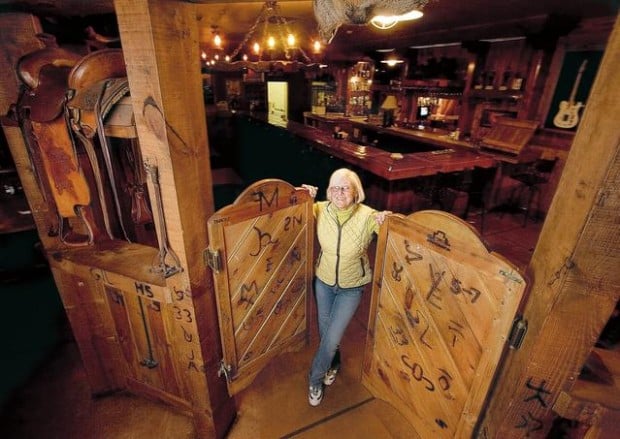
On Saturday nights during the college football season, Alex Flanagan's face is where it should be.
Beamed across the world as the sideline reporter for ESPN's Southeastern Conference coverage, Flanagan's image shows up on the television above the saloon at The Steak Out, a cowboy steakhouse in Sonoita.
How could she be anywhere else? Flanagan's parents have owned The Steak Out since she was 7 years old.
At 10, she started hostessing and washing dishes.
At 19, when she was old enough to serve alcohol, Flanagan became a waitress. She'd return during busy times as a University of Arizona student.
As an adult, she'd fly home to help out during the town's annual rodeo and horse races.
So this past December, a few days before Flanagan would appear on her largest stage as a reporter during the network's bowl season, the Salpointe Catholic High School and UA grad couldn't help but help.
People are also reading…
She was sitting at the restaurant when a family walked in. The hostess was nowhere to be found.
So Alex Flanagan, 33-year-old television star, sat them.
"Everybody's got to chip in," she said.
Blazing times
The town of Sonoita is really more of intersection. Highways 82 and 83 cross there, about 50 miles southeast of Tucson, without a stoplight.
It's an intersection of genuine cowboys and weekend wranglers, vaqueros and vacationers.
The Steak Out sits at the southeast corner of the intersection, the front end facing Highway 82, where the road scene from "A Star is Born" was filmed.
Mike and Grace Wystrach bought the restaurant in 1979 after having to wait three hours for dinner. With four tired little girls.
They had moved there a year earlier so Grace could help her father run Elgin's Rain Valley Ranch, the property he purchased in 1949 from Missouri Sen. Stuart Symington.
John Wayne's "Red River" had been shot there a year before.
"We saw the movie, and my father said, 'That's where we're moving,' " Grace said.
Grace raised cattle. She and Mike ran the steakhouse, the kind of place where cowboys would hand their guns to the bartender before they sat down to drink.
The restaurant became a second home for the family of eight. It's where Flanagan first took the stage, performing the country standard "The Rose" on stage with her sisters after practicing it for weeks. She and her husband, former UA basketball player Kevin Flanagan, had their wedding rehearsal dinner there in September 1997.
"That was probably one of the few nights I didn't work," Alex said.
The restaurant burned down in 1998, and Alex hopped on a plane that day to help sort through the rubble. Family pictures were destroyed. The family recovered two bronze statues of cowboys rustling cattle and a handful of bean crocks.
The restaurant was rebuilt and reopened in December 1999. By then, the Wystrach family had purchased The Sonoita Inn, an office building built by Margaret Carmichael, the co-owner of Secretariat. Artifacts from the horse's Triple Crown run still hang in the lobby.
When the restaurant reopened, local ranchers branded the wood-paneled walls with their logos.
You get the feeling Flanagan feels more comfortable there than in the limelight.
"Being a small-town girl, I tend to be a little bit of a hermit," she said. "I have a hard time being recognized."
Her big break
Kevin Flanagan told former UA center Ed Stokes he was going to marry Alex before the two even met. He saw her from across the room at a club when the two were freshmen. But Alex was dating someone else, so Kevin was patient. They became friends, then dated, and he proposed to her on her 24th birthday after a horseback ride in Sonoita.
The two lived together in France for a year while Kevin worked for sunglasses manufacturer Oakley, then moved to Los Angeles in 1998. Alex got a job working for a weekend magazine show called "Goin' Deep" on Fox Sports Net.
While working for "Goin' Deep," Alex was introduced to former Fox Sports anchor Keith Olbermann, whose office was next to her desk. She was headed out to report on a baseball story, so she picked the former SportsCenter anchor's brain about the topic.
"Very few reporters, even on a national level, will sit and say, 'I need to do a lot of research before I leave the office,' " said Olbermann, who now hosts "Countdown," a nightly news show on MSNBC.
A year or so later, Olbermann was given his own weekly show, "The Keith Olbermann Evening News." He picked Alex to be his only full-time reporter.
On that show, Alex interviewed Lute Olson shortly after the death of his wife, Bobbi.
"Not only did I know Coach Olson, but I knew Bobbi fairly well through Kevin," she said. "That was a difficult thing. He said some really beautiful, inspiring things.
"As a daughter, a mother and a wife, I was happy to share those things, to remember their mother and for people to really see his relationship. It was special to be a part of it."
Style, substance
Flanagan, who moved to ESPN in August 2001, has covered five seasons of football for the network. She's on television so much that her 2-year-old daughter, Addison, says "mama" every time a female sideline reporter pops up on television.
The UA media arts major might have the most awkward job in sports — trying to pry an interesting answer out of a coach as he runs off the field at halftime.
"Often, it's difficult for him to stop and have a meaningful conversation," she said. "But even if you get coach-speak, it's good for viewers to get the mood of the coach. Sometimes, just seeing their demeanor is a payoff at home."
Flanagan works against the stereotype some have of female sideline reporters — that they're more style than substance.
"I think that's something we're always battling, is trying to prove your credibility," she said. "I am not naive enough to not recognize that a big part of being on television is entertainment. What you look like has something to do with it."
When she worked with Olbermann, the anchor would introduce her on-air as "Mrs. F," something he described as a "sign of respect" and a subtle clue to his audience that Flanagan was a journalistic equal.
That's not always the case with some reporters who play strictly to looks, Olbermann said.
"It's a self-defeating process — no matter how far you get, eventually somebody more cosmetic will show up," he said. "Alex is different. She holds her own in that area without playing to it. She's a bona fide, hardworking, good sports reporter who happens to not look unpleasant on TV."
Super support
In the past two years, Flanagan has balanced working and being a mother. She had her second daughter, Grace, on July 25. She worked a game in San Diego on Sept. 4 — driving down from her home in Irvine, Calif. — then resumed her full-time duties three weeks later.
On weekends during the football season — and during the off-season, when Flanagan covers Los Angeles teams for the network — her husband watches the kids and the games.
Though, truth be told, he's not much of a sports fan. Kevin, who played for the UA from 1991-1994, used to be teased by his teammates because he couldn't name all the mascots in the Pac-10.
"But I watch every game she does," Kevin said. "I'm her biggest fan."
He gets some competition from Alex's parents, who still wish they had the videotape from the news programs Alex made on the camcorder when she was a kid.
Alex gets her looks and work ethic from her mother, who still raises cattle. Grace does most of the work on the ranch herself.
"She's probably fitter than most Division I athletes," Kevin said.
Her mother's success in another male-driven industry is not lost on her daughter.
"By being in the industry that she's in — ranching — my mom's been the one to give me the confidence to do what I do," she said.
Alex gets her inquisitive nature — and her attraction to show business — from her father. For years, Mike, a former Pepperdine football player, used to call her after every television appearance to give her pointers and support.
It's that kind of support system that enabled Flanagan to go from Sonoita to Hollywood and back again, even if it's just her face being beamed onto the television back at the steakhouse.
"I definitely never would have guessed that this is where I would be," she said. "But I think that my family and my life experiences really gave me the ability to never question that I'd be there."


 5 takeaways from Arizona football’s 28-17 loss to No. 15 BYU | Michael Lev


