It was everything you could possibly want in a big-time college football game.
Two excellent teams trading haymakers. Superstars making play after play. A robust, rowdy crowd trying to will the home team to victory.
But no matter how entertaining and suspenseful it all was, only one team could head home happy.

Michael Lev is a senior writer/columnist for the Arizona Daily Star, Tucson.com and The Wildcaster.
That team was not the Arizona Wildcats.
No. 23 Arizona lost a heartbreaker to No. 2 Utah 40-39 Saturday night at Casino Del Sol Stadium.
The Wildcats came as close to upsetting a top-five team as possible without actually doing it.
What was the difference in the end? How did the Utes escape? Where do the Cats go from here?
We dive into all that and more via Five Takeaways.
People are also reading…

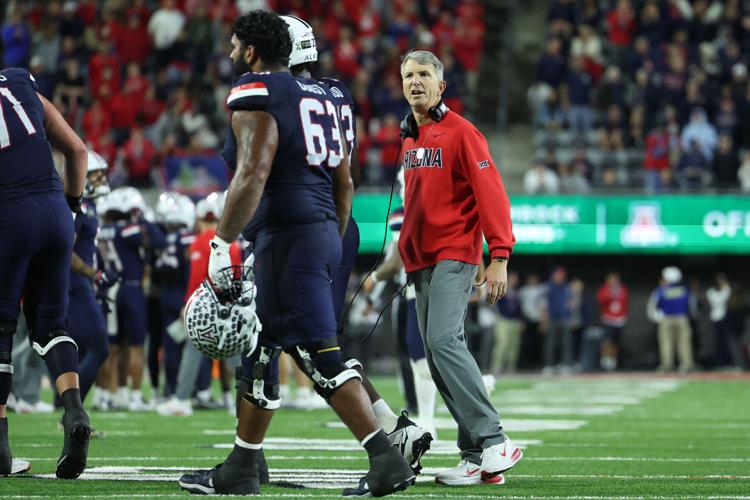
Arizona head coach Brent Brennan looks on during the Wildcats’ game against Utah at Casino Del Sol Stadium, Nov. 14, 2026, in Tucson.
1. Fourth down-and-out
In a game that featured seven lead changes and multiple massive momentum swings, it’s hard to boil it all down to one play.
But one play will haunt Noah Fifita, the Wildcats and their fans forever.
Down by one with the clock ticking toward the two-minute timeout, Arizona faced fourth-and-2 at its 33-yard line. Despite the UA having only two timeouts, the best move in that situation was to let the clock hit 2:00, use the commercial break to regroup and call the best play in the playbook.
That’s not how it went down.
Brent Brennan chose a tactic that he soon after regretted — trying to draw Utah offside.
It actually appeared to work for a brief moment. Utah linebacker Cyrus Polu made a move toward the line of scrimmage directly across from center Zach Henning. Henning, thinking Polu had entered the neutral zone, did what he’d been instructed to do: He snapped the ball to Fifita.
The problem was, Polu wasn’t offside. It wasn’t a free play.
It was, instead, a discombobulated one.
If you watch the replay — which I’ve done several times — you can see that all the Wildcats weren’t on the same wavelength. The play itself was a low-percentage call — a back-shoulder fade to slot receiver Giovanni Richardson well past the line to gain. It was the type of call you make if you think you have a free play. It very likely wasn’t what offensive coordinator Seth Doege would have called after the two-minute timeout.
As is his way, Fifita wouldn’t blame anyone but himself for the botched sequence.
“I don't think it's my place to speak on that,” he said. “At the end of the day, the ball was in my hands with a play to be made, and I didn't make it.”
Brennan pointed the finger squarely at himself.
“That situation right there, that's my fault,” Brennan said. “I never should have put Zach in that position.”
It was a heat-of-the-moment call. It was ultimately the wrong one.
2. Too many hits
On the previous play, Fifita hit Isaiah Mizell on a slant pass for 8 yards. Fifita also got drilled just as he released the ball.
That happened far too often Saturday night. It’s been happening far too often this season.
The UA offensive line and other members of the blocking unit haven’t taken care of their No. 1 responsibility as consistently as they need to.
They haven’t prevented No. 1, Fifita, from getting hit, harassed and hurried.

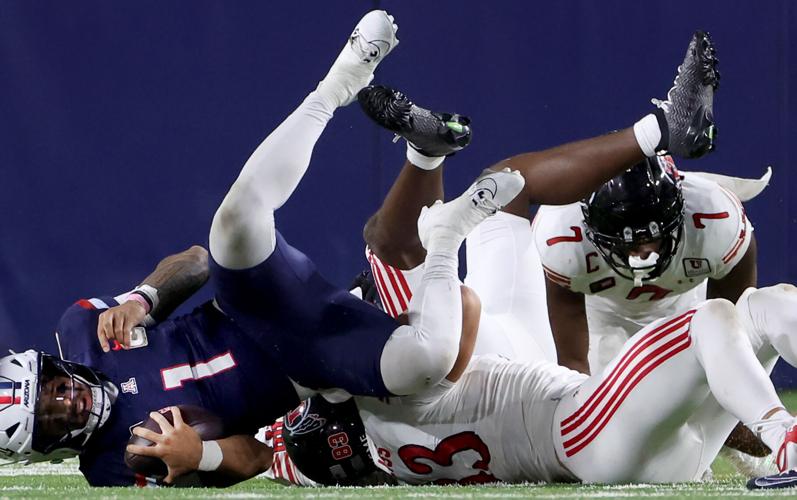
Utah linebacker Elijah Elliss slings Arizona quarterback Noah Fifita to the turf for a sack during the fourth quarter of their game on Nov. 14, 2026. The No. 2-ranked Utes won 40-39.
Utah finished with four sacks for 50 yards in losses. The latter is a massive total. At times, it seemed like Fifita had no choice but to retreat.
Doege tried to make an adjustment in the second half. In certain situations, he kept a running back and a tight end in to block. It didn’t end up mattering.
According to Pro Football Focus’ initial game charting, Fifita was pressured on 32.7% of his dropbacks. The previous week, against TCU, it was 43.6%. You’d like that number to be 20% or lower.
PFF charged veteran right tackle Tristan Bounds with four pressures allowed. He’s yielded at least three in each of the past four games, per PFF.
Bounds’ apparent regression is bizarre. He steadily improved last season and seemed poised to anchor Arizona’s line after being granted a sixth year of eligibility.
Bounds missed time in the offseason while recovering from a broken ankle. But he was good to go by training camp.
He’s been so off-kilter lately that I wonder if the ankle or some other injury is hampering him.
Others have had issues, too. At times Saturday, the UA offensive line looked completely overwhelmed against the fast, physical, oft-blitzing Utes.
“We're blocking a good front,” Brennan said. “It's hard. Everyone's fighting their ass off. Sometimes you get beat.”
Fifita excels at escaping pressure and making off-script plays. You just don’t want Plan B to become Plan A.
The line has three more games to get its act together and keep No. 1 from getting pummeled.
3. More dual-threat doldrums
It’s really hard to win a football game when you allow 300 rushing yards, or thereabouts.
Utah had 296 net rushing yards. If you take away the final two kneel-downs, that total climbs to 299.
It’s the third time this season Arizona has allowed about 300 yards on the ground. The Wildcats are 1-2 in those games.
They all have something in common: The quarterback is a significant part of the rushing attack.
First it was West Virginia’s Michael Hawkins Jr. Then it was Texas Tech’s Thomas Castellanos. Saturday it was Utah’s Devon Dampier.
It was no secret leading up to the game that Dampier would be the focal point of the Utes’ offense — and of the Wildcats’ defensive game plan.
What makes the Phoenix native so special is that it’s incredibly difficult to stop him even if you know what’s coming.
Utah makes it even harder by utilizing Dampier in multiple ways and complementing him with other speedy playmakers.
Dampier’s partner in crime Saturday was tailback Daniel Bray, who filled in for the banged-up Wayshawn Parker and had a career-best 197 yards and a touchdown. Bray ran the 100 meters in 10.38 seconds in high school. He’s a blur.
Dampier is a deluxe athlete who’s both slippery and strong. He’s a brilliant escape artist. He finished with 100 rushing yards and two scores and made some jaw-dropping plays with his legs and arm.

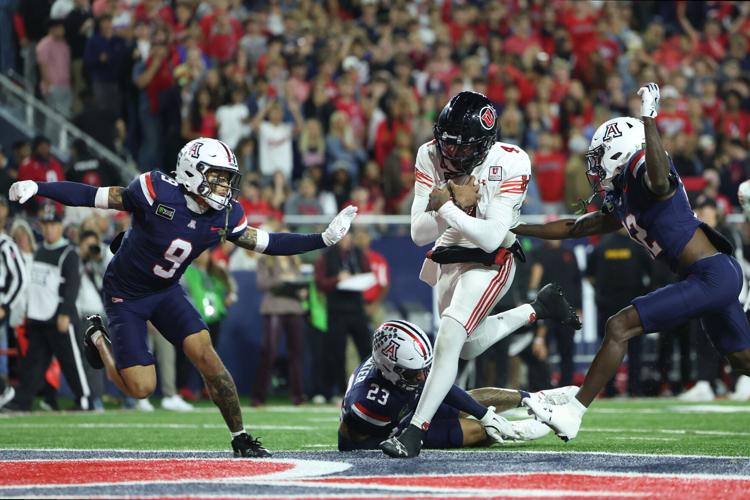
Utah quarterback Devon Dampier runs the ball for a touchdown in the first half against Arizona at Casino Del Sol Stadium, Nov. 14, 2026, in Tucson.
UA defensive coordinator Danny Gonzales, who recruited Dampier to New Mexico out of high school, tried to counteract Utah’s pick-your-poison ground attack by changing personnel. Gonzales’ base defense features three linemen and three linebackers. He added a fourth linebacker, Myron Robinson, to the mix for much of the second half.
That was a smart tactic for multiple reasons, including the fact that Arizona’s secondary has been depleted by injuries. But it didn’t help as much as Gonzales had hoped.
After barely trying to run the ball in the first quarter — four attempts, 8 yards — Utah committed to the run and repeatedly succeeded at it. The Utes gained 95 yards in the second quarter, 106 in the third and 87 in the fourth.
The Wildcats knew the Utes would run the ball after turning it over on downs late in the fourth quarter and still couldn’t stop it. Bray carried twice for 9 yards. Dampier put the game away with a 12-yard rush.
The good news moving forward: Unless Kansas State’s Avery Johnson returns from injury, Arizona won’t see another athlete of Dampier’s caliber the rest of the regular season.
4. Flipping the field, script
The performance of Arizona’s special-teams unit mimicked the flow of the game overall.
It was a roller-coaster ride from start to finish.
Coming off a stellar outing vs. TCU in which it was arguably the biggest factor in the game, the special-teams group faltered early and often vs. Utah.
Freshman Ian French’s first kickoff hooked out of bounds. Then fellow freshman Caleb Smith made a poor decision on a punt return that flipped the field and set up the Utes for a score.

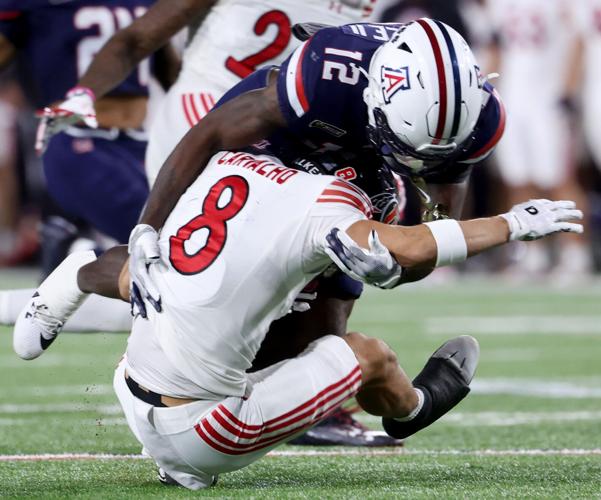
Arizona cornerback Dwight Bootle II steamrolls Utah punt returner Mana Carvalho and forces a turnover in the fourth quarter of their Big 12 game in Tucson on Nov. 14, 2026.
Late in the first quarter, Utah’s Orion Phillips launched a punt from the Utes’ 15-yard line. He boomed it. It landed at the UA 26. Smith was backpedaling. Would it have been difficult to corral it? Yes. Should Smith have gotten his body in front of it? Probably.
He elected to let the ball bounce and roll. It was downed at the 1-yard line. An 84-yard punt. Just like that, the Wildcats were backed into a corner.
They couldn’t gain a first down. UA punter Chase Ridley couldn’t re-flip the field. Utah got the ball at the Arizona 42.
The Utes gained a first down before stalling. But they were in field-goal range. They came away with three points in a game that was decided by one.
Early in the fourth quarter, UA snapper Drew Nicolson was flagged for kick-catch interference. I thought Nicolson avoided punt returner Mana Carvalho. But the call was made.
Utah again had prime field position. The Utes needed just three plays to cover 37 yards and take a 33-28 lead.
Then the redemption began.
Ridley blasted a 50-yard punt. Carvalho should have fair-caught it. He didn’t, and Arizona’s Dwight Bootle steamrolled him. Carvalho muffed the ball. Who should recover it? None other than the hustling Nicolson.
Arizona took over at the Utah 17. The Wildcats then went backward, including an 11-yard sack on third down.
Michael Salgado-Medina, one of the heroes of the TCU game, drilled a 47-yard field goal to make it 33-31.
It’s great that he made the kick. It was bad for Arizona that he had to attempt it. That blown opportunity cost the Wildcats four more points.

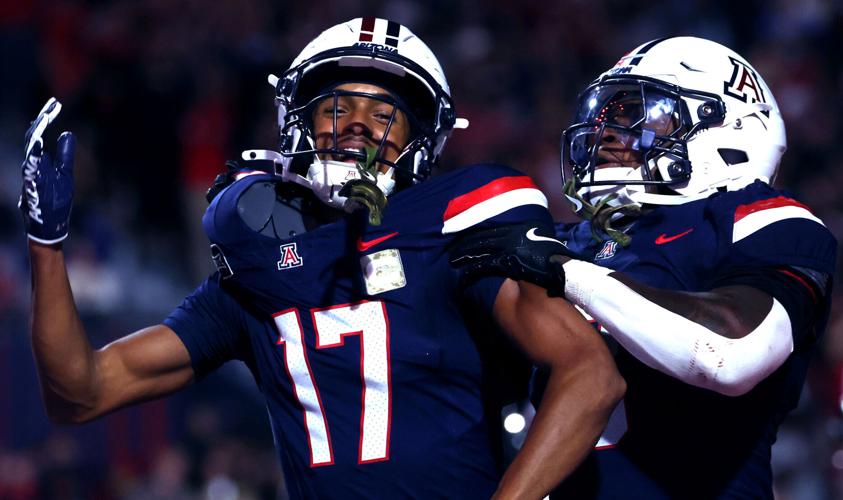
Arizona wide receiver Isaiah Mizell, left, and running back Kedrick Reescano celebrate Mizell’s touchdown in the third quarter against Utah on Nov. 14, 2026.
5. Nine would be divine
One week after winning by a point, Arizona lost by a point. It was a disappointing ending to an otherwise amazing day on the UA campus that began with “Big Noon Kickoff” and continued, many hours later, with pulse-pounding football for nearly 60 minutes.
I don’t think less of the Wildcats after what I witnessed Saturday night. If anything, I gained even more respect for them after they went toe-to-toe with one of the best teams in the country.
The loss knocks Arizona out of the Big 12 title chase for all intents and purposes, but the 7-3 Wildcats still can achieve something historic: a second consecutive nine-win season.
The Wildcats haven’t done that in more than 50 years. It’s still there for the taking.
Kansas State is a mess right now, having lost four in a row while cycling through multiple quarterbacks. Arizona State is frisky and possibly rounding into form. But the Sun Devils have to come to Tucson, and they have a freshman quarterback who’s never seen a defense as funky as Gonzales’.
If Arizona pulls it off and finishes 9-3 in the regular season for the second straight year, it would be a tremendous accomplishment. If that’s not good enough for you, I suggest you brush up on UA football history and recalibrate your expectations.
Although much was expected from this UA team, it was never College Football Playoff or bust. At least not in the current format. If the 24-team Playoff existed now and this squad didn’t make it, that would be a real failure.
As it is, Arizona will go to a bowl game for the second straight year. An Alamo Bowl representative attended Saturday’s game. Wouldn’t that be a fitting bookend for Fifita’s illustrious career?
I know he wanted more than that. I’m sure it hurts that those goals are probably out of reach.
But he’ll look back upon this season with pride. If the Wildcats finish it properly, so should all of us.
Contact sports reporter/columnist Michael Lev at mlev@tucson.com. On X (Twitter): @michaeljlev. On Bluesky: @michaeljlev.bsky.social

Michael Lev
Sports Reporter/Columnist


 On the single biggest factor in the UA-Utah game, other Big 12 thoughts | Michael Lev