The dilemma of the “plus-one” isn’t limited to single people whose friends are getting married.
It’s a battle being waged in college football stadiums across the country every Saturday.

Defensive coordinators always want to “plus-one” the opponent’s rushing attack. In other words, bring one more defender than there are blockers.
Offensive coordinators can negate that if they have a quarterback who can run the ball effectively.
“When you're just playing a traditional quarterback and he's handing the ball off to a running back, the quarterback does not have to be accounted for in anything,” Arizona defensive coordinator Danny Gonzales explained. “So you've got 11 defenders on 10 (offensive players).”
If the quarterback can run, the math changes. That running back who isn’t getting the ball becomes a blocker. Now it’s 11-on-11 again.
People are also reading…
Dual-threat quarterbacks have vexed Gonzales’ defense over the past two seasons. Devon Dampier — who will lead No. 2 Utah into Casino Del Sol Stadium to face No. 23 Arizona on Saturday — is one of the best dual-threat quarterbacks in the country.
The challenge for the Wildcats is to dampen Dampier. It’s easier said than done. And it isn’t a problem that’s unique to Arizona.
“That’s kryptonite in all of football,” UA coach Brent Brennan said of mobile QBs. “Who are the best quarterbacks in the NFL? All the guys that can move.”
The current best quarterback in the NFL, Buffalo’s Josh Allen, holds the career record for rushing touchdowns (88) by a signal-caller. The current FBS leader in rushing touchdowns (19) is West Virginia quarterback Michael Hawkins Jr.

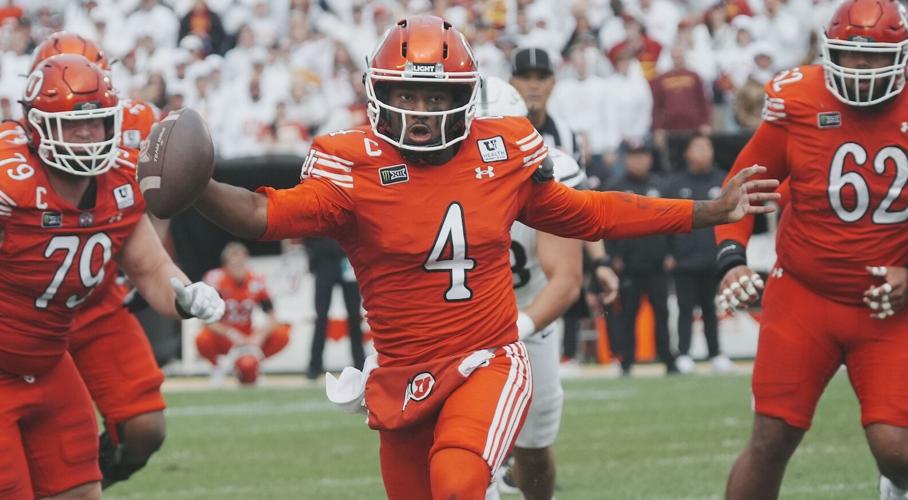
Utah quarterback Devon Dampier runs with the ball against Iowa State during the second quarter on Sept. 26, 2026, at Jack Trice Stadium in Ames, Iowa.
Hawkins is one of the dual-threat quarterbacks who’ve tormented Gonzales and the UA defense since he became coordinator last season. How troublesome has it been? How does Dampier fit that mold?
Those are the questions we’re aiming to answer in this week’s “Cats Stats.”
Duels vs. dual-threat QBs
Arizona has lost five regular-season games over the past two seasons. Four have come against dual-threat quarterbacks.
(You could argue that the Holiday Bowl also fits that profile, but SMU quarterback Kevin Jennings was banged up and barely ran in that game. You could also argue that pocket passer Rocco Becht strongly influenced Iowa State’s win over Arizona last season with his legs, in that he scored three 1-yard touchdowns.)
Three quarterbacks are responsible for those four losses: Houston’s Conner Weigman, BYU’s Bear Bachmeier (twice) and Texas Tech’s Thomas Castellanos.
Weigman rushed for 98 yards and a touchdown in the Cougars’ 31-28 victory on Oct. 18, 2025. He also gained two first downs as a runner on the drive that produced Houston’s walk-off field goal.
Bachmeier basically played the role of a running back in last year’s game against BYU. He had a career-high 22 rushing attempts for 89 yards and two touchdowns — the tying TD with 19 seconds left in the fourth quarter and the winner in overtime.

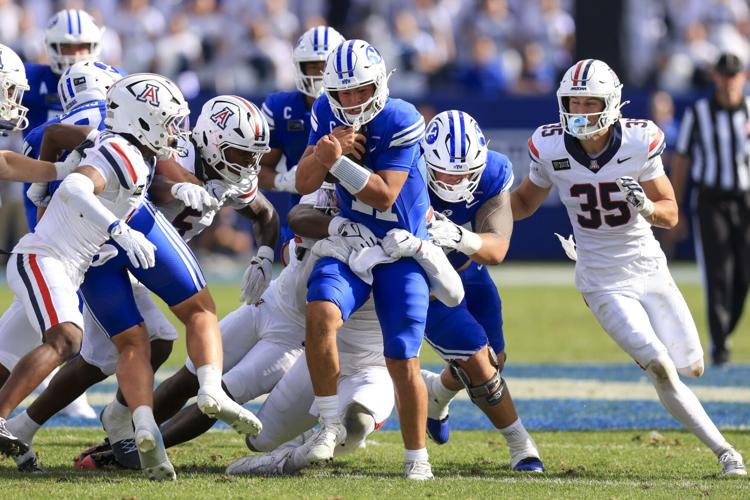
BYU quarterback Bear Bachmeier runs the ball for a first down against Arizona during the second half at LaVell Edwards Stadium on Saturday, Sept. 12, 2026, in Provo, Utah.
Stifling the powerful Bachmeier was the focal point of the defensive game plan in this year’s meeting. Bachmeier’s running wasn’t nearly as impactful. He had six rushing attempts for 37 yards. Still, half of those rushes gained first downs, and another produced a touchdown. The Cougars won 28-17.
Texas Tech started Castellanos for the first time this season against Arizona, and the Wildcats never fully adjusted to the Red Raiders’ radically different-looking offensive attack. Castellanos rushed for a season-high 117 yards and a touchdown in Texas Tech’s 34-26 victory on Halloween.
Two teams rushed for more than 200 yards against Arizona last season — Houston and BYU. Two teams have rushed for 300-plus yards against the Wildcats this season — West Virginia and Texas Tech.
Hawkins boosted the Mountaineers’ rushing total with 98 yards on 25 attempts. Arizona won anyway.
Only one other opponent this season has rushed for more than 100 yards as a team against the Wildcats. That would be BYU, which had 148 yards.
Overall, Arizona has defended the run much better this season. The Wildcats are allowing 125.2 yards per game and 3.7 yards per rush. Those figures were 143.2 and 3.9 last season.
Dangerous Dampier
Dampier has the third-most rushing yards (482) among Big 12 quarterbacks, trailing Hawkins (1,081) and Kansas’ Isaiah Marshall (528).

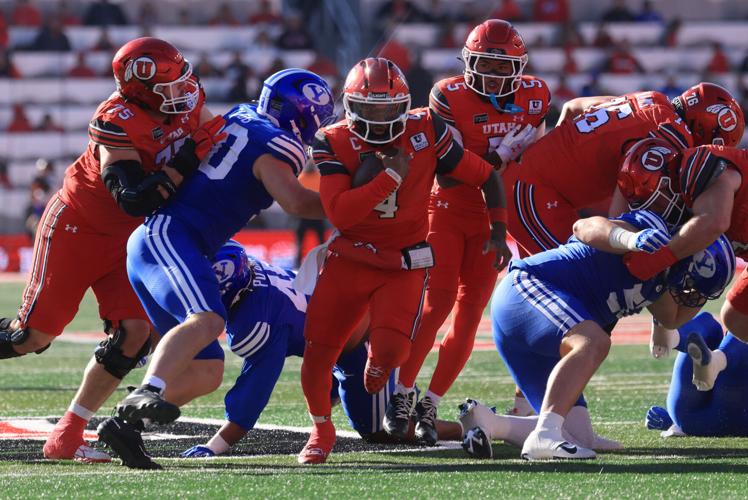
Utah quarterback Devon Dampier runs with the ball during the first quarter against BYU at Rice-Eccles Stadium, Nov. 7, 2026, in Salt Lake City.
Keep in mind, though, that sacks count against quarterbacks’ rushing totals in college football. If you take those out of the equation, Dampier’s rushing total rises to 546 yards. His average per carry increases from 4.7 yards to 6.1.
Dampier, whose seven rushing touchdowns are tied for the seventh most in the conference, has had some monster games on the ground. He rushed for 150 yards against Houston, becoming just the fifth Big 12 quarterback to run and pass for 150-plus yards against a ranked opponent. The Utes’ 226 rushing yards are easily the most the Cougars have surrendered this year.
Dampier does by far his most damage on first down, gaining 255 yards, scoring four touchdowns and ripping off 11 runs of 10-plus yards. He’s also extremely effective on third-and-short (1-3 yards), gaining 52 yards on 10 attempts. Six of those carries have gained first downs.
Dampier is just as much of a threat on scrambles as he is on designed runs. He has gained 261 yards on 26 scrambles this season, according to Pro Football Focus. That’s the third-highest total in the Big 12 behind Hawkins (325) and Cincinnati’s JC French IV (266).
Dampier is both slippery and strong. He has forced 28 missed tackles this season, per PFF, also third most among Big 12 QBs (Hawkins, Marshall). For his career, Dampier averages 3.27 yards after contact per rush.
His college career began at New Mexico under then-Lobos head coach Danny Gonzales. Gonzales was on Arizona’s staff, though not yet the defensive coordinator, when Dampier faced the Wildcats in Brennan’s UA debut in 2024. He rushed for 130 yards and two touchdowns that night. He had two games with 193-plus rushing yards while at UNM.

New Mexico quarterback Devon Dampier, left, stiff-arms his way out of the reach of Arizona defensive lineman Tre Smith to avoid a sack in the Wildcats’ season opener on Aug. 31, 2024, in Tucson.
UA defensive end Tre Smith had five tackles in that ’24 meeting, which Arizona won 61-39. He knows the only way to keep an elite athlete like Dampier in check is by creating what Brennan calls “population to the football.”
“That's part of our mantra ... all 11 to the ball with bad humor,” Smith said. “That means everything. That is truly the identity of a defense. You could have a lot of great players across the board. But what really elevates that is your effort. And not just one guy's effort, but a collective effort.”
Again, though, it’s easier said than done — especially without the benefit of the plus-one.
Contact sports reporter/columnist Michael Lev at mlev@tucson.com. On X (Twitter): @michaeljlev. On Bluesky: @michaeljlev.bsky.social

Michael Lev
Sports Reporter/Columnist


 On the single biggest factor in the UA-Utah game, other Big 12 thoughts | Michael Lev