I've listened to jazz for decades, and trumpeter and composer Wynton Marsalis still makes me discover something new every time I hear him play. His music asks more of a listener than most performers dare demand — it wants you to follow the conversations between instruments, catch harmonies that flare and vanish in an instant, track how one idea becomes another. Wynton's music makes you work for it. I love every minute of that work.
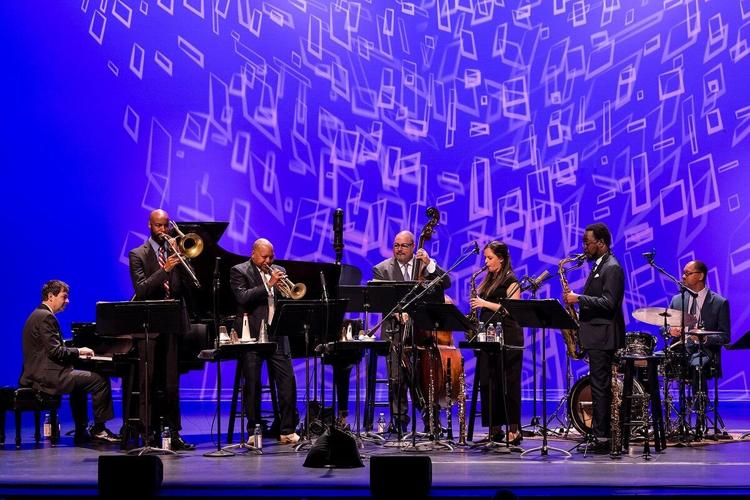
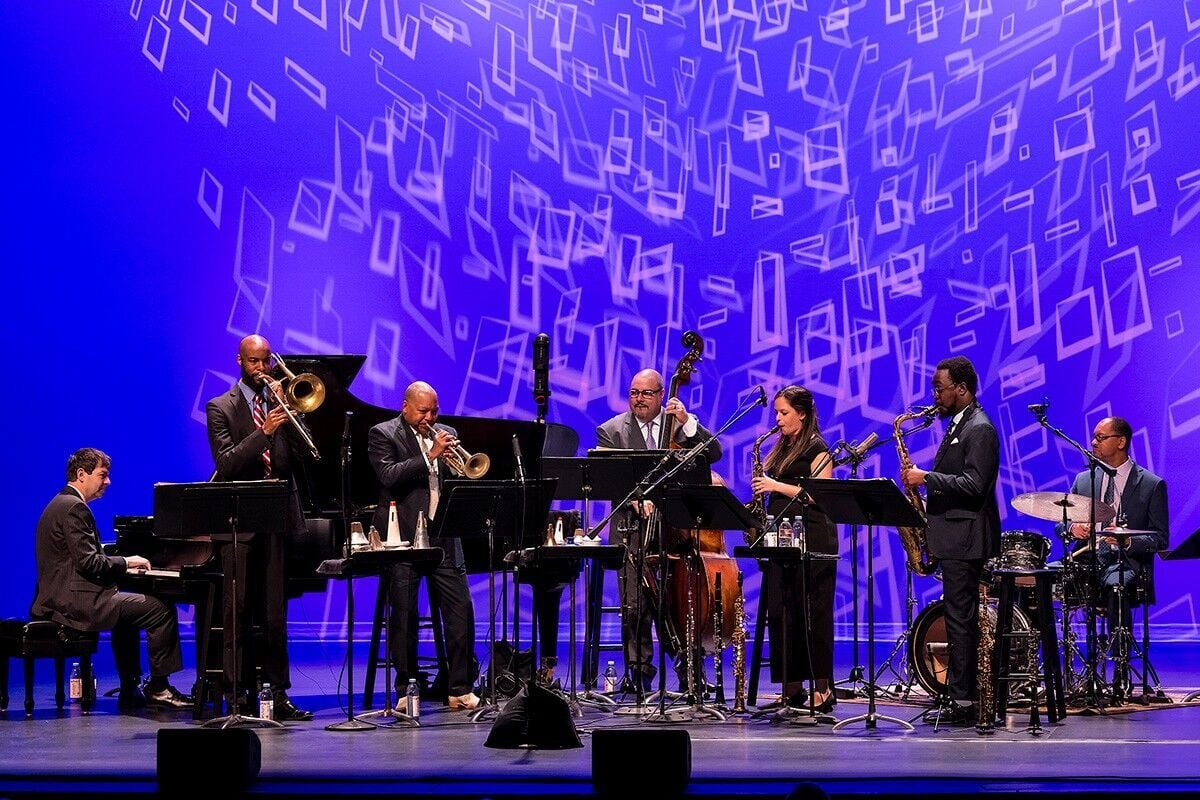
The evening at the Lobero Theatre in Santa Barbara, California, turned even more special when Wynton brought out his younger brother, Jason Marsalis, on drums. Audiences expect greatness from Wynton; seeing two members of America's first family of jazz share the Lobero's intimate stage was rarer still. The connection between them was unmistakable, built over a lifetime — Jason didn't just keep time, he became an equal voice in the conversation.
They were surrounded by a formidable septet: Chris Crenshaw on trombone, Alexa Tarantino on alto sax, flute and clarinet, Chris Lewis on tenor and soprano sax and clarinet, Dan Nimmer at the piano and Carlos Henriquez on bass. Each has an impressive résumé, but what stood out wasn't individual talent — it was how closely they listened to each other.
People are also reading…
The first set reached back to jazz's roots with Jelly Roll Morton's "Dead Man's Blues," written a century ago and sounding as alive as anything written this year. Henriquez opened with a warm, melodic bass solo that explained, in about 90 seconds, why he's regarded as one of the best bassists working in jazz today.
The emotional center of the night was "Moscow Blues." Wynton noted before playing it that the piece had been performed in both the Kremlin and the U.S. Supreme Court — proof, he said, that music sometimes succeeds where politics fails.
What followed was a clinic in ensemble playing. Tarantino and Lewis built saxophone harmonies that floated through the theater before Crenshaw stepped in with a rich, expressive trombone solo. Henriquez returned with another bass feature, full of warmth and authority. Then, Jason Marsalis took his turn and reminded the room why the Marsalis name carries the weight it does. His solo wasn't built on speed or volume — it was built on swing, imagination, and storytelling, each phrase leading naturally into the next, each accent placed with intent. It drew the loudest ovation of the night.
What made "Moscow Blues" linger wasn't the solos themselves but how they never broke from each other — one flowed into the next and back into the ensemble, as if seven musicians shared a single musical mind. Somewhere in the middle of it, the outside world simply stopped mattering: no deadlines, no noise, just seven people building something spontaneous and unrepeatable.

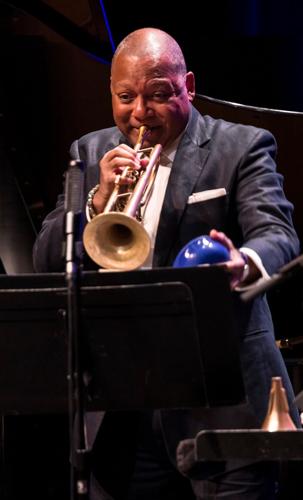
Wynton Marsalis
Later, introducing "That Dance We Do (That You Love Too)," Wynton explained why he'd written it standing beside the late Congressman John Lewis — his remarks about courage, dignity and standing together landed with real weight. Unlike the ensemble showcase before it, this piece stayed close to Wynton's trumpet: lyrical, personal, direct, saying plainly what words often can't.
The septet returned for the encore after a standing ovation, and this time the focus stayed on Wynton, the band framing him with the kind of sensitivity that only comes from musicians who know exactly when to lead and when to step back. It was a fitting close to a night built on generosity rather than ego.
The concert ended, but the music didn't. I woke up the next morning still carrying its rhythms — smiling before I had a reason to, the emotional temperature of the day already shifted. That may be the clearest measure of great musicianship: not what happens while the notes play, but what's still there once the room has gone quiet. At the Lobero, Wynton Marsalis and his septet left something behind. It came home with me.