Newly reviewed books by Southern Arizona authors:
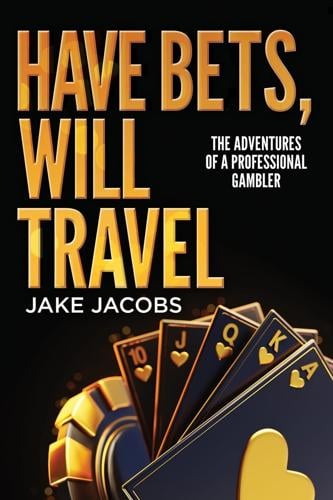
- “Have Bets, Will Travel: The Adventures of a Professional Gambler” by Jake Jacobs. 456 pp. $19.99 paperback; $9.99 Kindle.
When Jake Jacobs was 6 years old, a psychologist gave him a test. She read a series of numbers to him— probably four or five — and asked him to recite them back in order, and then in reverse. Easy peasy for little Jake. So she increased the numbers. Still easy peasy. She quit when he could recite nine in order and eight in reverse, but he figures he could have gone further. As an adult, remembering 10 digits was a piece of cake for Jacobs.
That made him a perfect card counter. And a challenge to casinos.

This expansive memoir covers one decade of Jake Jacobs’s four decades as a professional gambler. It began when he followed his brother from Chicago to Las Vegas in 1982 to join a blackjack team as a card counter.
People are also reading…
Being caught in a play and getting barred from a casino are clear occupational hazards, so this period took Jacobs from Las Vegas to Reno, Atlantic City, Korea, Japan and Thailand. His exploits and those of folks he knew are interesting. They include rubber-banded wads and bags of cash, phenomenal wins and losses, various girlfriends, and one innovative massage parlor experience.
In addition to being a natural storyteller, Jacobs is a natural teacher. Admittedly, this mathematically challenged reviewer couldn’t follow all the rules, strategies, mathematics and statistics of games, but Jacobs offers them up to those who can.
And Jacobs’s ability to recall story details? Right up there with remembering numbers.
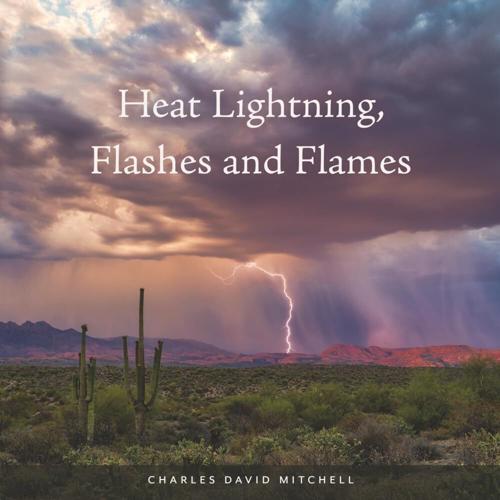
- “Heat Lightning, Flashes and Flames” by Charles David Mitchell (CDM Press). 132 pp. $11 paperback; $9.99 Kindle.
There’s seemingly no separating the personal from the fictional, the politics from the art in this raw, principled work by “Chicago-escapee,” Tucsonan Charles David Mitchell.
It consists of a novella (“Heat Lightning”), poems (“Flashes”) and stories (“Flames”), which reflect on one another.
Like Mitchell himself, the narrator in the novella “Heat Lightning” works with the intellectually disabled, the addicted, and the incarcerated. We follow him as he arrives in Tucson, settles in Five Points, deals drugs as he searches for work, and finally lands a job overseeing a group of learning-disabled men on a landscaping crew.

The action in the novella is replete with opinions … probably Mitchell’s as well. Right off the bat, the narrator takes some swings at academic poets’ responses to his work: “Erudite English Ph.Ds … proclaim my declarations cliché, spiritual hokum … eco-crap pornography, far from real poetry.” He advises those academics to “check the political, experience the real/unreal,” and free themselves from “technically perfect poems.”
Other objects earn the narrator’s disdain: the entitled wealthy, “American Settler Colonizer Capitalism” still taking advantage of The People, human-caused environmental degradation, racism, “The Malevolent Wretched Orange Man,” heartless deportation.
We see similar concerns in the short stories in “Flames,” but they’re most powerfully expressed in the raw, real poems of “Flashes.”
Compassion for society’s damaged shows up in “Veteran’s Boulevard.” (“His feet are phantoms of pain ….”)
Mitchell takes a poke at “The Colonizers” in a poem about a group of Navajos taking the Special Car (with less than a quarter tank of gas and the oil light on) into space to rescue the crew stranded in the Space Station:
After they have delivered “cases of evaporated milk, large tins of lard, cans of indeterminate meat./ They pick up the red pipe wrench they left behind last month./” The astronauts decline the volunteers’ standing offer of a ride home and refuse the offer of their dog for companionship.
"It’s a good dog,” the poet says, “and won’t run off.” You’ve gotta smile.
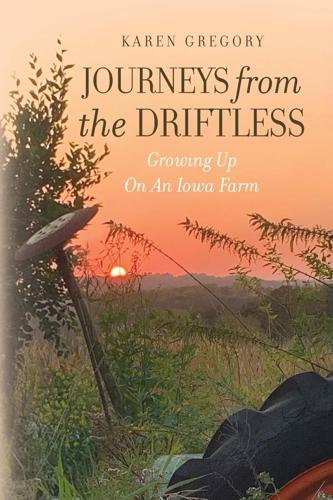
- “Journeys from the Driftless: Growing Up On An Iowa Farm” by Karen Gregory (Palmetto Publishing). 267 pp. $28.95; $9.99 Kindle.
This memoir by Tucson graphic design artist and writer Karen Gregory will appeal especially to those who can remember stretching out in the back window of their parents’ mid-century sedan and watching the telephone poles go by. Or have pictures of their little sun-burned selves squinting out from under cowboy hats.

The family farm Gregory grew up on consisted of nearly 500 acres in “the Driftless,” in northeast Iowa. Not your stereotypical cornfield Iowa, the Driftless contains bluffs, rivers and forests. Gregory’s childhood experiences reflect the challenges of farm life, but also the beauty and freedoms it afforded.
Its brief chapters amount to reflections upon or individual memories of that life in the 50’s, 60’s and 70’s: being the country girl in the city schools, the 24/7 nature of farming, in which she and her three siblings were expected to participate; larger-family holiday traditions that sound almost 19th century; learning the realities of slaughter as part of raising cattle and hogs; but also the headiness of unchaperoned play— climbing and leaping from barn heights, the 14-year-old driving the car to town to collect a forbidden puppy; a tragic farm accident.
With nearly 40 pages of family photos supporting her tales, Karen Gregory presents a clear, warmly nostalgic glimpse of her life as an Iowa farm girl.
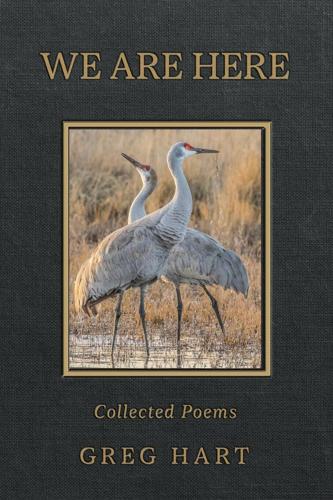
- “We Are Here: Collected Poems” by Greg Hart (Milagro Corn Company). 148 pp. $24.95 hardcover; $19.95 paperback; $9.99 Kindle.
Loss, love, the transience of life, and restorative qualities of nature feature in this poignantly lyrical collection by educator and poet Greg Hart.
Forty poems supplemented by a half-dozen prose reflections, the work opens and sets the tone with a prose piece. “Leo of St. David” begins with this exchange between the poet and his wife, Vicki:
“Have you seen my husband lately?” she asks.
“Yes, I have. I am your husband.”
She laughed a little and said, “I must be losing my mind.”
“And,” he writes, “of course, she is.”
The couple had gone the previous weekend to Whitewater Draw to see the sandhill cranes. Hart calls the world’s “dwindling number of mass migrations” — "a sad reminder of what we have lost and are losing,” but finds solace in the cranes’ “… jubilant, insistent/ cries, we are here, we are here, ….just like the 10.000 generations/ before came and came./We are here.”
Vicki Hart died in January 2025, and many of the poems in “We Are Here” are the expressions of a grieving husband. “I lost the love of my life,” he writes. “I’m still learning what it means to love with all your heart.”

He shares that with us through recalled dreams, through the experiences of feeling her presence at sunset, in first summer rains; in the sense that they will see one another again.
Hart expands his observations and includes us in them as well. Life is short. We, like all other living things, are part of a line of ancestors, to become ancestors.
There’s a transcendent spiritual quality in the poems. “I think there is something in us,/ that is not us,/ that is the best of us, ” he writes. He finds consolation in being part and parcel of a kind of universal nature.
Hart is not so bereft or philosophical, however, that he can’t land a political jab. In “American Beast,” calling out William Butler Yeats, he admonishes, “…enter the raging gyre, fight your way through.”
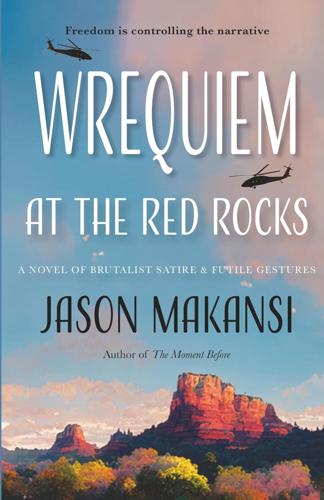
- “Wrequiem at the Red Rocks : A Novel of Brutalist Satire and Futile Gestures” by Jason Makansi (Layla Dog Press). 395 pp. $18.95 paperback; $4.99 Kindle.

So if you’ve ever sat in a seminar and watched an arrogant grad student spin words out of straw, or witnessed a locally born professor effect a posh English accent and humiliate a school teacher, or rolled your eyes at the latest cultural sensitivity — plus could use a laugh — this is the book for you.
This “brutalist satire” by Tucson fiction and technological writer Jason Makansi pulls few punches when it comes to cultural, educational, social, economic, philosophical, sexual, or linguistic issues.
He brings them all together in an academic colloquium setting — the “Neo-Anthropocentric Models of Retrospective Freedoms” — in Sedona.
From opening presenters Gail — ex-director of the Cold War Missile Museum — who shows up with a gun on her hip; Azul — the wealthy Nigerian representative of the HOMI-G (History of Musical Instruments Gallery), who plays in a band called SAMBO; and Ashera — director of the Tomahawk Hill Preservation Society, whose service animal is a gecko; to wealthy project supporters Rag, who hosts an annual boys’ week out and believes Brahmins should rule the world; and the press-averse Bolt-Mart heir Conrad, almost no one’s ox is spared goring.
Did I mention the situation of the disappointing dildo, or central character Bradley’s Compulsive Masturbation Disorder?
Much of the action in the novel occurs in the colloquium’s heated disputes, sidebars, and shouted complaints (“pronouns!” “old white male” “Humans are an invasive species!”). Thematically central to discussion — and to the novel — are questions of freedom, power and social standing.
But the real strength of the work is Makansi’s wit, which he wields like an academic jargon-buster: There are the positions attendees hold: the Rudolf Guiliani Chair, for example. The books some of them wrote: the “richly illustrated” Dismantling the Patriarchy: Penis by Penis; “Predestination: How the Lack of Free Will Makes the World a Better Place.”
And the jargon itself: With references to “spatial opacity of barriers, olfactory circumstances,” one speaker drones on with “ micro-normalities and abnormalities, dynamic constellations, sanctioned vs. squatter micro-performance spaces….”
That lexicon meaningless enough for you? Pick up “Wrequiem.”
The top stories from Sunday's Home+Life section in the Arizona Daily Star.
Former high school and college English instructor Christine Wald-Hopkins is an essayist and longtime regional and local book critic.
If you are a Southern Arizona author and would like your book to be considered for this column, send a copy to: Elaine Encinas, P.O. Box 26887, Tucson, AZ, 85726-6887. Give the price and contact name. Books must have been published within a year. Authors may submit no more than one book per calendar year.