
NOGALES, Sonora — Although for residents it may sometimes seem as if the city is in a state of emergency every other week during monsoon season, this week’s storms were a thousand-year-level event, a researcher says.
U.S. Geological Survey gauges, which ranged from more than 2 inches to nearly 4.5 inches in some areas Wednesday, showed that the rains were between a 50-year, 24-hour storm and a 1,000-year, 48-hour storm event, said Laura Norman, a research physical scientist with the agency.
The Santa Cruz County Flood Control District said one of their rain gauges in Nogales, Sonora, located between the Nogales Wash and Ephraim Canyon Wash watersheds, registered 7.99 inches of rain in 48 hours.
By Thursday, much of the water had receded from the major roads — if not completely, at least they were passable again. But left behind was all the sediment and debris that had been swept downstream.
People are also reading…
Conjunto Jardín was one of the hardest-hit neighborhoods. The area is prone to flooding because water from a retention basin known in Nogales as el Represo naturally flows through one of its streets. City officials reported Thursday that el Represo was over capacity.
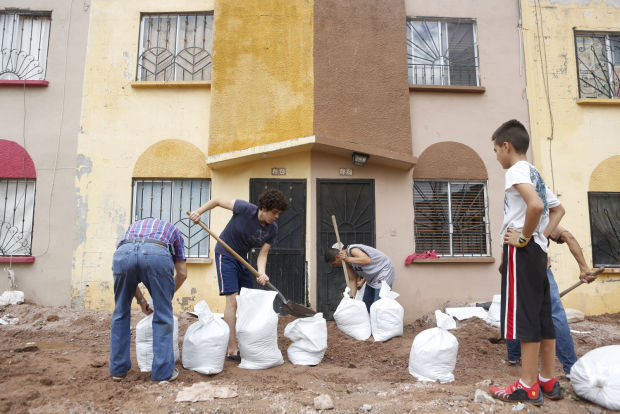
Residents filled bags with sand left behind by the storm to prepare for what was coming later in the day. Others hauled buckets of muddy water and shoveled out sand from their homes.
School was canceled, but for many children there was no fun and games from the day off. They joined their families cleaning and packing sandbags.
Veronica Zepeda, 29, said the rain didn’t start seeping under her home’s door until about 9 or 10 p.m. Wednesday. But once it got in, the flow didn’t stop until about 5 a.m. Thursday. When a nearby concrete wall designed to hold back some of the water flowing from el Represo collapsed, the water rushed inside.
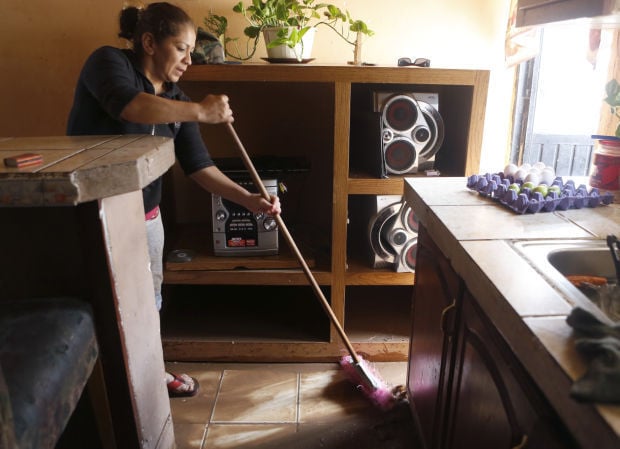
Zepeda and her son worked to push muddy water outside.
They had spent all morning scooping out the dirt that now covered their doorway — which was only accessible by using a makeshift path of sandbags that led to their house.
“I really hope the government can help us,” she said. “This happens every year.” When she bought her home 14 years ago she had no idea it had such severe flooding problems.
The city called in large loaders to remove the more than 12-inches of sediment that covered one paved street.
Flooding is nothing new in Nogales. Every time it rains, even a little, certain ares are going to flood.
The city was established in the low-lying reaches of the Arroyo Los Nogales and its tributaries have developed into streets, Norman said.
Then there’s the rapid growth of the city. Residents have created colonias, generally small, informal and unstructured settlements that have expanded rapidly. They are not built in the floodplains, Norman said, but are often perched on the steep hillsides, which contribute to erosion-hazards when surface runoff is high.
Vicente Sanz, head of the civil protection unit in Nogales, said engineers were building a type of diversion Thursday so the water won’t come through the middle of the Conjunto Jardín neighborhood when it rains again.
“We would rather have the street fall apart than to have water keep flowing through there,” he said.
The city already has rock retaining walls to mitigate hazards.
But more needs to be done, said Norman. Their research has shown that more urban growth in impervious areas will potentially increase runoff.