As much fun as it can be to mix baking soda and vinegar and watch a mini-volcano erupt, it's a science-fair project without much real-world value.
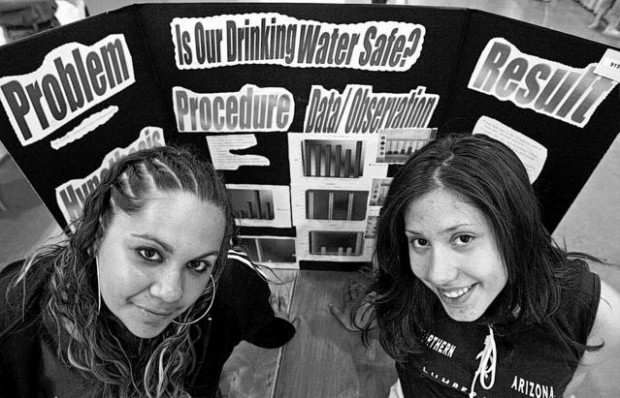
Two girls found a project for this year's Southern Arizona Regional Science and Engineering Fair that could make a difference at their school.
Raquel Garcia and Gladyz Villalobos, 16-year-old sophomores at the Arizona State Schools for the Deaf and the Blind, tested the water in the drinking fountains at their school — and found one was positive for coliform bacteria.
The Environmental Protection Agency's Web site notes that the bacteria "are common in the environment and are generally not harmful. However, the presence of these bacteria in drinking water is usually a result of a problem with the treatment system or the pipes which distribute water, and indicates that the water may be contaminated with germs that can cause disease."
People are also reading…
Villalobos, who is deaf, used American Sign Language to explain why she and Garcia chose to do the project. The teens' science teacher, Suzanne Smith, translated.
Villalobos signed that all of the water comes from the city through Tucson Water, but the pipes and filters are different in all six of the fountains they tested. Each fountain is in a different building at school.
"We wanted to see if it's safe to drink, see if it's healthy," Garcia signed. "If kids get sick, is it from the water?"
After collecting the samples, they tested the water for iron, chlorine, copper, pH levels and the presence of coliform bacteria using a kit Smith ordered from a scientific catalog.
The girls signed that they plan to show the results to their principal and suggest the school change to bottled water.
Garcia and Villalobos both won awards for their individual projects in last year's regional science fair.
"It helps them understand how science works and do the investigation and the process," Smith said while signing. "That's what science is — it includes reading, writing and art. I think it's great to be able to present and defend their projects."
Garcia said through Smith that she thinks the fair will help prepare them for college. She wants to attend Gallaudet University, a college for deaf and hard-of-hearing students, and pursue her study of diseases and cells to become a nurse.
Villalobos said through Smith that she wants to go to the Rochester Institute of Technology to study psychology.
If You Go
What: The Southern Arizona Regional Science and Engineering Fair
When: Open to the public 9 a.m.-8 p.m. Wednesday-Friday
Where: Tucson Convention Center, 260 S. Church Ave. Projects are on display in Exhibit Halls A and B.
Admission: Free
For more information, go to www.sarsef.org.