

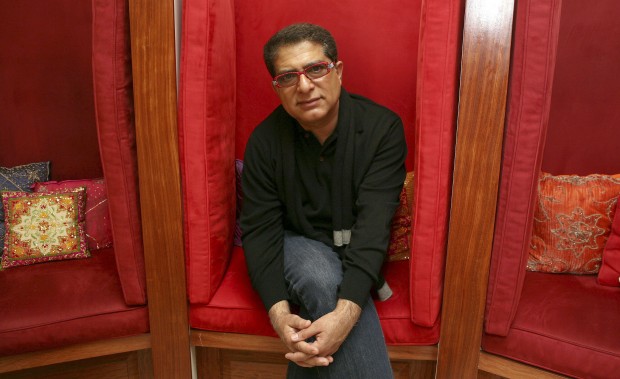
Dr. Deepak Chopra was clearly miffed, if not a little angry, though it might be stretching it to attribute that strong an emotion to a man known worldwide for his practiced equanimity.
Chopra is clearly all right with himself, as he has demonstrated in 64 books, countless appearances and the occasional television shows about the connection between body, mind, spirit and healing.
On Tuesday, he was not all right with Susan Blackmore, a writer who described herself as a reformed parapsychologist.
Blackmore had been given the role of skeptic at a "War of the Worldviews" session that opened the "Toward a Science of Consciousness" conference at Tucson's Ventana Canyon Resort.
Blackmore's slide show contained a series of critical comments about Chopra's books, including one that called him to task for preaching that the path to enlightenment can be strewn with abundance. "Deepak, you may be happy to call this spirituality, but I don't," Blackmore said.
People are also reading…
"Spiritual people should not be ashamed of being wealthy," Chopra said when it came time for his rebuttal.
"I am very wealthy, and I put that money to good use," Chopra said, noting that his foundation "feeds 1.5 million each day and sends them to school."
Perhaps Chopra was asking for it. He had pretty much dismissed the work of many of the folks in the room by telling them their attempts to scientifically measure or philosophically express the concept of consciousness were futile. Some snippets:
"Consciousness cannot be observed or measured."
"There is no scientifically testable theory of consciousness."
He was even bolstered by the so-called other side - Cal Tech physicist Leonard Mlodinow, co-author with Chopra of a book called "War of the Worldviews: Science vs. Spirituality."
Mlodinow stood up for the scientific method, and said it had little to say about the subject at hand. "Scientists are not embarrassed at not having a theory of consciousness," he said.
He told a questioner later that scientists stay away from consciousness studies because they have a hard time disproving things they can't measure or test. "Nobody really knows anything yet, and let's just accept that," Mlodinow said.
Case closed. Cancel the remaining three days. Everybody go home.
But of course they were back the next day to continue with the roster of 150 speakers and 200 poster presenters, not to mention the yoga and meditation classes, poetry slams and "Zombie Blues" jams.
Consciousness is a hot topic in the public mind and on the fringes of academia. The conference was filled with psychologists, philosophers, quantum physicists and more than a few of the doctors who make their living rendering people unconscious - the anesthesiologists.
Some, like University of Michigan researcher Dr. George Mashour, kept their presentations strictly mainstream.
On Wednesday, Mashour presented peer-reviewed research, funded in part by the National Institutes of Health, that is trying to uncover the reasons why a small percentage of people who undergo surgery have memory of their operations afterward.
He fended off questions about the philosophical meaning of what he had found.
He has always been interested in "consciousness" as a philosophical concept, he said afterward, but his research is directed toward clinical results, not metaphysical revelations.
Anesthesiologist Dr. Stuart Hameroff, on the other hand, said he has done research with clinical application in the past, but "what really interests me is understanding consciousness."
Hameroff, who is also a professor of psychology, is director of the University of Arizona's Center for Consciousness Studies, which hosted the first consciousness conference here in 1994 and is now hosting its 10th one.
According to the official UA press release on the conference this year: "It was a quirky worldwide success from the start."
The scientists who attend are used to the "quirky" label.
Physicist Karla Galdamez, who presented a poster on how observers can alter the outcome of a "split-beam" light experiment, said most scientists are "afraid to look within" for answers to natural phenomena.
Formerly with the physics department at the University of California-Berkeley, Galdamez said she has found a more comfortable fit at the Institute for Noetic Sciences in Petaluma, Calif., which does research into consciousness that isn't "bound to the study of the external."
"If we really want to understand nature and natural phenomena, we need to look internally," she said.
Contact reporter Tom Beal at tbeal@azstarnet.com or 573-4158.


