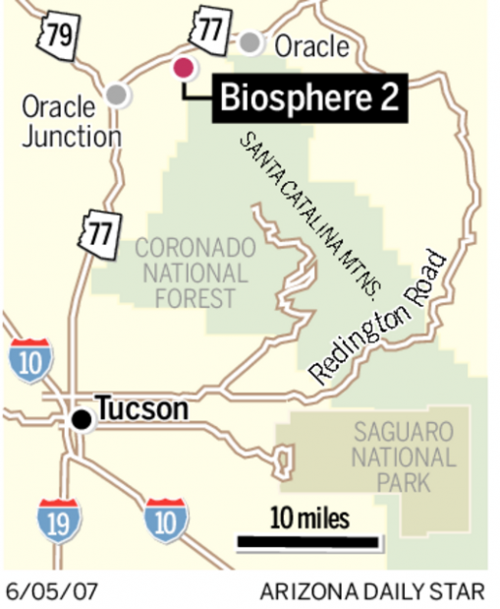
Twenty years after Biosphere 2 broke ground near Oracle, the one-of-a-kind terrarium and its surrounding land have been sold for $50 million.
Development of 1,500 new homes and a resort hotel on the land has already been approved.
Announced Monday, the sale price is just a quarter of the $200 million construction cost of the 3.15-acre miniworld, which drew global attention in 1991 when eight people were sealed inside to conduct a two-year experiment in self-sufficiency.
The 1,658-acre sale was announced by Jerry A. Hawkins, vice president of CB Richard Ellis Tucson, who negotiated on behalf of purchaser CDO Ranching & Development, L.P. The company's partners include Tucson developer Peter G. Backus and Martin C. Bowen, who was vice president of Biosphere seller Decisions Investment Corp.
The property was formally put up for sale in early 2005 and last year was under contract by local developer Fairfield Homes, but that deal was called off by mutual agreement.
People are also reading…
Along the way, the University of Arizona began eyeing the facility as a laboratory for large-scale climate experiments, and last year the university was negotiating to acquire the Biosphere 2 as part of the sale. The UA is still negotiating, now with hopes of leasing the terrarium, said Joaquin Ruiz, dean of the College of Science.
The CDO Ranch development has already been approved for more than 1,500 homes, a resort hotel and commercial uses, with lot availability projected for mid-2009, Hawkins said.
Pinal County Supervisor Lionel Ruiz, whose district includes the Biosphere 2 land, said the development will be good for the area but must be approached cautiously and be well-planned.
"I don't want to see just a whole bunch of rooftops from Tucson all the way to Oracle," he said. "We want to see sustained communities and some open spaces and wildlife corridors. Like anything else, if they come in with proper plans, it'll make it a plus."
Ruiz said the development could be an economic boon to the southern part of Pinal County, which has a shortage of medical care available and a struggling economic base dependent on mining.
"What I see it bringing to the county is services and jobs," he said. "It's going to be very unique, and it's going to be a plus for the area, especially if it's going to be a destination."
He also supports the UA taking over the Biosphere 2 and maintaining it as a laboratory.
The terrarium's future is also on the mind of Texas billionaire Ed Bass, co-founder and now-former owner of Biosphere 2, whose only comment Monday came in a short statement relayed from his spokeswoman Terrell Lamb.
"I am hopeful that CDO will have success in attracting significant institutional participation in Biosphere 2 for research and educational purposes," Bass said.
The announcement of the purchase said the "Biosphere 2 facility will continue to remain open to visitors for tours," and said there will be continued educational and research uses, but made no mention of specific research or any potential leases of the facility.
Attempts to reach Backus and Bowen were unsuccessful late Monday and when reached at home after business hours, Hawkins declined to comment further.
The original Biosphere 2 experiment was widely criticized after a crew member was sent for medical attention 13 days after being sealed in and later air was pumped into the facility. Columbia University began managing Biosphere 2 as a research laboratory in 1996 but ended its involvement in 2003.