
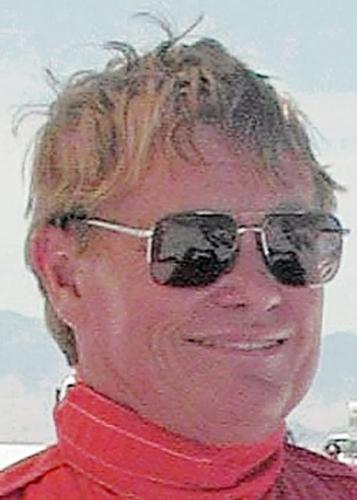
When M. Bonner Denton popped the parachute and felt his body weight, doubled by deceleration, thrown against the seatbelt, he knew he was going fast.
But the University of Arizona professor did not know just how fast until two people from the racetrack came running up to his car saying, "Bonner, you're going to like this," smiling as they handed him a slip of paper.
Denton, who teaches chemistry and geosciences, broke a land speed record last month in the "AA" modified sports car class, when he was clocked at more than 300 mph at the Bonneville Salt Flats Speedway in Utah.
"My biggest recollection during the race was seeing the 5-mile marker, and thinking, 'That couldn't be it already,' " said Denton, who passed that distance in roughly 90 seconds.
Official speeds at Bonneville are calculated by averaging the velocity of two passes. The fastest of Denton's three passes were clocked at 305.726 and 292.241 mph, putting the new record at 298.983 mph.
People are also reading…
Denton was racing against 60 years of accumulated records at Bonneville, but the record he beat on Aug. 20 was actually his own, set in 2002, in the same car. That record was 254.138 mph.
"Pumping the record up that much, that's really significant," said JoAnn Carlson, spokeswoman for Bonneville Nationals, Inc. and the Southern California Timing Association. "He blew the old record away."
The car, "Bonner's Bad Berkeley," is a highly modified 1957 Berkeley, a British sports car that runs on gasoline. Denton began rebuilding the front of the car in 1991, in Tucson.
The car now includes a 540-cubic-inch Chevy engine, but the car remains classic from the dashboard to the rear.
Denton said he began to dream of racing at Bonneville when he was 14. He couldn't afford a car, so he built one of his own.
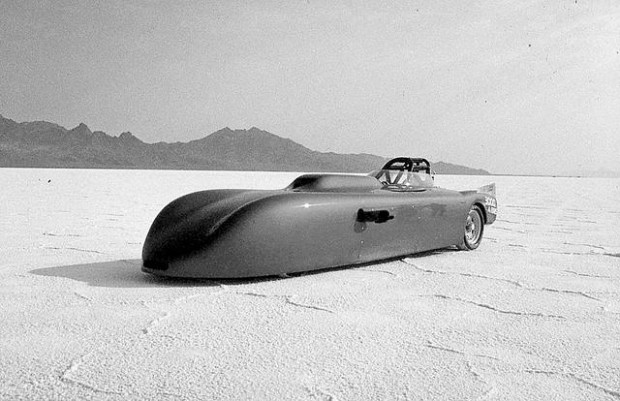
His inspiration back then was a picture of the world's fastest car at the time, a streamliner, shaped like a rocket. That photo was taken at the same salty white plains where he set his own records.
"The people who announced the speeds were pretty amazed," said Denton, as he proudly showed off his 200 Club trophy from Bonneville.
"They were yelling and shouting for me in the pits after the race. No one's ever done that in a sports car before."
Racers become members of the 200 Club when they break a record at speeds of 200-299 mph. Even though he was clocked at more than 300 mph, because his average score was slower, he's not a 300 Club member. Yet.
"We're going to tear apart the engine and start rebuilding again for next year," he said. "I want to be in the 300 Club."
When he's not racing, the professor is working on campus to develop technology to sense explosive chemicals. But Denton considers himself a scientist, whether he's in the garage or the lab.
"To be successful in life and whatever goals you set for yourself, in these modern times you need science and technology on your side."
What is Bonneville?
Bonneville is a 30,000-acre salt flat near the Utah-Nevada border, used as a raceway for motor sports.
Once a year, motor enthusiasts from around the world gather for Bonneville Speed Week, to "shoot the salt" and challenge world records. UA professor M. Bonner Denton raced during the week, which was founded in 1948 by Bonneville Nationals Inc. and the Southern California Timing Association.
"Bonneville is special because it's really the last venue for international drivers to come and race," Denton said. "There's not really any prize money, but you don't need to work under the guidelines of NASCAR or drag racing.
"It's a friendly atmosphere," he said. "We visit and talk cars in the pits. We help each other out, too, giving or lending out parts."
To learn more about Bonneville Speedway, go to: www.scta-bni.org