
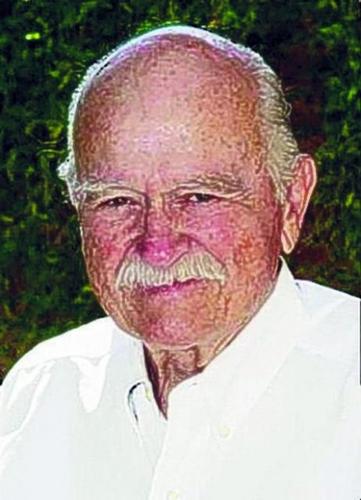
W. Kirby Lockard was a rock star in the realm of architecture.
Students worldwide came to Tucson to take drawing classes from the influential University of Arizona professor.
"He has disciples all over the world," said architect Frank Slingerland, who was a student of Lockard's in the late 1980s. "Everybody knew him; not just in Arizona, not just the United States, but throughout the world. His books are used as textbooks in schools."
During his more than 40 years at the UA, Lockard taught thousands of students. They will carry on Lockard's legacy of design communication now, his family and colleagues said.
Lockard died Monday in hospice care. He was 77 and had battled cancer.
Upon graduating from the University of Illinois, Lockard moved to Tucson in the mid-1950s to work for an architectural firm. After a few years, he moved back East to earn a master's degree from the Massachusetts Institute of Technology.
People are also reading…
When he returned to Tucson, he began teaching at the UA's fledgling College of Architecture and Landscape Architecture while designing buildings on the side.
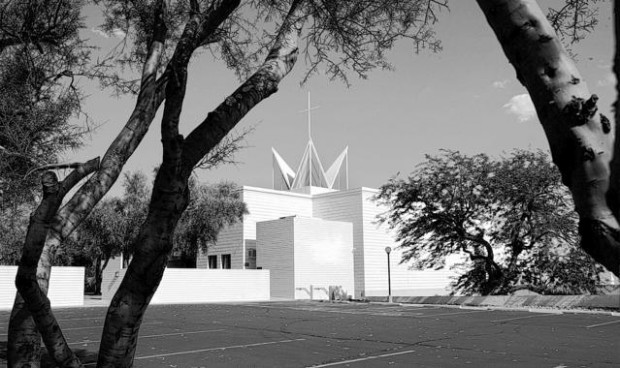
His best-known structure in Tucson is the Dove of Peace Lutheran Church on West Roller Coaster Road, built in the early 1960s. He won a regional American Association of Architects award for what was then considered a futuristic design.
"He was a dedicated modernist and I think his work was extremely well-conceived and very thoughtfully conceived," said architect Jim Gresham, who knew Lockard for 51 years. "His use of materials was very honest and very simple; I think of very lasting value.
"I used to kid him that he loved symmetry. That was kind of an architects' joke. The Dove of Peace Lutheran Church is very symmetrical. The odd thing is, most modernists don't design in a symmetrical way. They design in an asymmetrical way. Kirby had this wonderful feeling for symmetry and it permeated his work to a large extent," Gresham said. "He had sort of a light-handed touch to all his work, which I think is reflective of his personality."
Lockard, said UA professor and architect Bill Stamm, "is the whole reason I came to teach at the UA."
Stamm was teaching at a Minnesota university when he met Lockard in the late 1960s and Lockard gave him a draft of his first book, "Drawing as a Means to Architecture."
"We used that thing until it fell apart," Stamm said.
A few years later, Stamm was offered a job at the UA. When he learned Lockard was there, he immediately accepted the job.
"He was seriously one of the major, major guys — if not the major guy — in the teaching of architectural drawing; certainly in America, if not in the whole world," Stamm said. "He really was a famous, famous guy and you would never know it. The guy was the most humble guy you've ever met. It was one of the luckiest things that ever happened to me to be able to teach with him."
Fortunate, too, for students.
Architect Kim Fernandez transferred from Arizona State University to the UA after taking a summer class in the late 1980s that was taught by Lockard and emphasized design communication.
"He was instrumental to get me to decide to attend the UA," she said. "As an architect, the way you draw, the way you communicate the ideas in your head to your clients, to your staff members, to yourself as you are trying to work out the design, all of that is design communication and he was a master at that.
"You can have the greatest ideas, but if you can't communicate them, they will never become reality."
Teaching future architects to draw seems obvious, but it's not as common as it should be, said one of Lockard's three children, Scott, who also is an architect.
"If you're just drawing lines and don't really know what it's going to look like when it's done, that's not good," he said. "You're more effective as a designer if you can draw it with perspective in mind. As much as that seems that would be a normal architectural skill, you don't find that very often. They don't have the training to design in three dimensions."
A professor with Lockard's global reputation typically would teach upper-division classes and graduate students, Slingerland said, but Lockard taught freshmen to draw; students who weren't even admitted to the professional phase of the architecture program.
In his teaching, Stamm still uses a series of educational videos Lockard made to teach architectural drawing.
"He had an amazing ability to communicate ideas," said College of Architecture Dean Chuck Albanese, who knew Lockard 40 years. "What he was so capable of was having students rise far above their ability and understanding and learn aspects of architecture basically through the act of creating it."
Lockard's own architectural drawings from trips the faculty members took to Europe are so artistic that Albanese is working with Lockard's wife of 34 years, Peggy, and his son to compile a book of his drawings.
He said his college will host a September event to celebrate Lockard's achievements.
"When they finally have a tribute here for him, I think former students from every corner of the world will show up," Stamm said. "He had such a profound effect on so many students from around the world. People from all over the country are indebted to him."
More Life Stories
Kim Matas' series chronicles the lives of recently deceased Tucsonans.
Kim Matas' blog
'Last Writes' is the sometimes serious, sometimes irreverent extension of the Life Stories series.