These are some of the things Androuw Carrasco learned at the University of Arizona:
Less privilege doesn't mean less potential.
Sometimes caring is more about listening than fixing.
And sometimes you don't find your passion - it finds you.
The 21-year-old with a drive to become a pediatrician graduated with honors in physiology Saturday after sometimes working three part-time jobs at once; sometimes supporting his single mom; and all the while doing research, volunteering, training for cycling events and making the dean's list.
Carrasco was one of six Centennial Award winners among the 3,882 winter graduates. The UA honors students "who have demonstrated integrity, overcome enormous challenges to achieve a college education and made a contribution to self, community and family."
People are also reading…
An accident led Carrasco to an interest in medicine.
His junior year at Catalina Magnet High School, an injury caused him to spend two months in the hospital.
"I was this football jock, and the next minute I was in the ER and doctors were arguing over whether to amputate my leg and my mom was crying," he said. Doctors at Tucson Medical Center saved his leg but couldn't explain the injury.
That bewildering time opened his eyes to medicine, he said.
"It kind of made me put my life in perspective and made me realize that I was given this opportunity to experience this," Carrasco said.
As a college freshman, Carrasco was holding down three part-time jobs: a research assistant in the surgery department, a patient sitter at University Medical Center and a caregiver to a paraplegic man.
Carrasco said he went into the caregiver job naively thinking he was able to relate to people with much more permanent injuries than he had experienced.
"I had the false expectation that medicine was about fixing, but I learned sometimes it's not at all," he said.
He learned to listen intently, to use humor appropriately and to care for someone like a member of your own family, he said.
Carrasco's family was headed by his single mom.
His dad, who knew a few French words, had given Carrasco the fancy spelling of his first name because he thought it sounded authoritative. But his dad left the family.
His mother, an immigrant from Mexico, worked odd jobs as a hair stylist or office manager before she became a real estate agent.
Growing up, "He challenged everything, that boy," said Michelle Carrasco.
When Carrasco was in college, she made quiet sacrifices to help him with a couple of hundred dollars here and there, he said, so he tried to ease her burden by working.
Then the market nose-dived.
He used savings from his jobs to make several mortgage payments, but his mother's house was foreclosed. While she became homeless, he felt privileged to be living in the dorms, working as a resident assistant.
He paid for her to fly to distant family, whom he thought could help, but found more problems. She settled in Phoenix, living in a shelter.
Carrasco visited her there and offered support, but he realized that "all she really ever wanted was love and to know that someone cares."
He acted out mock job interviews with her, contacted community leaders he knew and trusted her when she decided to get a job as a truck driver.
"We help each other. We definitely support each other a lot. I wouldn't know what to do without Androuw," his mother said. "He's just very courageous. He has a great heart."
Carrasco plans to become a pediatrician.
He's deciding whether to enter medical school or the Peace Corps, which might offer him a different perspective once he enters medical training, he said.
His undergraduate work at the UA College of Medicine started with washing petri dishes.
He worked his way up and studied with surgery professor Marlys Witte.
"She was known for wearing these necklaces in the shape of a question mark," he said.
He adopted her philosophy of asking questions instead of assuming.
Witte said Carrasco was "very imaginative and creative" and "intensely curious about science."
"He showed enthusiasm, interest and skill," she said.
He researched cerebral sinus fluid with her, and then researched albinism with genetics professor Murray Brilliant.
"My research experiences overall were just amazing because I was able to challenge myself to dig deeper in a subject," Carrasco said.
His interest shifted from biomedical research to a new interest in education and health-care disparities, in part because of his own family experiences.
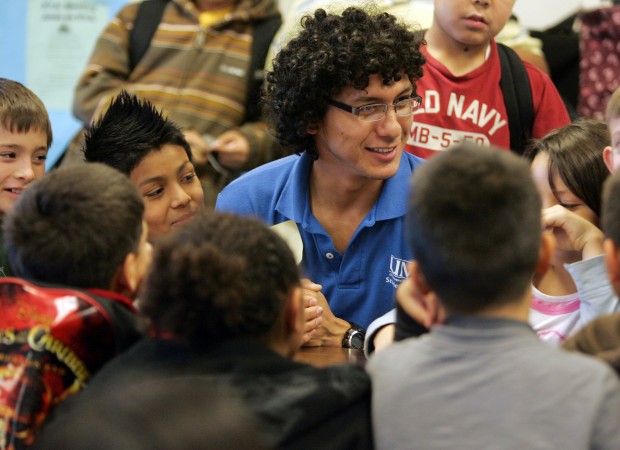
Those experiences - and seeing how his mother persisted despite the many challenges she faced - were the inspiration for his senior honors thesis, a family health-education program he developed and implemented at Roskruge Bilingual Elementary School. The program teaches heart health to kids and single moms, a group Carrasco especially wants to serve.
Single parents have additional challenges in raising a family effectively, and the support they receive is minimal, Carrasco said.
"They're a disadvantaged group, and they're underserved," he said. "I think I saw that in my own mom."
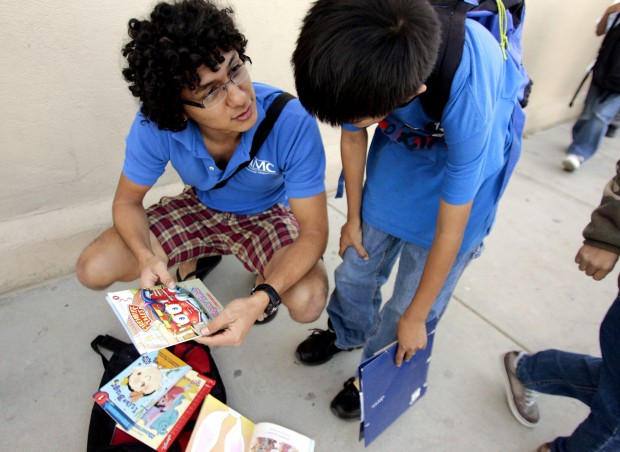
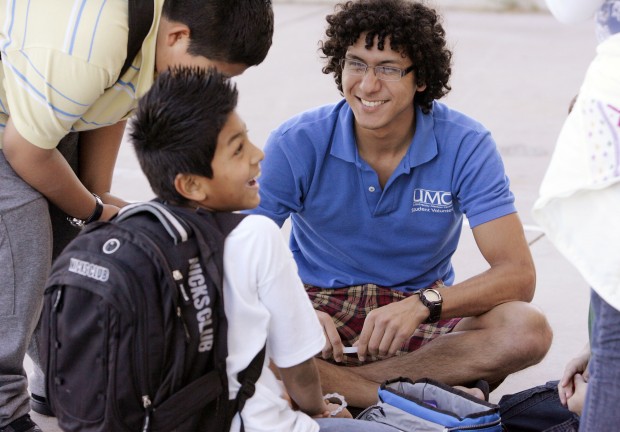
After school, Carrasco reads with the kids in the school library as a Reading Seed volunteer, tying health to fun and education. He engages them with questions and really listens to their answers, and they love his wacky activities that help them use their imagination.
"I think the most important thing I've taken away from that experience is how crucial the simple exercise of compassion is," Carrasco said. "The simple will to care and to show up matters to them so much."
Contact reporter Becky Pallack at bpallack@azstarnet.com or 807-8012.