When Mason Kumet, a staff photographer for the Daily Wildcat student newspaper at the University of Arizona, was teargassed, his first reaction was to run for fresh air. His second, he said, was to try to keep using his camera as he covered the police actions at a pro-Palestinian protest encampment.
“I was coughing so hard I was getting whiplash,” he recalls. “But I tried as hard as I could to keep documenting and taking photos.”
Kumet was one of the student journalists covering the two encampments at the UA broken up by police on May 1 and May 10. His experience wasn’t out of the ordinary. All over the country, as pro-Palestinian encampments have popped up on college campuses, student journalists have been at the forefront of the action, reporting and photographing the political protests against Israel’s actions in its war with Hamas in Gaza.
People are also reading…
At 19 years old, a rising sophomore with a double major in journalism and business at the university, Kumet said he knew it was a “matter of time” before students at the UA tried to organize an encampment after watching those at other universities including Columbia, the University of Southern California and Arizona State University.
“I really love sports photography, but I’ve covered protests a couple of times and it has a much more impactful feeling,” he said. “Photos of events like this really mean something to everyone that sees them.”
Others covering the events for the Daily Wildcat included Sam Parker, a rising senior and journalism major, who is the news editor for the student newspaper. She said her immediate response to the encampments was that “this was something I should bear witness to, as a journalist, and as a person.”
Although it was finals season, Parker remained committed to covering the encampments and law enforcement response.
“It was important to me to be there,” she said, “to cover it and be able to tell the story of what was happening on our campus within the national context.”
Parker said it can often be easier for student journalists to cover these issues because of how well they know their schools.
“I think we as student journalists know our campus and know our community in a more in-depth way than anyone else really does,” she said. “I think that allows us to tell a more insightful story.”
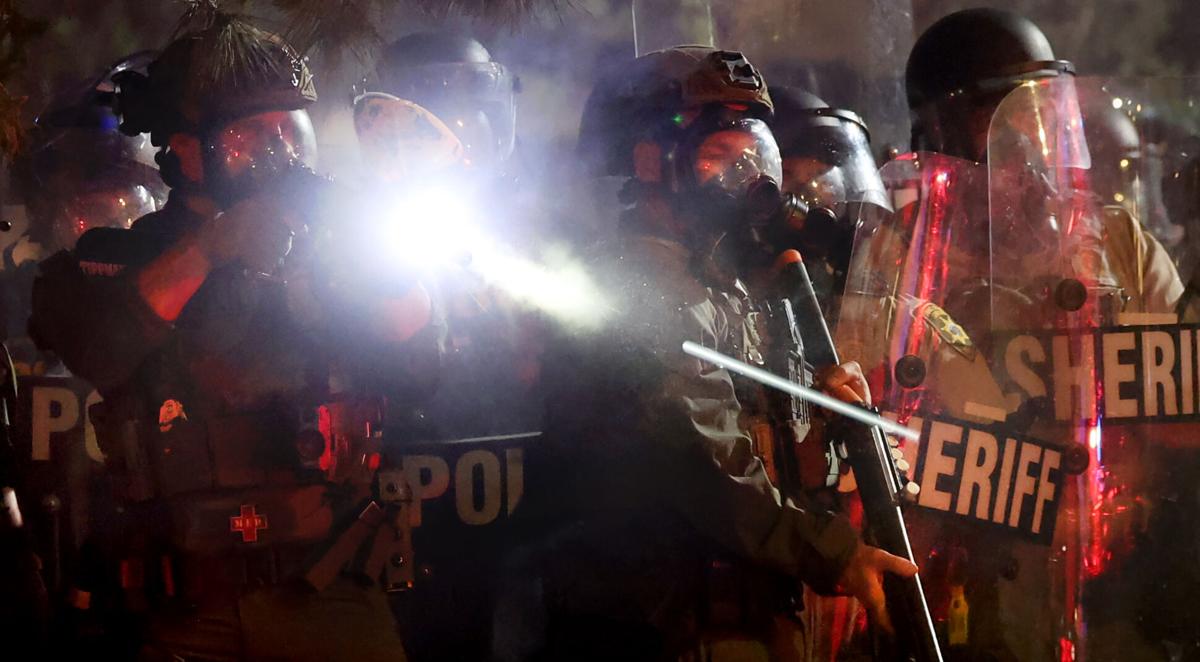
Like Kumet, Parker said she was affected by tear gas after police officers threw a canister in her direction while she was with other student reporters. She also said she was worried about possibly getting arrested during her coverage, which has happened to student journalists at Dartmouth College and the University of California at Los Angeles, for example.
“We were told by a member of the police force, ‘If you’re wearing media badges we don’t care and will arrest you if you’re not behind this line,’” she recalled. “I was like, ‘okay, that’s frightening.’”
A similar sentiment was shared by Kiara Adams, a rising senior and journalism major who has been on the Daily Wildcat staff and currently works as an intern for Arizona Luminaria, a nonprofit news outlet. Adams said she wasn’t covering the encampment for Arizona Luminaria and was there on her own accord as a student journalist.
She spent most of the evening live tweeting updates to her followers with photos, videos and vivid descriptions.
“I was a little nervous because I was trying to toe the line of ‘I need to get this covered,’ but also (protect) my safety,” Adams said. “It was weird to cover something while also making sure that I was safe.”
Adams said she would start to take a video of an altercation, and then, in fear of being shot with a rubber bullet or tear gassed, would have to retreat.
“It was kind of surreal to be in that moment,” she reflected. “A lot of it was in-the-moment decisions. I’ve never been in a setting like that.”
Like Parker, Adams said she knew people in the encampment, which made covering it “eerie” and stressful. All she had, she said, was her notepad and her cellphone.
At one point, as she was taking videos of law enforcement officers taking apart the abandoned encampment, one of them began shining a bright light in her face and cellphone camera to try to disturb the recording process. Despite that, she was able to capture plenty of videos of photos, which she shared on her social media accounts.
“This was my first time really doing mobile journalism,” she said. “I was really hoping to give a play-by-play for people who weren’t there, to sort of let them see what’s happening, what’s going on.”
Pro-Palestinian protestors at the University of Arizona retreat after arrests.
Reporter Ellie Wolfe covers higher education for the Arizona Daily Star and Tucson.com. Contact: ewolfe@tucson.com.

Ellie Wolfe
Education Reporter