Albert Olivas, a teacher at C.E. Rose K-8, almost never watches the news in the morning.
“I don’t like to turn on the TV in the morning because most of the time it’s bad,” he said. But on Sept. 11, 2001, “something, just something said turn it on” and “there were the towers,” he said.
“The plane had just hit, and they kept playing that over and over,” he said. “Even to this day, 25 years later, I can’t believe that’s what was happening.”
Olivas quickly got dressed, left for the same school he’s worked at for more than 30 years and gathered with the other teachers in the library, huddled around their small box TV as they watched the first tower fall. Then the bell rang, and he was off to teach his second-grade class.
“I was thinking, ‘How do I talk to my 7- and 8-year-olds about what has just happened?’” he said. He said he tried his best to answer questions and explain what was happening without scaring his students, hoping to relieve their fears while “still in disbelief.”
People are also reading…

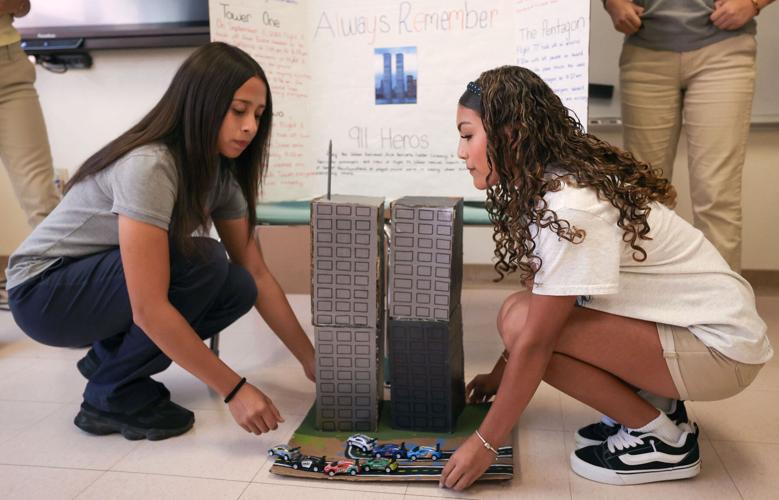
Jocelyn Castro, left, and Mar’elle Vences present their replica of the Twin Towers during a lesson on the Sept. 11 attacks at C.E. Rose PreK-8 School.
“After that, I’m not really sure what we did because I was still (in shock),” he said. “I was trying to explain it to the young kids because I preferred they hear it from me than to go home (to) something completely different.”
As more information came out about the attack, he said, new fears arose about where else an attack could take place.
“Because of Raytheon, could Tucson have been a target?” he remembers thinking. “It’s something we’re all like, ‘Oh, that could never happen to us.’ Guess what? It did.”
Today, about 30% of U.S. residents were born after 2001, according to U.S. Census Bureau data — meaning nearly a third of the country wasn’t alive to witness the attacks that killed nearly 3,000 people. That shift shows in Olivas’ classroom. It’s odd to him, now an eighth-grade teacher, that every year more students can’t answer a basic question: What happened on Sept. 11, 2001?
About seven years ago, he said, he asked his class that question, “and they just had a blank look on their faces … it opened my eyes that maybe a lot of times parents don’t talk to them.” He said many of his students’ parents were themselves young children on 9/11 and don’t remember much to pass along.

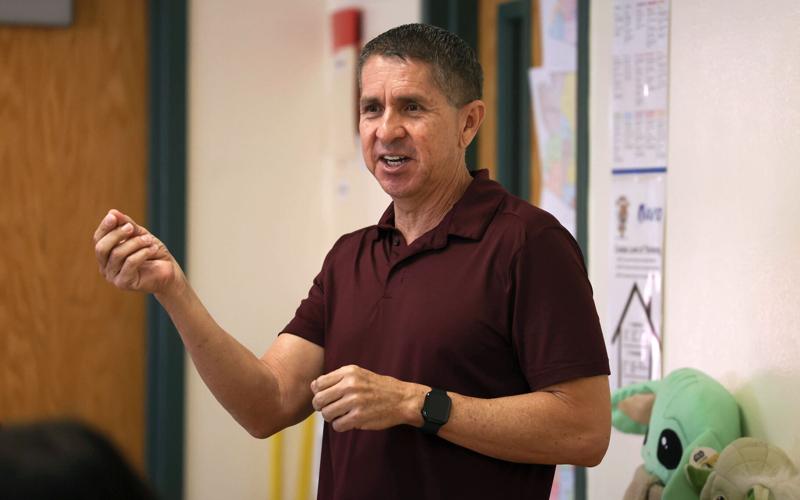
Albert Olivas teaches his eighth grade class at C.E. Rose PreK-8 School a lesson centered around the Sept. 11 attacks.
One of his second-grade students from 2001, for example, is the mother of one of his eighth-grade students this year.
Natalie Saylor, 32, said she still remembers "the sadness filling up the classroom” when Olivas explained what was happening to her class.

Saylor
“Mr. Olivas kind of explained to us like what the Twin Towers were, how important they were, and what was going on,” she said. “We had a teacher that was next door to the classroom that was from New York, and his family was there, so witnessing everything firsthand I remember Mr. Olivas telling us like to be kind to him.”
She said Olivas teaching her daughter about the event opened up conversations in her family about how the day changed her worldview.
“Seeing my daughter being educated on what happened and the lives that were taken and how important first responders are, she’s being educated on different perspectives and communities,” she said. “Their legacy lives on, but so does the burden that it holds on their family members … I think she got to see a bigger picture of how important those buildings were and the lives of the first responders.”
Saylor’s daughter, 13-year-old Amira Martinez, told the Star she didn’t know much about 9/11 before her school project, other than that planes crashed into the twin towers.
“This project really showed me all the other stuff that happened and how tragic it was,” she said. Olivas tasked his students with creating an informational project on as much of what happened on Sept. 11 as possible, he said.
Students built trifold poster boards with drawings and photos of the towers, the western facade of the Pentagon, and the empty Pennsylvania field where United Airlines Flight 93 crashed. Some added lights to represent the twin beams that shine at Ground Zero from dusk on Sept. 11 until dawn on Sept. 12, and another group built a 3D-printed model of one of the towers, complete with stairs representing the flights firefighters climbed and a plane.
“(Mr. Olivas) is pretty direct and really made sure that we knew what happened in 9/11instead of just writing it down,” Martinez said. “Just thinking about what the people went through during that just really got me sad.”

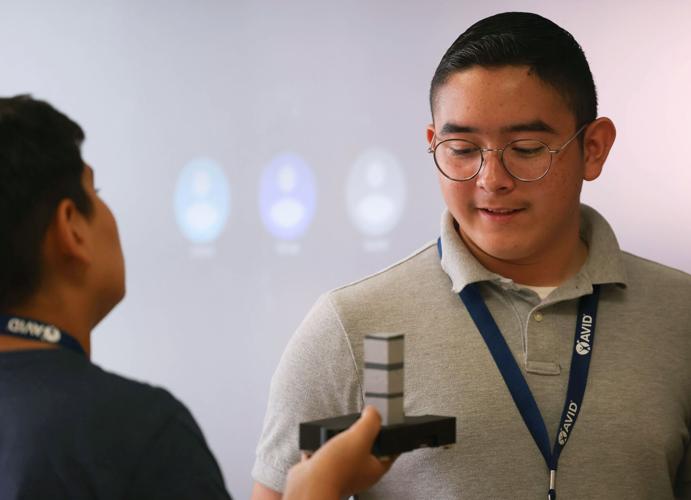
Levi Rodriguez looks at his group's 3D printed replica of the World Trade Center during a lesson on the Sept. 11 attacks at C.E. Rose PreK-8 School.
Levi Rodriguez, another of Olivas’ eighth-grade students, said he used YouTube tutorials to learn how to use his own 3D printer to build his model.
“It’s been one of my favorite hobbies,” he said. Rodriguez and his family traveled to New York City two years ago, he said, which is when he first learned about 9/11. He visited Ground Zero, which he described as “bigger than the cafeteria,” and saw “a lot of things in the museum, like the antenna on (one of) the towers that got destroyed and a fire truck that was also crushed, and a lot of people’s things that were very sad.”
A classmate who also worked on the class project, Dimitri Alday, said he already knew a fair amount about 9/11 but liked learning about the “bravery of the firemen.”
“Our tower shows the courageous bravery of the firefighters and how many steps and how much bravery they took to go in first as first responders, just rescuing as many people as they could find,” Alday said.