

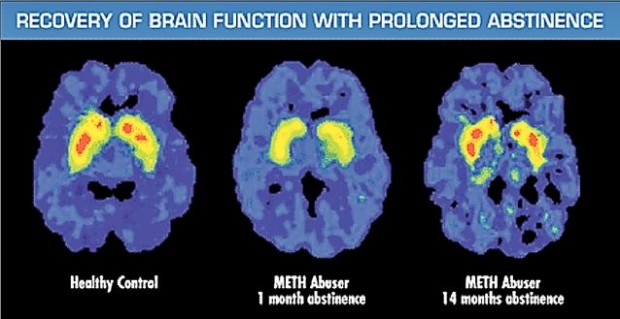
This is an MRI of your brain, and this is an MRI of your brain on drugs. Any questions?
Some local educators are learning a new approach to combat teenage drug use, and experts say it's more effective than teaching teens to "just say no."
Science teachers and counselors from the Sunnyside, Marana and Tucson Unified school districts are taking a seven-week training course at the University of Arizona to learn how science can be incorporated into drug-prevention education.
The idea is that if the educators can provide students with more scientific evidence about why they should avoid drugs, students will take the message more seriously.
"If I went to talk to a 14-year-old about drugs, they might say to themselves, 'What does this lady know?'" said Kris Bosworth, a UA education professor who is leading the course based on a curriculum from the National Institute on Drug Abuse.
People are also reading…
"But if you show them a side-by-side image of a normal brain versus the brain of a cocaine or marijuana user, it takes it out of an interpersonal realm and into a factual realm."
Statistics show that most students who have used drugs tried them first during high school.
A survey by the Arizona Criminal Justice Commission conducted last spring showed that while about 16 percent of eighth-graders in Pima County have used marijuana at least once, more than 43 percent of high school seniors have.
In the last 10 years, technology used to look inside the body has improved and it's only natural to use the science as an extension into drug-prevention education, said Maryann Judkins, a UA training coordinator with the program and a former middle school teacher.
"Kids learn best thinking in context," she said. "Embedding this information in science classes is a natural fit."
The education goes beyond looking at images of the brain. In one of the lessons, the teachers looked at a normal beetle heart and then at hearts under the influence of caffeine and the decongestant drug Sudafed.
"Students may have a friend who does drugs and physically looks fine. This shows them what's actually going on inside the body," Judkins said.
She said that in her experience as a teacher, kids tend to tune out adults when it comes to drug prevention, but that scientific evidence can be valuable and profound, allowing students to see for themselves the effects drugs can have.
"It gives a different perspective," she said.
One teacher taking the course already has begun using the approach in her classroom.
"It fits well with science curriculum," said Danielle Schroeder, a science teacher at Mountain View High School.
"Students in my anatomy course have found it fascinating."
Danielle Clurtney, 17, a junior in Schroeder's anatomy and physiology class, said that although she has always been against drugs, she found the images powerful.
"We looked at different drugs and how they get into the brain. We saw how they react with chemicals and the effects, like being tired or hyperactive," she said. "It shows how much they can take over and affect you."
Schroeder said that not only are her students learning about the harmful effects of drugs, the information is making lessons in anatomy and physiology more interesting for them.
Schroeder is taking the course with a counselor from Mountain View. She said that as a science teacher, she appreciates incorporating science education and school counseling, because they offer different strengths.
Once the course is completed, the two plan to develop a lesson and share it with other teachers in the district, providing a greater number of students with the information.
"It's a huge issue. Kids are bombarded with messages in their teen years," Bosworth said.
"We want to provide the kind of information so that they can make healthy choices."
To Learn More
The National Institute on Drug Abuse offers free science-based information for students of all ages. To order, go to backtoschool. drugabuse.gov or call 1-877–NIDA-NIH (1-877–643–2644).
High school teachers can go to science-education.nih.gov/ Customers.nsf/highschool.htm to download curriculum supplements.
Teens can visit teens.drugabuse.gov for science-based information, games and downloads.