

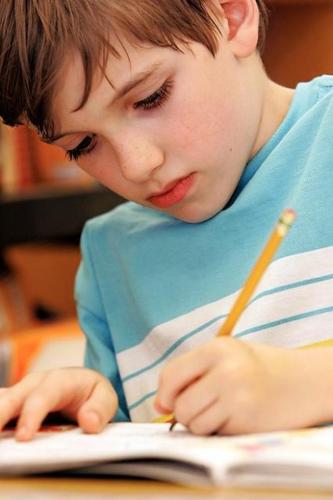
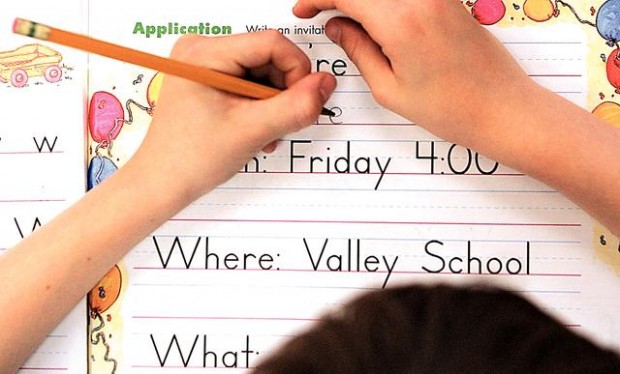
First-grader Cole Kipling can't say he's a big fan of the small letter "e," with its origin starting in the middle and looping around, like a stomachache.
But the Tanque Verde Elementary School student has a particular affinity with C's of either case, in no small part because his name begins with one.
The fact that a 7-year-old has spent any time pondering the angles and dips of writing perhaps explains why he'll be representing Arizona in a national handwriting championship in the next few weeks.
Cole, the statewide champ among first-graders, has a penmanship primer with some 60 sticky stars — prized among his classmates and far better than the hand-drawn ones his teacher makes in red for good, but not outstanding, effort.
His teacher calls him a perfectionist in all subjects, but Cole has a reason he practices his writing every week.
People are also reading…
"People need to read your handwriting," he says.
Handwriting isn't a state standard in Arizona, although students are expected to learn to write legibly. So the way schools approach writing varies widely.
And increasingly in a day when texting and typing and electronic machines have all but eliminated personal, handwritten letters or even checks, there's been a growing debate about whether schools should still be in the penmanship business.
So far, they're still largely teaching it, according to an unofficial survey of local elementary school principals, though there's a growing shift toward efficiency and less focus on aesthetics, such as slant and style.
Steve Graham, an education professor at Vanderbilt University, conducted a study in 2007 of 200 teachers of first through third grades and found 90 percent provided instruction in handwriting, with cursive generally starting in third grade.
There are reasons writing remains important, Graham said.
Studies, he said, have consistently shown that readers, when presented with the exact same content, only with one sloppy version and one crisp version, will inevitably assign lower grades in assessing the quality of ideas in the less-legible paper.
And poor writing hurts students on other levels. Faster writers are better at capturing ideas flitting around the brain, compared with students who labor over every curve, he said. Plus, there's also only so much cognitive power to go around. If students are worried about the mechanics of writing, they're less likely to be reflective about the content itself.
Having said that, Graham said, studies also have shown that students dramatically improve the quality of their writing when they use a word processor, so he's not such a booster of handwriting that he can't imagine it being replaced.
"You can foresee a future where, if the technology becomes available, that the skill of handwriting can lose its importance," he said. But that's a long way off, since most first-grade classrooms don't have computer stations set up for every child.
And when that day comes, he cautioned, then schools would have to focus on fluency in keyboarding from very early ages to avoid the same pitfalls.
Maureen Armijo, Cole's first-grade teacher, said she hopes to never see that day.
"There's something personal about receiving something that's handwritten," she said. "That would be very sad if it went away. Nice writing shows respect for the reader. It's still important."
There were 200,000 entries nationwide in the handwriting contest, sponsored by Zaner-Bloser Educational Publishers Inc., a publisher of handwriting programs for students. National winners for each grade level, who will receive a $500 savings bond and a Nintendo game package, are selected from state winners, who will receive a certificate. Results are expected in the next few weeks.
Zaner-Bloser, based in Columbus, Ohio, hasn't kept track over the years of the number of lefties, like Cole, who have taken the big prize.
And if Bill Kipling, 46, is right, there's no genetic component to neat writing, given that his son doesn't take after his own sloppy writing.
Zaner-Bloser spokesman Dennis Williams said private schools tend to dominate the grand-prize pool.
Not if Armijo has anything to do with it.
A first-grade teacher in the Tanque Verde Unified School District for 22 years, Armijo had a national champion in 1995, Jeffrey Frankel., who is now a junior at the University of Missouri-Columbia studying finance.
Now 21, Frankel doesn't remember much about the award, other than having his picture in the paper with no front teeth — and being ripped off for the big grand-champion award because some fourth-grader who knew cursive swooped in with the advantage over his blockier printing.
If his experience will be any gauge for Cole, he said teachers will look more kindly on assignments through the years.
And his perfectionistic tendencies served him well. He has nearly a perfect grade-point average.
But, alas, real life interferes. His writing isn't really that good anymore, he insists.
"For the contest, we had all sorts of time and you could perfect the arc of every letter," he said. "My writing is nice, relatively compared to other people, like doctors, of course, but it's nowhere near as good as it was.
"I don't have the time."