Tucson Water customers will see "no immediate changes" in their water service or in their daily water-use requirements as a result of the water-cutting plans laid out in a new federal report, city officials said.
While city officials are still reviewing the final environmental impact statement on the Colorado River released last Friday by the U.S. Bureau of Reclamation, "initial indicators" are that the report generally aligns with Tucson's expectations, they said in a news release.
"And the city's water supply remains resilient" for the long term, the news release said.
At the same time, city officials acknowledge they don't know yet exactly what the environmental report's recommendations will mean for Tucson, if implemented.
People are also reading…
The city's release was notably devoid of the harsh rhetoric that most Arizona and other Lower Basin states' water officials have used to blast the bureau's new environmental report. From Arizona Department of Water Resources Director Tom Buschatzke on down, those officials have warned that a 40% cut in Lower Basin river water supplies, the maximum contemplated by the new report, would "devastate" Arizona.
Tucson Water officials haven't responded to a question from the Star asking how the utility will react if the bureau adopts that worst-case proposal for the river, as spelled out in the final report. That proposal would cut the Lower Basin's water supply about 3 million acre-feet a year, or 40% of the basin's legally authorized supply of 7.5 million acre-feet. California and Nevada are the other Lower Basin states.

Tucson Water Director John Kmiec
Reclamation officials have stressed a cut of that scale would be the "upper end" of their alternatives. But if it did happen, a large amount of the cut would likely fall upon the Central Arizona Project, which supplies most or all of Tucson's drinking water supplies. That's because legally, the CAP is lowest on the priority list for getting Colorado River water during shortages, according to a 1968 law that authorized construction of the 336-mile-long canal-pipeline system bringing river water to Phoenix and Tucson.
If Tucson's CAP cuts are small enough, Tucson Water can absorb them without reducing how much Colorado River water it serves its customers. That's because currently, the utility has the legal right to take nearly 45% more CAP water than Tucson-area residents and businesses use each year. Tucson Water has, since the early 21st century, been recharging and storing the extra water underground to be saved to meet future needs.
But if CAP cuts leave Tucson with less total river water supply than its customers use, the utility will eventually face some difficult and potentially costly choices. One is to encourage or require more water conservation in a city that is already unmatched for its conservation efforts among most if not all western cities.
Another is to start using CAP water that's been stored underground in the Tucson area for more than two decades — a supply estimated to last a decade if we ever had to rely solely on it to meet current needs.
Another is to invest large sums into projects to treat wastewater for drinking, a technology the city officials call advanced water purification. Tucson is currently designing a small-scale advanced water purification plant on the northwest side, to be built with federal money, that will provide drinking water for 3% of Tucson Water's customers.
A fourth possibility would be to fall back on pumping some of the 47 years' worth of groundwater Tucson owns in the Avra Valley west and northwest of the city.
Tucson Water's technical team has begun reviewing the new bureau report to understand its "operational, legal and planning implications," said utility Director John Kmiec in the news release.
"This proposal represents an important step in shaping how the Colorado River will be managed for years to come. Our priority is to fully understand what it means for Tucson and continue advancing practical, collaborative solutions that protect long-term water reliability for our community.
"Our charge to diversify our water resource portfolio with advanced water purification is a direct, forward-looking, sustainable and local approach while the Colorado River is under stress," Kmiec said.
University of Arizona water researcher Sharon Megdal said she would like to hear more specifics from Tucson Water about how it would react to a deep cut in CAP supplies. It's possible to level with people about potential impacts without being alarmist, she said.
"Tucson probably is in better shape than most other Southwestern cities. That doesn’t mean we shouldn't adjust how we use our water," said Megdal, director of UA's Water Resources Research Center. "Water is going to keep coming out of the tap. We're OK. Tucson Water has done a great job.
"But I think the messaging from them needs to change. People keep saying to me they want to hear straight talk about the water situation."
The bureau says a 40% cut in river supplies to this region would only happen under the worst environmental conditions on the river due to shortages caused by drought.
With Lakes Mead and Powell now nearing their all-time low elevations, those worst-case conditions could occur as soon as next year, unless the current El Niño weather system ushers in good snowfall this winter in the Upper Basin states where most river flows originate. Those states are Colorado, New Mexico, Utah and Wyoming.

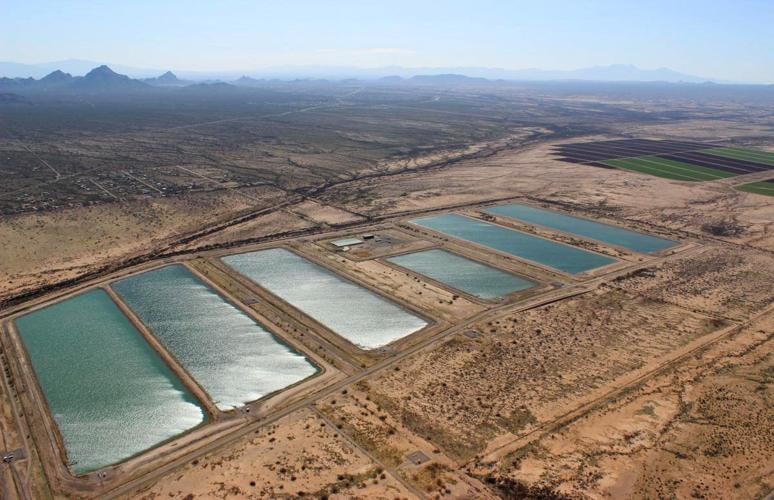
CAP water is stored in the Central Avra Valley Storage and Recovery Project near Sandario and Mile Wide roads in the Avra Valley.
Under more favorable conditions, the cut to the Lower Basin states would be much smaller, perhaps as little as 1.25 million acre-feet a year, or 16.6% of the Lower Basin's total annual supply.
The final environmental report incorporates some elements of the Lower Basin states' proposal that would cut 1.25 million acre-feet annually, and could end up cutting another 350,000 acre-feet a year, the city's news release said.
But the report's assumptions about the Lower Basin states' proposal "are preliminary and do not establish Tucson's final Colorado River reduction, or voluntary conservation contribution," the city's news release said.
"Separate federal operating plans and annual operating guidelines will determine actual reductions," it said.
The bureau's proposal is for a 10-year plan to establish a framework for cutting river water use, with specifics being revisited and potentially revised every two years.
Overall, Tucson's initial review of the new federal report will focus on the following matters, the city release said:
• Water reliability, in that Tucson’s diversified water portfolio, conservation programs, groundwater recharge, and stored-water reserves provide important safeguards as Colorado River operating conditions change.
• Colorado River allocation: The final environmental impact statement doesn't establish Tucson’s CAP reduction for 2027 or 2028. Tucson Water is coordinating with the Central Arizona Project, the Arizona Department of Water Resources and regional partners to evaluate potential impacts.
• Long-term planning. Tucson Water will incorporate the bureau's final operating guidelines for the river into its water-supply, recharge and conservation planning once the federal decisions are issued.
• Infrastructure and innovation: Tucson will continue advancing groundwater recharge, conservation, and advanced water purification programs as part of its long-term strategy to diversify sustainable water supplies and strengthen water reliability under changing conditions.
"The Colorado River is essential to the future of Tucson and the economic vitality of the region. ... The City of Tucson remains committed to protecting our community's long-term water security while working collaboratively with our state, tribal, federal, and regional partners to build a more resilient Colorado River system for future generations," said Tucson Mayor Regina Romero in the news release.
Contact Tony Davis at 520-349-0350 or tdavis@tucson.com. Follow Davis on Twitter@tonydavis987.

Tony Davis
Reporter


 CAP shortage will force Tucson to dip into groundwater