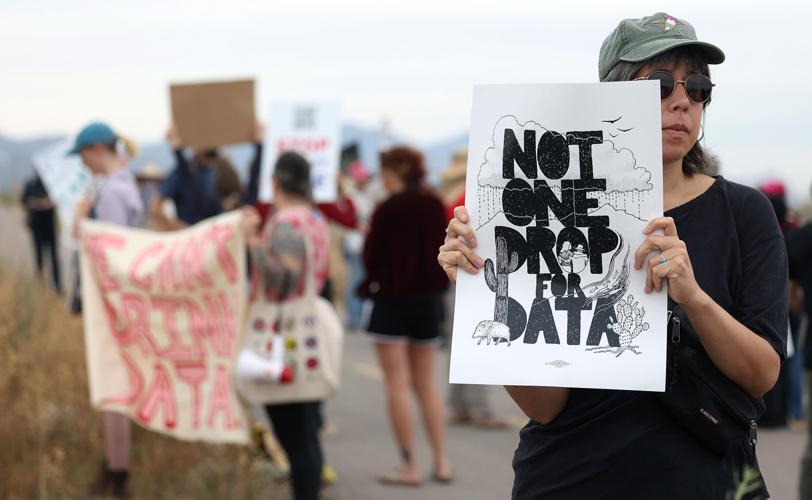
In this May file photo, demonstrators hold signs during a protest against a data center being built southeast of Tucson. A new report by Pima County explores potential health risks from data centers.
A year ago, Pima County Health Department Director Dr. Theresa Cullen approached other member cities of the Big City Health Coalition, an organization of 36 of the largest public health agencies in the US, asking how they were evaluating data centers.
“I thought this was going to be easy ... I was a little taken aback,” Cullen said.
What she was looking for largely did not exist a year ago, she said, as hyperscale data center developments are such new technology.
The county ended up partnering with researchers from Johns Hopkins Bloomberg School of Public Health, and released the resulting Data Center Public Health Review this week.
About 20 pages summarize existing knowledge on a data center's potential to impact heat, air and noise pollution, water consumption, and economic conditions of a surrounding community. Perhaps most importantly, the report points to exactly how much communities don’t know about how the presence of a data center could affect human health. The report’s findings will help inform developments going forward and encourage data collection, Cullen said.
People are also reading…

Cullen
The framework also gives the county leverage to evaluate a specific project down the line, she said.
“We're very clear that we don't know specific data about specific data centers . . . What we did with this framework was really look at are there areas of concern just in general, if data centers are proposed,” she said.
Pima County already has high levels of cardiovascular and respiratory disease that could be made worse from environmental changes from data centers, according to the report.
The most common ways data center development impacts air quality is from kicking up fine particles during construction, emissions from backup generators, and fossil fuel emissions from power plants providing the electricity, the report reads.
The asthma rate among Pima County adults is 15%, higher than both the statewide and national levels.
High levels of cardiovascular disease could also make the county more vulnerable to any additional heat and air pollution coming from data center development, the report says. Almost 36% of adults in Pima County have been diagnosed with high blood pressure, which is also slightly higher than the state and national rate.
The Health Department cites a study from 2026 that found hyperscale data centers elevated surface temperatures by an average of 3.6 degrees Fahrenheit over a six-mile radius.
Noise has also been shown to increase high blood pressure, Cullen said. Data centers have been found to produce high- and low-frequency noise from their servers, cooling systems and backup generators.
Pima County also doesn’t enforce decibel limits for unincorporated areas, the report points out.
One limitation is that existing data center studies have mostly been targeted towards environmental impacts instead of health, the report reads. The “defining limitation” was the lack of epidemiologic studies in communities near data centers to track health outcomes over time.
Epidemiology is the study of how and why health conditions spread and what groups of people they affect.
In this May file photo, demonstrators hold signs during a protest against a data center being built southeast of Tucson. A new report by Pima County explores potential health risks from data centers.
The report also notes that air quality, noise, and heat impacts affect highly localized areas. Data collection will have to be targeted to communities closest to any given site, and can’t be accurately measured with county-wide statistics.
For example, the department already tracks respiratory disease at the county level, but needs to zoom in to census-tract level to measure any potential local impacts from data centers, Cullen said.
“Say a data center goes live, and we believe that there will be a respiratory impact. It's hard for me to believe there won't be, to tell you the truth. Then we would start monitoring that right away,... and we would recommend additional air monitor units,” she said.
Cullen said one solution could be the Health Department taking a more active role in development and including mechanisms to track air quality and heat into the actual project and surrounding communities.
At the same time, the Health Department itself doesn’t have regulatory authority.
The county’s Board of Health would have the power to request the Health Department to evaluate a data center if public health concerns arose down the line, Cullen said. Then the Board could issue a resolution opposing a project to the Board of Supervisors.
As data center technology continues to develop, and more communities begin to live with and among the projects, Cullen said the county’s evaluation criteria will likely evolve.
Determining exactly what the county does with the report sits with the Board of Supervisors, as they weigh a potential data center moratorium. On Aug. 12, the Board voted 3-2 to draft a resolution that would suspend data center development for three months.
Read the full report on the Pima County website.