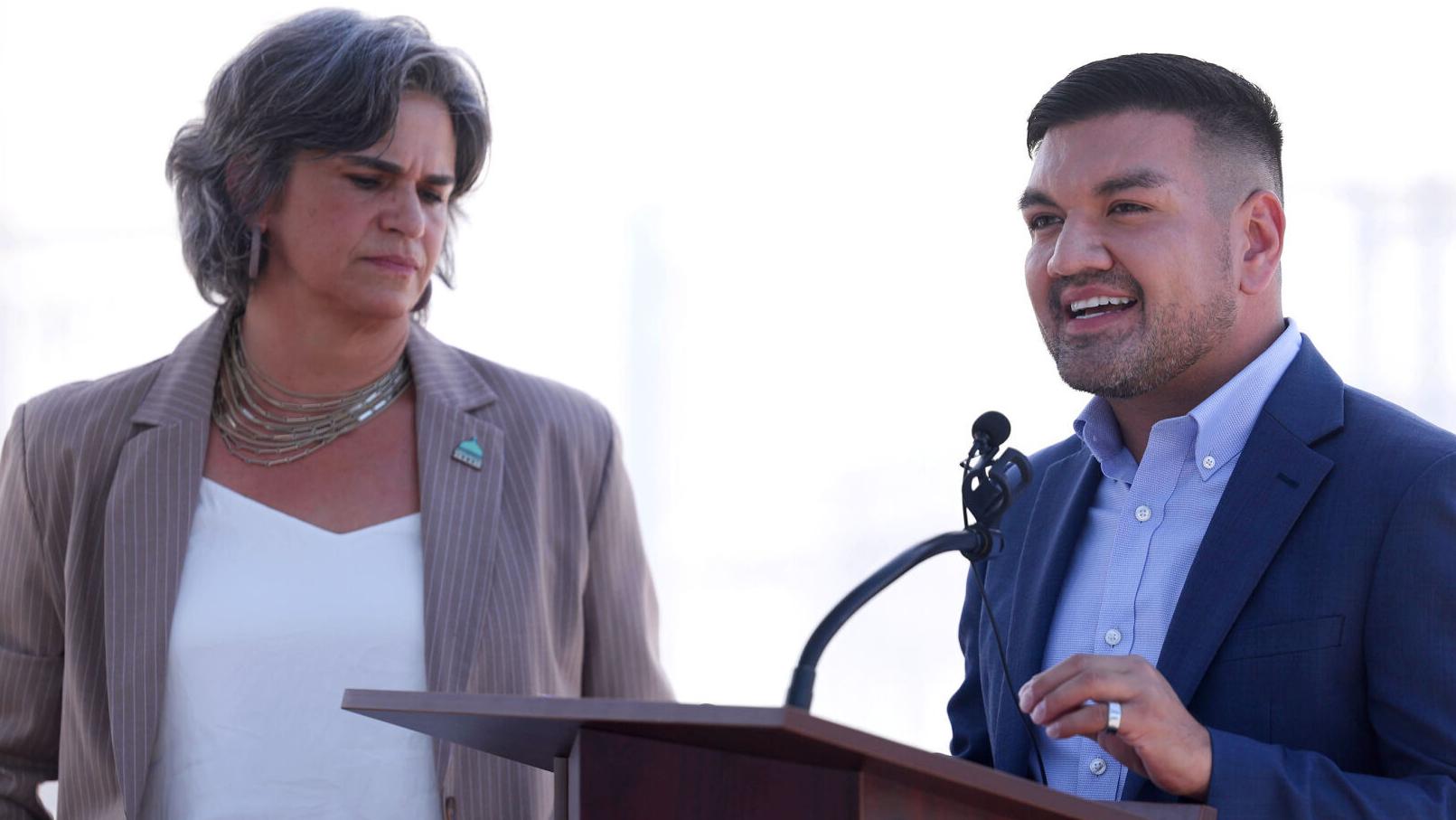
An education nonprofit received a full contract renewal from the county despite weeks of scrutiny on its CEO after a tense run for state office.
The Pima County Supervisors approved $122,000 in county funds to the Southern Arizona Education Council in a 4-1 vote Tuesday alongside new accountability measures.
The nonprofit, formerly known as the Metropolitan Education Council, mainly offers financial aid assistance and career guidance, peer coaching, and civic engagement opportunities for youth. Its governing board consists of education leaders from the University of Arizona, Pima Community College, elected officials, and community members.

Perez
Next year’s funding will be contingent on regular reports to the board and proof that the organization is doing what it’s supposed to, said Jan Lesher, the county administrator.
People are also reading…
“At the end of the month or the quarter, whatever we've determined, if everything has come in as it is required, then payment is sent,” she said.
According to contract amendments laid out by Board Chair Jen Allen, at least 4,000 students will need to receive college or career support, and at least 2,500 of them will need to complete college applications, scholarships, or the Free Application for Federal Student Aid, or FAFSA. The organization will also have to host at least three events reaching 3,200 students in the next year, and show that its application numbers are increasing.
Supervisor Rex Scott requested the contract renewal be continued until the organization provided the board a detailed report on its spending, meeting frequency, and membership, he wrote in an email to Lesher in June.
Scott told the Star initially he would not support funding the SAEC for anything more than the city’s portion of about $20,000, with the understanding the county would match whatever outside funding sources the organization could find.
Board Chair Jen Allen defended the organization’s expansions in the last year.
“The organization has doubled the number of host schools for a total of 18, added a new school system, and almost tripled the number of peer coaches. Those are significant achievements,” she said.
Complicating matters is what CEO and President Rocque Perez calls lingering backlash from his narrow loss to current state House Rep. Alma Hernandez for the Legislative District 20 Senate seat.
“The outside interests pouring in using what seems like ChatGPT to form letters and lines of questioning is totally an unusual political circumstance ... I think it tainted a normal process,” Perez said.
Sally Ann Gonzales, who ran as a slate with Hernandez, wrote a letter to the Board of Supervisors against the contract renewal, alleging Perez’s top officer role was the result of advantageous political alliances, and that his annual salary of $91,770 was too high.
“Do more research and before you give him $122,000, show taxpayers exactly what they are buying,” she wrote.
Scott told the board he did not intend his questions to cause an “extension” of the primary race between Hernandez and Perez, emphasizing the county board doesn’t have jurisdiction over any nonprofit's leadership. He ultimately supported Supervisor Allen’s motion to approve the contract for its full amount.
“My questions are about the operations of the council and how our investment is being justified,” he said.
In his response to the Board, Perez referred Scott to the council’s posted minutes and agendas for membership and meeting details. The council has only met three times in the last year and about half of its 24 board seats are filled, Lesher added in an Aug. 19 memo.
Perez told the Star he has worked to reduce the number of board seats to help solve quorum issues, which he said led to missed meetings. The council held two meetings this year, one in January and one in July.
“I think normal nonprofit boards don’t meet more than I would say six times, and so obviously that one lapse between January and July is seemingly the point of contention here. But when I first came in, we met 13 times in a consecutive year, and I think that overdid it,” he said.
The Teen Town Hall presented by the SAEC did not happen in 2025 after over 30 years of annual events, another concern raised by Supervisor Scott. Perez told the Board the event will resume this year.
Supervisor Andrés Cano also distanced himself from the leadership conversation, saying that scrutinizing the leaders of the 130 organizations that receive county funding would set a bad precedent.
“The decision that I'm making today to support this motion is irrespective of who the executive director is, irrespective of what I feel is, ultimately trying to put this board into a binary choice between whether we support progress or not,” he said.
Meanwhile, Supervisor Steve Christy, the only Republican on the board, said Perez’s leadership had “many red flags.”
“This whole thing stinks to high heaven,” he said.
Christy also raised concerns about the council’s potential expansion and subsequent retraction to Santa Cruz County, an issue scheduled to be addressed by the board in September.
According to Lesher’s memo, the council was in talks to bring Santa Cruz County into the organization, but a new County Superintendent of Schools caused a delay.
Lesher later wrote that those discussions weren’t actually happening.
“Mr. Perez has clarified that the SAEC has not interacted with Santa Cruz County Administration beyond engagement with one current and one former County Supervisor,” an Aug. 5 memo reads.
Perez instead requested the board officially remove Santa Cruz County from the membership structure, despite seemingly never incorporating in the first place, on September 8.