County officials say their plan to tackle systemic public safety issues is working with new data from the program’s eight-month mark.
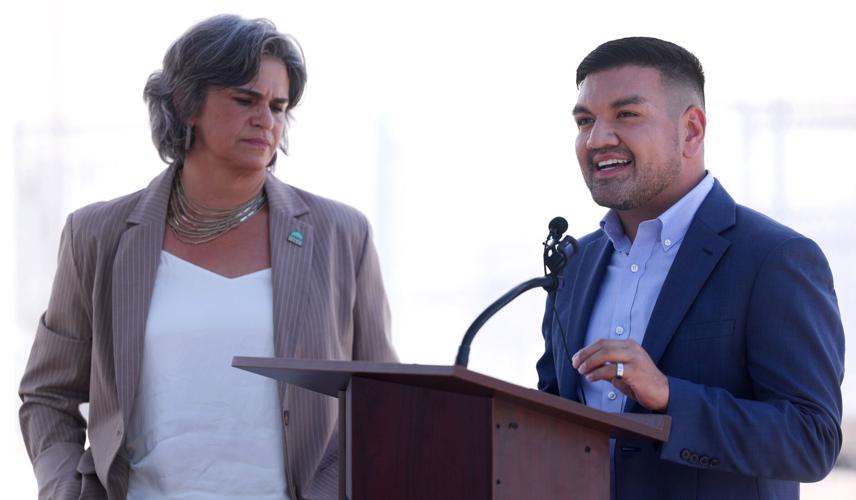
Supervisor Andrés Cano spoke to reporters and county staff Monday outside of the Pima County Adult Detention Center to talk about progress on the One Pima Initiative, a two-year public safety program focused on housing, addiction, and cleaning up public spaces.

Supervisor Jennifer Allen, left, hosts a one-year briefing Monday on the One Pima Initiative with Supervisor Andrés Cano at Pima County Transition Center, 1204 W. Silverlake Road.
“We've provided 3,000 families with rental and utility assistance, rapid rehousing, and life-saving support that has helped people keep people in their homes instead of living on the streets,” Cano said.
Eight months in, the county says the biggest investments have been made in housing and utility assistance and cleanup of the Chuck Huckleberry Loop since the program was launched in November 2025.
Over 300 tons of waste were cleared from the Loop in the first six months of 2026, and constituent complaints about encampments and waste have decreased, County Administrator Jan Lesher wrote in a news release.
People are also reading…
Cano introduced the plan in the weeks following the fatal stabbing of Enrique Mercado during a community bike ride on the Loop section near East Wetmore Rd. in September 2025.
Mercado’s death sparked renewed focus on both the city and county’s efforts to improve public safety, especially on the Loop. Within weeks of One Pima, the City of Tucson launched its Safe City Initiative, a similar program that also tackles homelessness, substance abuse, and quality-of-life issues.
“There was a tipping point from the community saying ‘it’s almost too compassionate,’... we’re really trying to say we’re here to help you, but also we can’t just let it go,” Morales said at a City of Tucson briefing the same day.
The county says it’s also diverting more people to treatment since it expanded hours of the Transition Center from five to seven days a week, from 8 a.m. to midnight, Cano said.
The program located in a modular building outside the Pima County jail launched in June 2023, aiming to reduce rearrests and missed court dates after the jail reached concerning capacity levels that summer.
According to their 2025 annual report, participants who were rebooked within 30 days of leaving jail fell to 6%, compared to a control group that saw 27% re-arrested. With expanded hours, an average of 650 more people a month are being seen at the center.

Deputy County Administrator Chad Kasmar, left, and Pima County Administrator Jan Lesher listen to a briefing Monday on the One Pima Initiative.
In housing, the county built 400 units of affordable housing in the last fiscal year, ending in June, and assisted 3,200 households with rent, mortgage, and utility assistance or home repair. They also partially funded seven affordable housing projects, Lesher wrote to the board.
Cano said the One Pima Initiative also helped launch the Tucson-Pima Shelter and Community Resource Dashboard, which provides real-time data on shelter bed availability and consolidates many of the city and county’s homeless resources into one website.
“This saves time, money, and avoids the endless phone calls looking for help at the worst moment in someone's life,” Cano said.
A separate $2 million grant will also fund a Homeless Prevention Hub call center for residents looking for rent and utility assistance, Cano said, expected to launch in September.