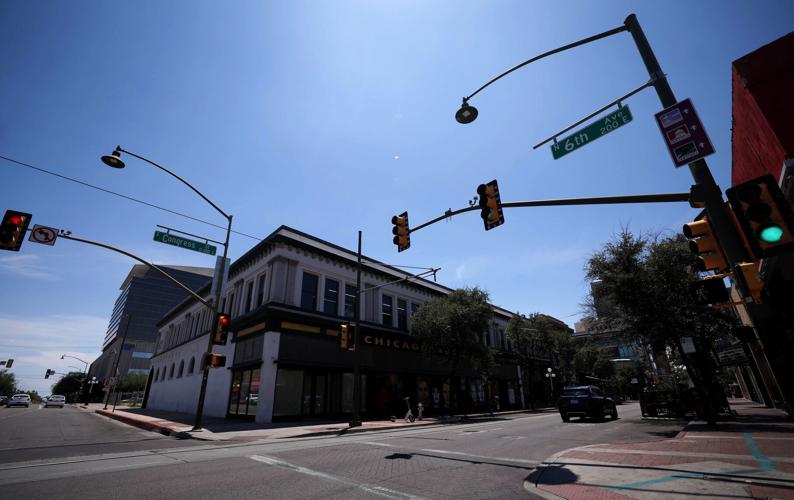
Downtown Tucson Partnership is working with the city to close Congress Street to cars on Halloween night for better crowd management, the organization's president said, as downtown safety issues come to the forefront after a shooting at bar closing time early Sunday left nine victims injured.
During times of high population density on the street in downtown, closing it to traffic would make it safer and help emergency responders respond properly when needed, said Crystal Moore, president and CEO of Downtown Tucson Partnership. If a Halloween closure proves effective, officials would also like to try closing Congress Street other times to improve public safety, she said.
Congress Street
Published
People are also reading…
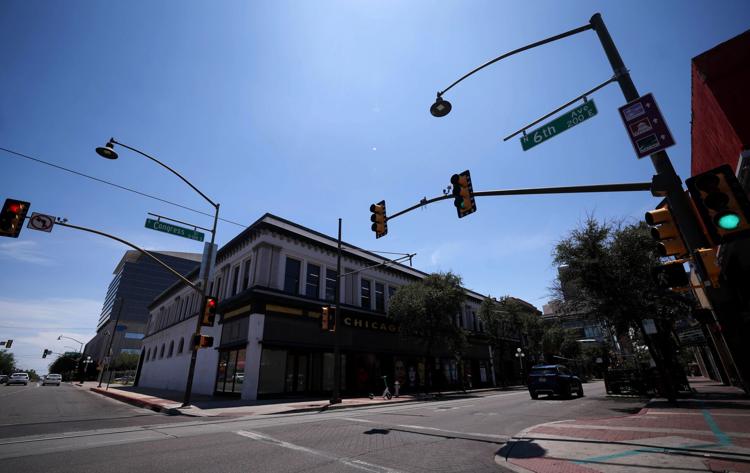
The intersection of East Congress Street and North Sixth Avenue in downtown, near where Sunday's mass shooting occurred. Downtown Tucson Partnership a…
Grace Trejo, Arizona Daily Star

The intersection of East Congress Street and North Sixth Avenue in downtown, near where Sunday's mass shooting occurred. Downtown Tucson Partnership and the city are working on a pilot project to close Congress Street to cars on Halloween night, a particularly crowded event downtown. If it's successful, DTP would like to see Congress Street closed to traffic for other crowded events, too, for public safety reasons.
Halloween night in 2024 recorded 16,000 people in downtown Tucson, while 2025 saw 24,000 people, Moore said. This year, since Halloween falls on a Saturday night, they’re expecting 30,000 to 35,000 people, she said.
“Instead of closing it down as a reaction, which is never ideal but does happen, to be better prepared to do it proactively — where we have proper wayfinding, proper barricades, proper staffing — would be a step in the right direction,” Moore told the Arizona Daily Star Thursday.
“We’d rather be overprepared than underprepared, and this is only made possible now because of the Links being open,” she said, referring to Downtown Links, the recently opened corridor connecting Barraza-Aviation Parkway in downtown to Interstate 10. “If Links wasn’t open, we wouldn’t be having this discussion. But we do have reports that are many years old, like decades old, that suggest that Congress could be partially closed and (open) for pedestrians only."

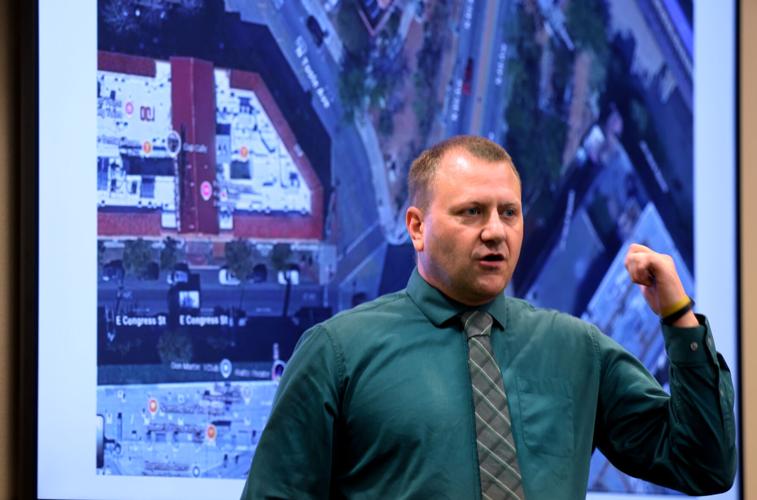
Tucson Police Sgt. Dave Schneider talks about some of the physical challenges in downtown, including the intersection of Congress Street, Fourth and Toole avenues — The Triangle — to representatives from surrounding bars, theaters, clubs and restaurants during a training session Wednesday on crowd control and other public safety measures.
Downtown Tucson Partnership is meeting with city leaders to figure out details and feasibility, using information from previous Tucson Transportation and Mobility reports to determine areas in which closure would be most effective, she said. They’re trying to decide if the closure should happen from Toole Avenue and Congress Street or Fifth Avenue and Congress Street all the way to Scott Avenue. It’s important to keep the Pennington Street Garage accessible to traffic, Moore said.
“This isn’t just in Tucson; this is all across the world from the UK to Australia to the United States,” Moore said, “that when people linger after drinking, there is conflict. Someone steps on someone’s toe, someone takes someone’s Uber, and people get angry. So, we need to evacuate downtown as soon as bars close. There should be no reason to linger after 2 o’clock."
Moore said this is a pilot program and “months away” from execution, but officials would like to see if it makes downtown more efficient, user-friendly and safe.
Such a closure “is absolutely crowd management, directly tied to public safety, how we move people through the district when there’s such a high volume of people,” she told the Star.
“I wasn’t downtown (last weekend) to understand how many people were actually downtown and if the responding police officers encountered any large crowds. I know there weren’t 30,000 people downtown, so I’m not sure if it (closing Congress) would have had an effect. If there were 30,000 people downtown at the time of the occurrence, I believe the answer would be yes.”
The downtown shooting occurred around 2 a.m. Sunday outside of a business in the 100 block of East Congress, near Sixth Avenue, after a confrontation broke out between two groups of people gathered there, police have said.
Officers who were patrolling the area heard the shots and ran over and encountered a suspect, later identified as David Leroy French, 21, who was given multiple commands before he was shot by an officer, police said. He sustained life-threatening injuries and was taken to a hospital, as were the shooting's nine adult victims, who were initially said to be in critical condition. Some have since recovered enough to be released, police said. French remained hospitalized Thursday.

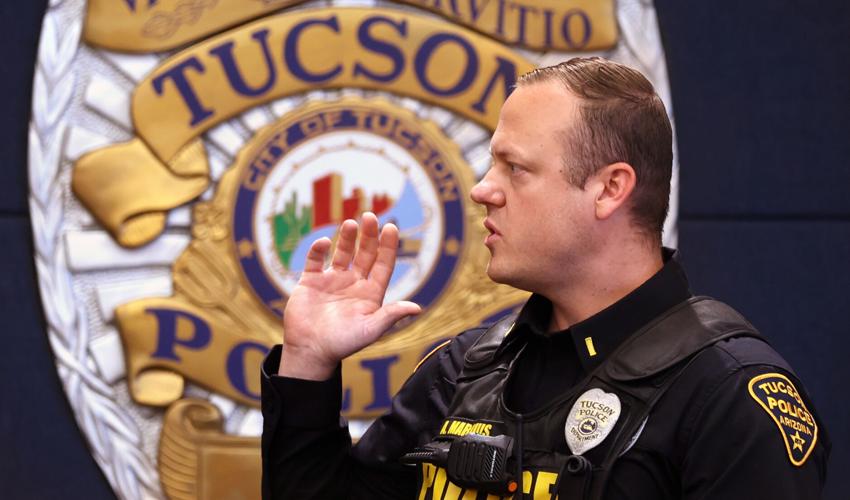
Tucson Police Lt. Aaron Marquis takes the dais while talking to a few dozen representatives from downtown businesses at a public safety training session Wednesday at the Westside Police Substation.
Training on crowd control, active shooter response
Tucson Police Department officers, in collaboration with Downtown Tucson Partnership, also addressed crowd management concerns and tips at a crisis and safety training session Wednesday for downtown businesses.
The training, hosted at the Westside Police Substation on West Miracle Mile, was the third of its kind for community members, police said. Officers provided advice on managing crowds, responding to an active shooter, and first aid in emergency situations. Planning for the training session began in April, months before last weekend's shooting.
About 17 downtown businesses — including Fox and Rialto theaters, The Neighborhood Bar Downtown, OBON Sushi Bar Ramen, LAVA bar, and more — attended the training.
“This is not in response to the mass shooting,” said Jakki Hill, Fox Theatre director of patron and events services. “It’s very important for us to be safe and aware. Active shooting training has been put on our list of things to do."
At the training, TPD officials noted there are many times when downtown sees a high density of people, especially with people going there for work, lunches, shopping, dinners and shows. There are times when lots of people fill the streets outside businesses, they added, when they’ve just finished a show and are going to dinner or waiting for their rides outside the theaters and restaurants, or when bars close.
In situations like these, police advised, it’s important for businesses to keep the crowd flowing by managing exits, to have specific and designated areas with signage for rideshare pick-ups, and have trained personnel who keep the crowd moving in a flow of natural pedestrian traffic so the sidewalks don’t get blocked. Officers also said having better lighting on downtown streets will help, as will being thoughtful about where to place street vendors such as food trucks.

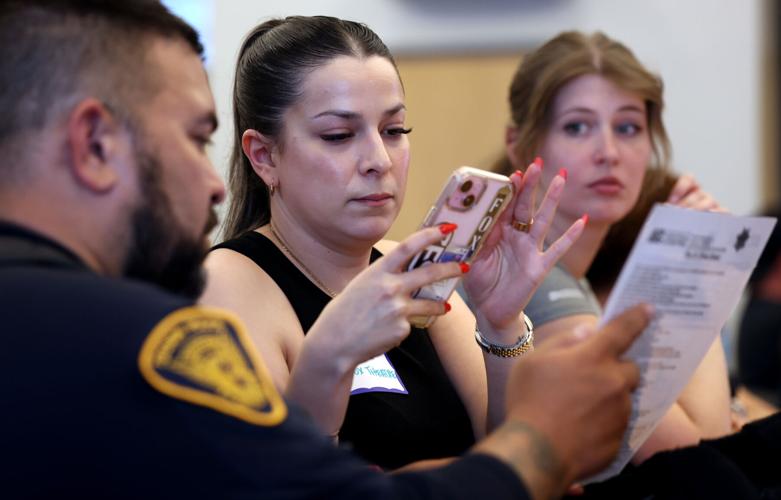
Tucson Fox Theatre's food and beverage manager Sophia Perez gets a photo of a checklist from Tucson Police Officer Albert Moreno following his talk on liquor regulations, rules and enforcement during a Wednesday training session at the Westside Police Substation on public safety measures.
It’s also beneficial to have parking lots be a little away or maybe outside of the district, they said, because when there are closer parking lots, they can turn into places where people hang out afterward, and that leads to a crowd forming there.
Officials said they’re currently working on another pilot program, in addition to the one to close Congress Street, where they’d like to establish pickup zones for Ubers and other rideshare services and cabs.
Officers also said it’s important for businesses to keep an eye on the different people moving in and out of various businesses, in case someone is exhibiting suspicious or concerning behavior that might become a problem later.
An investigator with the Pima County Sheriff’s Department, which is handling the investigation into last weekend’s mass shooting, said at the training session that the department has information that the suspect, French, might have been moving around the downtown area and going to multiple establishments Saturday night.
Miguel Pineda with The Neighborhood Bar Downtown said such training sessions provide really good tools for businesses like theirs because they deal with a lot of people every week.
“I mean, just to defend ourselves or kind of give you an idea of what you can do in cases like that,” Pineda told the Star.
He said he was downtown last weekend when the shooting happened, but The Neighborhood Bar had already closed for business. He said he and other employees stayed indoors to be safe for 20-30 minutes after the shooting and then went home.
In the part of the session about dealing with an active shooter situation, officers said to secure exits such as doors and windows by blocking them with obstacles like tables, sliding a clip into the lock on the door, or sliding a belt through the handle. The idea is to make it as hard as you can for the active shooter, officers said.
First aid training
If the situation escalates to a point where the shooter is entering the room, the first thing to do is to try to grab the person’s arm from the side as soon as they enter, which can work but is risky, officers said. After that, people in the room can try different things to try to deter the shooter, including spreading out so nobody is standing in the same place, tossing something like a blanket over his head, and using everything in the moment like chairs, pens, water bottles, hot coffee, etc. to throw at him.
Additionally, if there are windows in the room, people can also break those and get out, they said.
Moreover, in situations like these, the shooters usually make their way from room to room, so while the first room receives an unprecedented attack and has to act as quickly as possible, the people in the surrounding or neighboring rooms should already be locking their doors and windows and taking cover until the shooter reaches them, officers said.
Once police get to the scene and are surveilling all the rooms, it’s important for people to have their hands empty and hold them up or keep them clearly visible so officers can identify the shooter in the midst of all the confusion, they said.
And in the aftermath, since the trauma of such situations is so huge, officers advised people to talk to others and get the necessary help and support they need.
The last part of Wednesday’s session included training on first aid, where officers told the businesses to first designate someone to call 9-1-1 immediately.
Then, officers told businesses they should “stop the bleeding and start the breathing.” It’s important, when there’s an individual with any type of gunshot trauma or stab wound, to stop the bleeding as much as you can by tying a tourniquet, packing the wound and applying some pressure, they said.

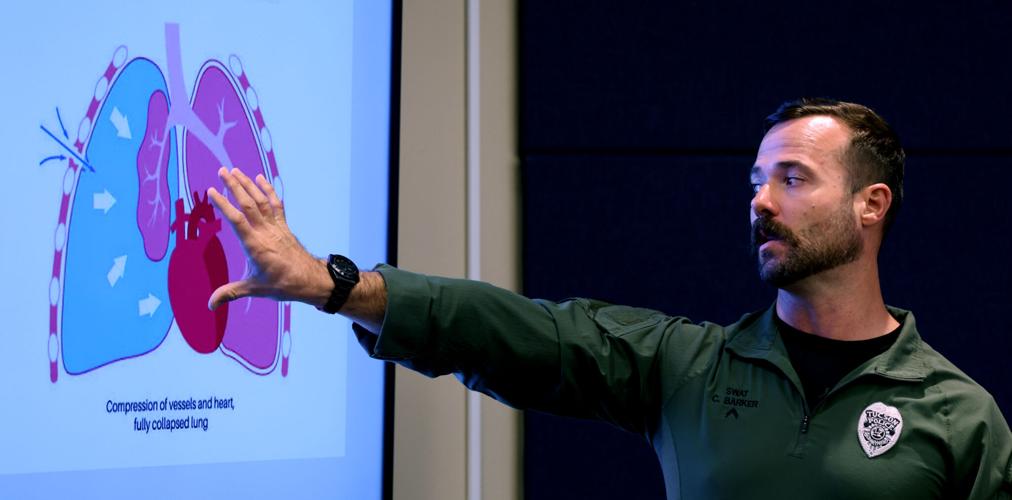
Tucson Police officer Chad Barker talks about first aid for tension pneumothorax, sucking chest wounds, to representatives from many downtown businesses during a training session Wednesday, as downtown safety issues come to the forefront after Sunday's shooting that injured nine victims.
This is especially important when the bleeding is really severe and in sensitive areas like the groin or the armpits, because an individual can bleed out in as little as 90 seconds, officers said.
They demonstrated ways to tie a tourniquet around somebody’s arm. They said that after packing the wound, it is also important to apply pressure directly to it to hinder the bleeding even more.
Officers said it’s also crucial to check if the person is breathing. If the person is conscious and able to breathe and talk, listen to them and heed their requests about things like which positions reduce or worsen their pain, they said.
These are also situations where an injured person's body will not be able to regulate heat adequately, so they can be covered with reflective blankets or sweaters if available.
By this time, police said, paramedics and responders will have arrived to administer more medical aid and take over the situation.
Another initiative to be presented
During the session, Downtown Tucson Partnership's Moore said she is presenting another new initiative to city officials, called “Increasing Nighttime Economy by Decreasing Nighttime Conflict.”
She formulated it after taking the last six months to research cities including Cleveland, Pittsburgh, New York City, San Jose, Sacramento and Nashville, to see how those urban centers support nighttime economies in a healthy and safe way.
“I have a pillar plan that will be shared with the city manager’s office tomorrow,” Moore said Wednesday. “Public safety is key to all of us, and the stronger our public safety is, the stronger our downtown will be.”
Reporter Prerana Sannappanavar covers higher education for the Arizona Daily Star and Tucson.com. Contact her at psannappa1@tucson.com or DM her on Twitter.

Prerana Sannappanavar
Higher Education Reporter