Four days after a mass shooting injured nine people in downtown Tucson, former Congresswoman Gabrielle Giffords gathered with city officials and called for reform of Arizona’s gun laws.
“Fail, fail, fail,” she said of Arizona’s gun laws compared to other states.
Giffords, who was shot and permanently injured in a 2011 Tucson mass shooting, now leads a national gun violence prevention group named for her.
She spoke on a panel Thursday with Tucson Mayor Regina Romero, Pima County Attorney Laura Conover, Tucson Police Chief Monica Prieto, gun control advocates and representatives from youth organizations amid the shooting aftermath that has one downtown business renewing conversations about the city’s crime response.
People are also reading…
Attendees at Thursday’s panel were invited by the mayor’s office and asked to submit questions via email.

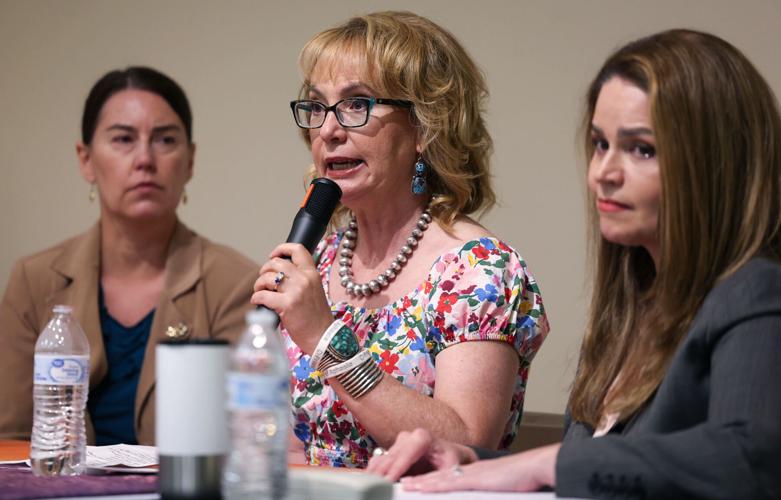
Former U.S. Rep. Gabby Giffords, center, speaks at El Rio Neighborhood Center at a news conference with Tucson Mayor Regina Romero, right, and Pima County Attorney Laura Conover, left, about Sunday's shooting in downtown Tucson that injured 10 people, including the suspect.
Throughout the event, city officials maintained that lower crime statistics show existing gun violence prevention efforts are working, but at the same time, stronger gun laws at the state level could be doing more.
“Violent crime for the past five years is down 20%,” said Prieto. “That's exceptional, right? Our clearance rates for solving shootings has gone up from 20% in 2024, to now 75 to 80%.”
Both Conover and Romero lamented the state has failed to pass policies that they say are proven to keep dangerous people from acquiring guns.
“We need background checks. … We need safe storage requirements. We need red flag laws that keep them out of the hands of convicted criminals and domestic abusers,” Romero said.
Former Congresswoman Gabby Giffords, Mayor Regina Romero and local officials discuss public safety in Tucson after the mass shooting that occurred in downtown last Sunday.
Video by Grace Trejo, Arizona Daily Star
Red flag laws allow the courts to temporarily remove guns from an individual who may be dangerous to themselves or others. Conover said she still thinks passing an Arizona red flag law is possible, although previous attempts have failed at the state Legislature.
“There's a right to a hearing. It's all due process. It's constitutional. Gun owners can and do support that in other states in the nation. It was under Governor (Doug) Ducey that our own red flag law made serious progress. So this is not impossible, and I don't intend to give up,” she said.
Arizona also does not have any laws requiring guns be locked or stored a certain way in a home.
Conover said the shooting was a “statistical anomaly," but that social media skews the public’s perception of safety.
“We are awash in firearms, shootings every single day, and because of social media, we're aware of it instantaneously, and it makes us feel unsafe,” she said.

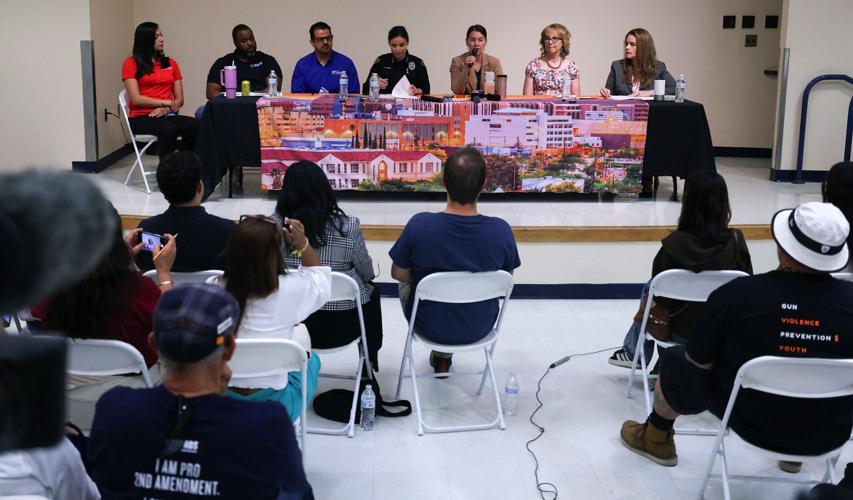
Panelists at Thursday's news conference, from left: Azul Navarrete-Valera, community enrichment coordinator with Community Safety, Health & Wellness; Lance Meeks, vice president of community engagement at Goodwill; Oscar Medina, City of Tucson Office of Violence Prevention and Intervention manager; Tucson Police Chief Monica Prieto; Pima County Attorney Laura Conover; former U.S. Rep. Gabby Giffords; and Tucson Mayor Regina Romero .
Empire Pizza, one of the businesses closest to Sunday’s shooting, disputes the city’s blame of inadequate gun control. The business has posted eight times on Instagram this week, saying it is forced to deal with poor police presence, cleanliness issues, drug use and property damage.
“No one in government seems to care about any of these things. This is the real story,” one July 21 post reads.
Comments on Empire’s posts are largely negative, with many users criticizing the business’ insinuation that Sunday’s shooting was related to homelessness. Court documents show the suspect arrested in connection with the shooting has a home address.
“You turning the blame on homelessness, drug addiction and free transportation is extremely tone deaf and posts like these hurt local businesses more than benefit. Please reevaluate where to put the blame on instead of jumping on the homeless or free transportation,” commenter Enrique Brown wrote.
Prieto said her department views homelessness as separate from violence.
“We know young adults, between 12 and 24, are prone to gun violence. It's about conflict resolution. It's about not having stability in the home life and turning to a life of crime. So it really is about needing to address those for youth,” she said.
One audience member asked Conover when she will see harsher punishments for gun violence.
The County Attorney’s Office is taking heat from commenters over downtown shooting suspect David Leroy French's 2024 conviction for shooting at a car wash employee, particularly why he received probation for an offense punishable by up to nine years in prison.
Conover told the Star the court system can’t handle taking every shots fired case to trial.
“This was a shots fired into the air case. One shot fired into the air. We have like thousands of those presented every year to us,” she said.
Conover also said the public doesn’t hear about the cases that receive longer sentences.
“Every single day, we're sending people off to prison for very long prison sentences, especially on attempted murder and homicide. We focus a lot on us human beings on the cases that fall apart or the cases that we can't get as much accountability as we would like. And the good news is that that's a tiny percentage.”