From Prescott to the border town of Nogales, "forever chemicals" contaminate the water of nearly 2 million people in Arizona. Some affected utilities have shut down wells and connected to clean sources of water or paid millions for treatment, but dealing with contamination will be a multi-generational problem.
"We will be working with PFAS for the rest of our careers," said Chris Avery, Tucson's chief water counsel, at the opening of the National 2026 PFAS Conference last week at the University of Arizona. It was the first time leading experts on PFAS met in Arizona for the conference and heard from impacted residents.
Over the past half century per- and polyfluoroalkyl substances, or PFAS, a class of 15,000 manufactured chemicals, have been widely used in many industries and have polluted soil, water and air across the globe. Well studied PFAS like PFOS and PFOA are the only ones that would be regulated on U.S. drinking water in three to five years, if proposed rules from the Trump administration go through.
People are also reading…
A growing body of scientific research links long-term exposure, even to low traces of these chemicals, to severe health issues like cancer, developmental effects, reproductive disorders and lower immune response.
Linda Robles and Yolanda Herrera, South Tucson neighbors affected by the legacy pollution, spoke at the UA conference. So did a New Mexico police chaplain and a Texas rancher whose lives have been upended by PFAS contamination.
Nearly 100 utilities in Arizona found PFAS levels in drinking water above the limit established by the U.S. Environmental Protection Agency.

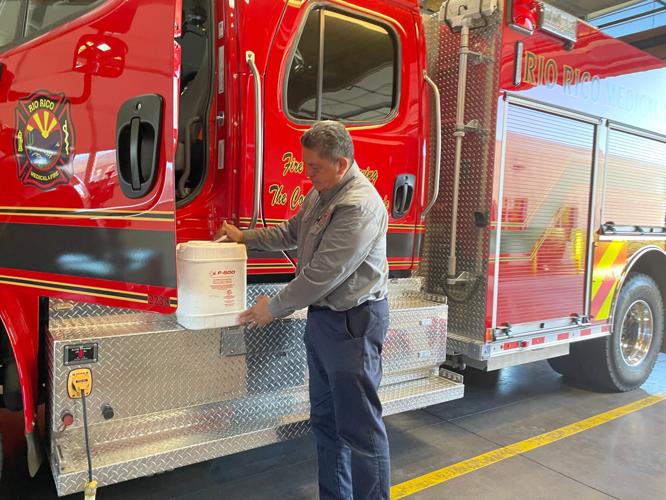
Frank Granados, a Rio Rico fire senior advisor, shows the replacement product for PFAS-laced firefighting foam.
Tucson began testing groundwater for the chemicals about 15 years ago, and is building a $33 million plant to treat PFAS and continue long-term aquifer cleanup of other hazardous chemicals near Tucson's airport. Marana, which joined Tucson in a lawsuit against PFAS manufacturers, also has operating treatment plants. But across Arizona dozens of small utilities will have to face the same mitigation challenge, often with fewer resources.
Most utilities are not yet required by law to inform water customers if they find high levels of PFAS in the water, nor are they required to reduce contaminant levels. That will become mandatory in 2027 and 2029, respectively. An extension proposed by the Trump administration could buy utilities more time, and roll back some customer protections.
Water providers near Amado, Buckeye, Chino Valley, Dewey, Kearny, Mayer, Nogales, Payson, Prescott and Yuma have received financial and technical support to deal with PFAS, either by connecting their customers to clean sources of water or building treatment plants.
The funding is part of a national annual appropriation that ends this fiscal year. In Arizona, federal dollars would add to a total of $104 million by the end of 2026. Funds are administered by the Water Infrastructure Finance Authority and managed by the Arizona Department of Environmental Quality, ADEQ.
"To date, $8 million has been allocated toward the planning and design phases for 22 projects and the completion of two projects. The remaining $96 million will fund the construction phase for those same projects, as well as additional future projects," ADEQ's communications director Caroline Oppleman told The Republic.

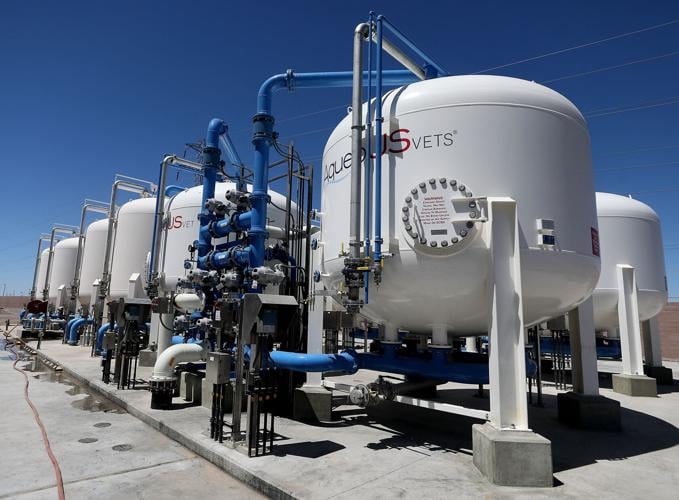
Twelve granulated activated carbon vessels where PFAS (per- and polyfluoroalkyl substances) are removed from water at the Tucson Airport Remediation Project water treatment facility.
Big utilities that have reported PFAS contamination above the federal limit — like those in Tucson, Gilbert, Chandler, Glendale, Sun City West and Lake Havasu — are not recipients.
The state agency began sampling and testing drinking water for PFAS in cities and rural communities statewide since 2023, before there were any federal mandates to do so, and created an interactive map with this public information.
PFAS treatment to protect groundwater
ADEQ has funded 24 projects in Gila, Maricopa, Navajo, Pima, Pinal, Santa Cruz, Yavapai and Yuma counties. Most of the projects are located in Yavapai County and involve mobile home parks with contaminated private wells.
Dealing with PFAS in rural communities is critical, as the aquifer is often their only source of water. In cities, cleaning up aquifers will become increasingly important; many communities will grow more reliant on groundwater amid looming Colorado River water cuts.
But treating water for PFAS is costly. Most of ADEQ's funded projects will build infrastructure to connect mobile home parks and small utilities to another water system with PFAS levels below the federal limit. So far, only four projects will help fund treatment plants.
In selecting, designing and funding the PFAS mitigation projects, ADEQ staff considered whether the utility would be able to sustain high operational and maintenance cost of a treatment plant, such as the operators' training cost and salaries, frequent replacement of granular activated carbon filters, and ongoing sampling and testing.
To choose the most suitable path to mitigate PFAS, the agency created a decision tree with step-by-step guidance.
Chino Valley will build an ion-exchange treatment plant; Buckeye's Clearwater Utilities will build a treatment plant and provide water to another affected utility; and Payson and Nogales' Valle Verde Water Company will build treatment plants with granular activated carbon filters. Mobile home parks or small systems near Amado, Dewey, Kearny, Nogales and Prescott will build pipelines or drill new wells to connect customers to clean sources of water.
The 24 projects funded by ADEQ, selected by priority due to their levels of PFAS and need for assistance, will use most of the federal funding. While only some $8.5 million has been spent, most projects are at the design phase, which makes a fraction of the total cost of construction. Some utilities will have to cost-share the projects.
The agency said it's evaluating an additional 57 public water systems that could be assisted with whatever funding remains.
Science about PFAS continues to evolve
The adverse effects of PFAS chemicals on human health have been known by manufacturers and the chemical industry for decades, but regulation in the United States has been slow. The first rules for drinking water were finalized in 2024.
Over the years, research to measure PFAS levels in water and soils has evolved, as has the wide range of adverse effects they may have in humans and the environment.
U.S. lifetime health advisories for some PFAS in drinking water began at 400 parts per trillion in 2009. The EPA updated the advisory to 70 ppt in 2016. Today, the limit for two of the best-known PFAS is 4 ppt; it's a minuscule amount, the equivalent of four drops of water in 20 Olympic swimming pools. The desired goal is zero.
Proving adverse health effects are caused by PFAS exposure, from high cholesterol to testicular cancer, is a high bar, said Rebecca Aicher, project director with the American Association for the Advancement of Science's Center for Scientific Evidence in Public Issues. That process is costly for the volume of scientific research required, and legally complex, she said.
But studies point in the same direction; being exposed over a long time to even trace doses of these chemicals can affect the immune, endocrine and metabolic systems.
Most of these chemicals made their way into groundwater after firefighting foam was used for training in fire districts, military bases, and airports nearby. In other areas, mining activities, manufacturing and landfills could have contributed to water contamination. Some chemicals could have migrated from sewage and biosolid sludge to soils, to water.
There was promising new research presented at the Tucson conference around methods to remediate contaminated sites, track PFAS emissions on air, and remove PFAS from the human body, said Aicher, with the EPI Center. Other promising research could emerge from public concerns.
With the attendance of community advocates and the scientific community leading PFAS research, the conference is a meeting point.
"It provides a model for how scientists and community members work together," Aicher said. Doing science that is "directly related to the questions that these community members are asking."


 Arizona could get water from San Diego within 6 months