Passion for Mexico’s national team is not only felt in stadiums, streets or family gatherings.
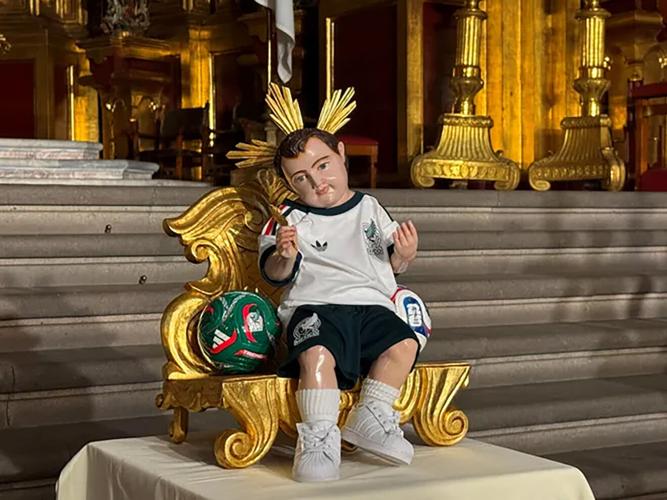
In many Mexican households, it also reaches home altars, where religious figures such as the Santo Niño de Atocha or the Baby Jesus are dressed in Mexico’s jersey during the World Cup.
This custom brings together two powerful elements of Mexican culture: faith and soccer.
For some devotees, placing El Tri’s jersey on the Holy Baby Jesus is a symbolic way of asking for protection for the players and good luck for fans who follow every match with hope.

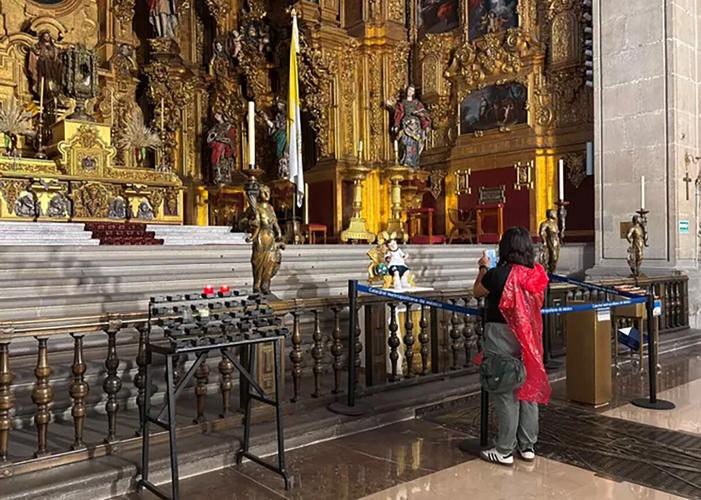
Santo Niño de Atocha, the Baby Jesus, is displayed in Mexico City’s Cathedral wearing the national team’s jersey.
A tradition between faith and soccer
Devotion to the "Santo Niño de Atocha" has deep roots. Its origin dates back to Spain and arrived in Mexico during the colonial period. In Mexico, its worship became especially strong in Plateros, Zacatecas, home to one of the most visited shrines among the faithful.
People are also reading…
Over time, the image became associated with the protection of travelers, miners, families, and people going through difficult times. From this practice comes the idea of dressing the figure according to special occasions such as the World Cup.
Some faithful question the practice
However, not everyone views this practice favorably. In Mexico City, some believers consider that dressing a religious image in the national team’s jersey can be seen as fanaticism and a lack of respect.
“We are confusing religion with sports, and that is called fanaticism. We should respect our sacred images,” said María Concepción Bautista, a 53-year-old homemaker and resident of Mexico City.
Mariana Carrillo Pérez, a 60-year-old retiree, shares the same opinion, believing that soccer and religion should not be mixed in this way.
“I don’t think it’s right. Soccer should not be mixed with religion, much less use the Baby Jesus to represent a team; we must be respectful,” Carrillo Pérez said.
The Church’s stance on the ‘soccer Baby Jesus’
Father José de Jesús Aguilar, from Cosme Church in Mexico City, explained that about 30 years ago an image of the Baby Jesus was dressed by a priest in a World Cup jersey, which drew criticism because many people interpreted it as an official position of the Church.
“We must recognize that religious images should always be treated with respect and care, and not confused with simple dolls that can be played with or dressed in any way,” Father Aguilar said.
The priest noted that popular religiosity is often practiced in private homes and cannot always be controlled by the Church, but he emphasized that the institution does have a responsibility to guide believers on what it considers appropriate.
“Imagine if we put a soccer jersey on the Sacred Heart or on a crucifix, which represents Jesus as an adult — people would surely be very upset. So why can we do it with a baby, when it is still Jesus?” Father Aguilar said.
According to Father Aguilar, that first image dressed in a World Cup jersey drew attention for its novelty and opened an opportunity for those who make clothing for the Niño Dios, especially during the Candlemas season. Since then, some vendors have begun replicating these soccer-themed outfits, although mainly for use in homes rather than in churches.

During the World Cup, some devotees ask the Santo Niño, the Baby Jesus, to protect the players, keep them free from injuries, accompany Mexico on the field, and give strength to the national team to advance in the tournament.
The image in Mexico City’s Cathedral sparks debate
The priest also referred to an image recently displayed in Mexico City’s Cathedral wearing the national team’s jersey, a situation that, he said, does not necessarily represent an official position of the Church.
“At the moment, only Mexico City’s Cathedral has this as something novel. I don’t know if it’s to attract tourists or bring in the faithful, but this is not correct,” he said.
What's asked of Santo Niño during the World Cup?
Traditionally, people ask the Santo Niño de Atocha for protection, health, work, help in difficult times, and companionship during travel. The image is closely tied to the faith of those seeking comfort, hope, or a special favor.
During the World Cup, some devotees ask the Santo Niño to protect the players, keep them free from injuries, accompany Mexico on the field, and give strength to the national team to advance in the tournament. For many fans, it is not about turning soccer into religion, but about bringing an everyday concern into the realm of faith.
A ritual that divides opinions
The green jersey, then, becomes more than just a piece of clothing.
For some, it is a lucky charm; for others, a promise or an expression of national identity.
But for those who criticize the practice, it can also signal that the blending of religious devotion and sports passion has gone too far.
Thus, the World Cup Santo Niño de Atocha reflects a deeply Mexican tradition, while also prompting some to argue that religious images should remain separate from the passions of the soccer field.


 Greg Hansen's picks for Mount Rushmore of University of Arizona coaches