It’s entirely possible to die of heartbreak.
Just ask Grant House.
“They stopped my heart,” House said, sitting on the deck by the pool at Arizona State University’s Mona Plummer Aquatic Center, reflecting on the moment his life ended.
“... however briefly,” he said, taking a deep breath.
House’s collapse came a couple of months after he missed out on a spot on the 2024 U.S. Olympic team by about half a second, about the time it takes you to blink your eyes.
He should have been a shoo-in, but he had been depleted by years of stress brought about by a lawsuit that would forever change college sports by allowing student-athletes to get paid.

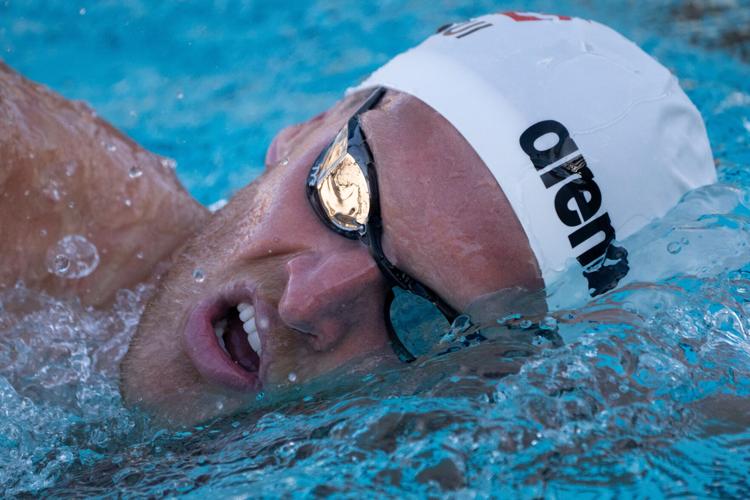
Grant House swims during practice at the Mona Plummer Aquatic Center, in Tempe on May 8.
He didn’t talk much about what he was going through. The vitriol online. The side eyes at meets. The death threats. Maybe he talked to his older brother about it. Maybe his mom. But even then, he never let on how bad it was.
People are also reading…
The ripple effects from the lawsuit had upset some powerful people, and for the first time in his life, Grant House knew what it was like to be the bad guy.
He always had been a prodigy, surrounded by love.
“I was raised with chlorine in my blood,” House said. “I was raised in a crib next to the pool.”

Grant House with "Mama Bear" Sue House during a family vacation in Myrtle Beach, S.C. Grant was only 2, but he was already a veteran swimmer. Sue and Grant's father, Ray, are longtime swim coaches, and they had Grant in the water before he could walk.
His parents were youth and high school swim coaches. His older sister and brother were college swimmers. And Grant? He was setting speed records in the water at the age most other kids were learning to doggy paddle.
He was a champion in high school. He was a champion in college. And at what should have been the peak of his powers, House walked to the deck of a pool, specially built inside Lucas Oil Stadium in Indianapolis, about 90 minutes north of his hometown, ready to fulfil his destiny and become an Olympian — the real goal of any competitive swimmer.
The 660,000-gallon tank was set up in an NFL stadium because of the intense interest in the U.S. Olympic Swimming Trials.
For context, the most highly attended college swim meet of all time had a crowd of about 2,900 spectators. (The record came in October 2025 at the same Plummer Aquatic Center at ASU.)
The 2024 Olympic trials, meanwhile, drew more than 285,000 fans across 17 sessions at a nine-day event. (That’s close to 17,000 fans per session.)
“It was very exciting, very surreal … for the sport of swimming to have that type of opportunity on that magnitude,” House said.
They all should have been cheering for their returning hero.
Instead, there were jeers, hecklers and a crescendo of boos.
House insists he didn’t hear any of it.
“Fortunately, for me, I didn’t know that I was booed, walking out,” he said. “I typically have my headphones in, and I focus on my internal process of breathing, (putting) one foot in front of the other, getting behind the block.”
His family and friends weren’t wearing headphones.
“I feel like I’m a pretty strong woman,” Grant’s mom, Sue House, said in an interview with the Arizona Republic. “I’m a pretty solid person as far as being strong for my kids, and there aren’t many times they’ve seen me cry.”
Then she choked up.
“That was hard,” she said. She took a long pause. “That was hard.”
It was hard on the rest of the family, too.
“You want to cry,” said Ashley Smith, Grant’s sister, who’s more like a second mom. “It hurts my heart … It hurts a lot to know how good of a human he is and the reason he does the things he does and for (all the boos) to be what people think about him?”
Big brother was upset, too.
“It really made me sad — a little angry to be honest with you. … As an older brother, I really struggle with it,” Kyle House said. “Swimming has been everything for us. The swimming community has been like family.
“This (rejection) has really reshaped how I feel about swimming.”
Grant House swam two events at the trials, the 200-meter individual medley and the 200-meter freestyle. He was almost fast enough, but in swimming “almost” doesn’t count.
The negative energy certainly made its way to the water, slowing House, one of the fastest, most consistent swimmers of all time.
“It was a buildup,” House said, noting that his problems had been mounting for years to that point.
“It was definitely a lot of subconscious stress, a lot of subliminal stressors, we’re talking five (years) times 365 (days in a year) — something that I had to try to navigate and grow through.”
Still, House refused to make excuses.
“Ultimately, an athlete’s responsibility is showing up that day and performing, regardless of the circumstances. … And unfortunately, I didn’t get to actualize my biggest dreams and goals of making the Olympic team.”
In other words, his heart was broken before the disappointing finishes at the trials in July 2024, and by August of that year, he would be lying on a table in a doctor's office, suffering from arterial fibrillation, a disease that normally strikes people in their 60s who have a long list of risk factors.
House’s AFib was hard to diagnose and harder to treat. It didn’t respond to medication, IVs, blood draws or any of the other typical methods doctors use to return a heart to a normal rhythm. So, “they manually restarted my heart,” House said.
“It was very scary, very alarming, very uncertain to have that much lack of control.”
Doctors stopped his heart. They had to kill him to save him. Grant House died because of his broken heart.
The last-ditch treatment worked, and now, at 27, an age when most swimmers have been retired for years, House is back in the water training for a shot at redemption. He’s been going around the nation talking about the case. He’s returned to competitive swimming, aiming for a shot at the 2028 Olympic Trials. And this week, House will return to Indianapolis to swim competitively for the first time since 2024.

Grant House (left front) talks with teammates during swimming practice at the Mona Plummer Aquatic Center, in Tempe on May 8.
Believe it or not, it looks like the crowd will be with him this time.
But who is Grant House, anyway?
Why all the hate in the first place? What exactly did he do that made him swimming’s public enemy No. 1? Is he really the guy at the center of the biggest sports story of this generation? And if that’s the case, shouldn’t we know a little more about him? Is his heart still broken? And what’s all this got to do with rap music and video games, anyway?
The Arizona Republic spent a few months investigating the answers to these and other questions and here’s the deal: The haters have it all wrong about Grant House.
Ushering in a new era in college sports

Grant House acknowledges the crowd at the Mona Plummer Aquatic Complex at ASU before a meet. House helped transform ASU from an "also-swam" program into one of the nation's best.
Grant House should have been a hero.
Instead, he became a pariah for doing the right thing. He can tell you now, better than most anyone, that no good deed goes unpunished.
House is a clean-cut, well-spoken, handsome, chiseled, 6-foot-5 human dolphin from rural Indiana who gets good grades, calls his mother and probably helps Boy Scouts with their merit badges.
House is such a good guy, in fact, that it made him a little naïve.
He didn’t realize how many people would be furious at him for changing the landscape of college sports with a lawsuit that ultimately led to student-athletes getting paid to play — a move that’s had an ever-growing flood of unintended consequences over the last five years.
Aside from college quarterbacks driving Ferraris and point guards transferring schools to play for the highest bidder every year, the case prompted athletic departments across the nation to slash their swim rosters, sometimes in half, depending on the school and its budget.
That meant a kid who had hoped to swim for Texas might have to go to Tennessee and a kid who would have gone to Tennessee might end up at Tulsa and the kid who wanted to go to Tulsa would end up at Toledo and the Toledo kid would splash down at Trifling State or Trivial Tech.
Plenty of these castaways needed someone to blame for their slide from the deep end to the kiddie pool of big-time college swimming, and Grant House became an easy target, since he’s the “House” in House v. NCAA, the federal case that ushered in the “NIL” era, allowing players to use their fame and popularity to earn money from “name, image and likeness” endorsement deals.
Previously, student-athletes were considered amateurs. The only compensation allowed came in the form of scholarships and, before 2008, the scholarships were limited to tuition and fees, rather than the entire cost of a college education.
The rigors of life as an athlete also severely limited the types of degrees that were reasonable to pursue. Football coaches making millions of dollars don’t want to hear about a chemistry final when there's a trip to the Rose Bowl on the line. Better to major in basket weaving to stay on coach’s good side.
“College sports has changed so much since my time,” ASU men’s and women’s swimming and diving coach Herbie Behm said.
“I specifically remember when I was in college — and I’m not even that old, this was in like 2010 — where it was legal for the coaches to give us a bagel, but if they gave us a bagel with cream cheese, that was a fireable offense because they were providing us with a meal.
“If you told kids that now, they’d be like, ‘Wait, what are you talking about?’”
It was a change that had to come, eventually, even if conventional wisdom said it never would.
The NCAA, founded in the early 1900s, was the only authority that mattered when it came to governing college sports. For more than a century, the organization defined college athletes as amateurs, and anyone found to be receiving or giving impermissible benefits — like cars, clothes and cash — faced stiff penalties. If the violations were deemed too egregious, programs could be hamstrung for years, and the involved parties would find their names erased from the record books.
But by the time House v. NCAA was filed in 2020, college sports were big business, a multi-billion dollar industrial complex involving television networks, advertisers, shoe companies, tax dollars, arenas, coaches, administrators and schools that all took a taste of the profits while starving out the student-athletes who generated the attention.
There was nothing “amateur” about this enterprise, and any level of critical thinking would have exposed the hypocrisy, and the mental gymnastics required to justify it.
But it’s easier to go along and get along than it is to do the right thing — unless you’re Grant House.
He started thinking about the inherent unfairness of the system after a chance encounter inside a dorm room at Barrett, The Honors College at Arizona State University.
It was during the pandemic, and House was listening to rap music.
The “rapper,” whose name has been lost to history since House never saw the guy again, was a fellow honors student who had set up a crude recording studio in his closet to make compositions that could loosely be described as music. However unlikely the scenario, if one of these tracks went viral, he’d become rich and famous overnight.
House listened for a while, nodded his head politely and eventually got up to leave, but as he was walking out, the would-be lyricist made a comment that stuck.
He said “he could benefit off this no matter how well or poorly it did, but if my teammate and I in the dorm rooms across the hall made the best music of all time and it reached the Billboard 100 or went No. 1, we couldn’t even collect anything” because of NCAA rules about what athletes could earn, House recalled.
The NCAA rules were restrictive at the time, and student-athletes faced a tangle of "what if" questions about any form of compensation connected with their status as an athlete. Even offseason jobs were subject to a thorough vetting process. The rationale, slim though it was, aimed to prevent a player from, say, painting a picture and selling it to a booster for far more than its market value.
On some levels, the rules made sense; but for House and others, the NCAA was going way too far. So he took a lap in a relay race that had started a few years earlier with a video game.
The revolution was begun on an Xbox
Ed O’Bannon should be a hero.
Instead, he became a pariah, the guy who got EA Sports’ NCAA video games pulled from shelves.
O’Bannon was a clean-cut, well-spoken, handsome, chiseled, 6-foot-8 human kangaroo from Southern California who led the historic UCLA men’s basketball program to its last national championship in 1995.
O’Bannon saw himself in a college basketball video game a few years after he retired from the NBA and wondered how that could be OK if he wasn’t getting a check?
“It wasn’t a complicated legal argument,” O’Bannon wrote last year in a guest column for Sportico. “If you use someone’s NIL to sell a product or service, you should get their consent and pay them.
“The case started (in 2008) when a friend of mine … invited me to his house to watch his son play ‘me’ in EA’s March Madness on his Xbox 360.”
O’Bannon wasn’t the only player whose NIL was being used without consent or compensation, but he led the 2014 lawsuit O’Bannon v. NCAA — and he won.
But instead of players getting paid immediately, the video games were discontinued, and O’Bannon became known as a spoilsport.
“The lawsuit was pretty taxing those five years,” O’Bannon wrote in a 2021 guest column for the Los Angeles Times. “… my kids saw a lot of the vitriol and hatred towards me, that in itself was taxing and hard. My wife and I knew what we were getting into. It wasn’t like I thought everybody was going to love us for doing this. But my kids were old enough to be on social media and to have friends on social media, and it was in their faces all the time.”
Still, O’Bannon had been out of the spotlight for a while by the time the case was resolved.
Grant House?
He was still competing for ASU and trying to make an Olympic roster.
There wasn’t anywhere he could go to hide, so he was about to take the first major losses of his life in full view of a scornful public.
A prodigy in the pool from a young age
Grant House was Mr. Perfect, growing up.
He’s the youngest child of Ray and Sue House. His brother, Kyle, is about nine years older. His sister, Ashley, was about 15 when he was born in 1998.
“I wanted to have one safe in the pool before I put another on the deck,” Sue House said, explaining the pacing of her family.
Grant calls her “Mama Bear.” He calls his dad, Ray, “Papa Bear.”
“You can tell he’s the youngest, right?” Kyle House said. “That’s classic youngest-child behavior.”

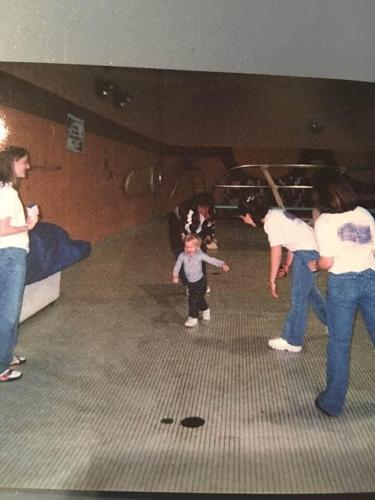
Grant House was everyone's little brother. He was about 2 in this picture, taken in 2000. His older sister, Ashley, was a sophomore, getting ready to go to a high school state meet. Her teammates treated him like family and many are among his biggest fans today.
Sue was a swim coach. Ray was a swim coach. Kyle and Ashley were both college swimmers. (Kyle at Purdue and later Queens University of Charlotte; Ashley at Baldwin Wallace University in Ohio.)
Grant? Everybody loved him, including Kyle and Ashley’s friends and teammates, plus all the swimmers Sue and Ray coached in the southeast Indiana town of Bright, an unincorporated community of a few thousand people along the Ohio border.
Kids who grew up there — about 30 miles west of Cincinnati and about 90 miles southeast of Indianapolis — were in something of a time warp.
It was the kind of place where parents didn’t worry too much if a game of basketball in the driveway morphed into a bike adventure through the woods with half of the neighborhood meeting down by the creek.
“It was a very small, very rural town,” Grant House said. “We had to go through two farms to get out of our subdivision.”
The only thing that kept Grant House indoors was swimming.
“A lot of my memories are poolside,” he said. “Growing up in a crib by the pool during practices.”
A crib? By the pool? Mama Bear adds context.
“With Grant, we had a playpen set up on the deck,” Sue House said. “He was on the deck every day with us. He was right along with these kids who were swimming with his brother and his sister.
“And all of those guys kinda took him on as a sibling (of their own.) He was exposed to so many different levels of swimming as he was little.

Grant House waits for his mother, Sue House, to finish preparing her team for a meet in 1999. She would seat him in a locker to keep him out of the way while she talked to her swimmers.
“If he got bored, we’d throw floaties on him, and he’d be at practices with the kids, floating around. You pick up a lot just from observing. And he seemed to develop really early.”
Grant was in the water from the time he was just a few months old. He would hear his parents and older siblings talk shop as they were driving to and from practices and meets. And he would tag along with his father as they drove around Ohio watching Ashley compete for the Baldwin Wallace Yellowjackets.
“Ray would go to the swim meets to watch Ashley in college, but he had to take Grant,” Sue House said. “So ... we loaded up every little Hot Wheels car he had, every little Bionicle he used. You know all the different toys that he had. Bey Blades and everything. Hand-me-down He-Mans that he had from Kyle.”
Grant got his do-gooder streak honestly.
At Indiana University-Indianapolis, “one of Grant’s very favorite pools,” an elementary-school aged Grant “slipped away and came back with a bag of snacks,” Sue House said.
“Ray goes, ‘Grant, where did you get those?’ He goes, ‘Up on the concession stand, they’re giving them away.’
“So, Ray took him up and said, ‘You have to pay for this, Grant.’”
Ray marched his son back to the register and made him pay for what he had taken. The lesson stuck.
Grant was especially close with Ashley.
When he was born, Sue was in night school, studying to be a counselor. Big Sis became Second Mom, changing diapers, warming bottles and rocking the little guy to sleep.
She was also his first coach.
Sue and Ray were running a high school swim team and a companion club swimming team. It gave Ashley, a high school swim coach today, a chance to work with the youngsters.
She must have been pretty good.
“By the time (Grant) was 6 he was fully swimming; and by the time he was 8, he was having state records,” Sue House said.
Grant was 8 years old and was setting records in the 10-and-under division.
“I remember Grant was 8 and at that age, you want it to be fun for the kids, otherwise they won’t continue with it,” Sue House said.
Grant was no different at first. He’d swim a race and seek approval from his parents and coaches like a normal little kid.
“He’d get out and say, ‘Did I do good?’ And we’d say, ‘You did great, Grant,’” Sue House said.
Then something changed.
“This time he came to me and said, ‘What were my splits?’” Sue House said, pausing for effect. “As an 8-year-old. I thought, ‘Oh, my God, we are doomed. We’re done.’”

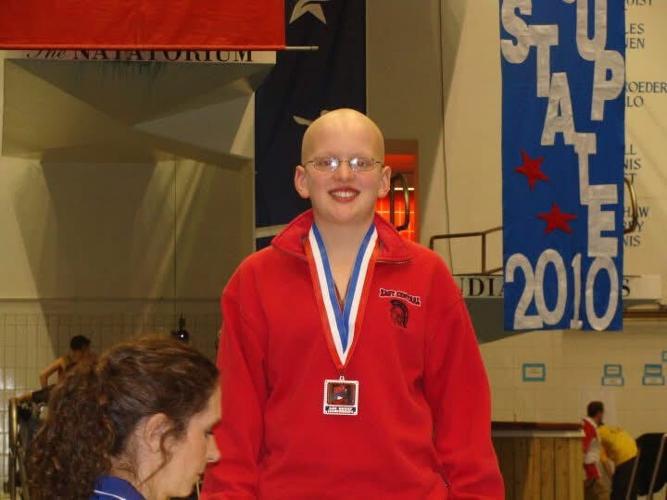
It used to be common practice for the best swimmers to go bald to reduce drag in the water. Grant House started shaving his head for championship meets when he was just 6. He was 12 in this 2010 picture at IU-Indianapolis, where he'll compete in June as a pro.
As it turned out, it wasn’t the House family that was doomed. It was every other swimmer in the region.
Grant didn’t burn out or switch sports after he started setting records. He didn’t lose interest or give up when things got difficult. He didn’t even quit as a teenager when he learned he had a severe iron deficiency in his blood.
He just kept winning.
“It was very early on that we knew he was promising,” Kyle House said, “and then it really exploded in high school.”
Grant spent so much time in the water with Kyle and his college teammates that they almost had to give the kid a varsity jacket.
He got so good that his parents decided to move across the border to Cincinnati so he could swim with and against the best competition possible.
He rewarded them by winning 13 state championships (eight individual and five relay) for Cincinnati’s famed St. Xavier program, giving him more titles than any other athlete in Ohio history.
“The winningest Ohio high school athlete ever,” Kyle House said, “almost winning every one of his events through high school swimming and posting some of the top times in the nation. That was really the start of it all, but we had pretty good insight early on when he was young that he was going to be something special.”
And when it came time to pick a college, there was really only one choice: Arizona State.
Bringing the best to the desert
There are levels to college swimming.
There are the elite teams: Texas, Florida, the entire Ivy League, Stanford, Michigan.
And then there’s everybody else.
ASU was part of the “also-swam” pack when the athletic department decided to ditch the program in 2008.
At that time, ASU wasn’t synonymous with Olympic heroes such as Bob Bowman, Michael Phelps or Leon Marchand.
The swimming Devils were consistently finishing in the middle of the Pac-12 and had only one top-10 national finish in the decade before the decision was made to disband the program. It turned out to be a rallying call for supporters who raised more than $1 million in donations from alumni and boosters to keep the team afloat until a permanent endowment could be established in 2014.
By 2015, with that fresh funding source in hand, athletic director Ray Anderson was ready to make a splash. He went out and hired U.S. Olympic coach Bob Bowman, who by that point had coached Michael Phelps to 18 gold medals and a stack of Wheaties boxes and magazine covers.
Phelps, in those days, followed Bowman wherever he went, associating the “Flying Fish” with Tempe.
Bowman started at ASU the way a lot of college coaches start: He tried to chase off as many of the existing athletes as he could to make room for his own guys.
His top recruiting target was Grant House.
“We joined at an interesting time,” said Aaron Beauchamp, House’s teammate and roommate at ASU.
Bowman was there to create “a serious Olympic program,” Beauchamp said.
Grant House was everything a coach could want. He spoke well. He had a great reputation. And he was a winner.
“You know it’s special when you get a freshman like that,” said Behm, who was an assistant under Bowman. “It’s like ‘OK, this guy gets it.’ … We knew the moment he stepped on that he was gonna be somebody to really help elevate this program.”
House became a two-time All-America honorable mention as a freshman. But he knew he needed to be around the best of the best to help reach his Olympic goals, so he started to help with recruiting, showing around campus guys like Marchand, who went on to win four gold medals with four Olympic-record performances at the 2024 Summer Games in Paris.

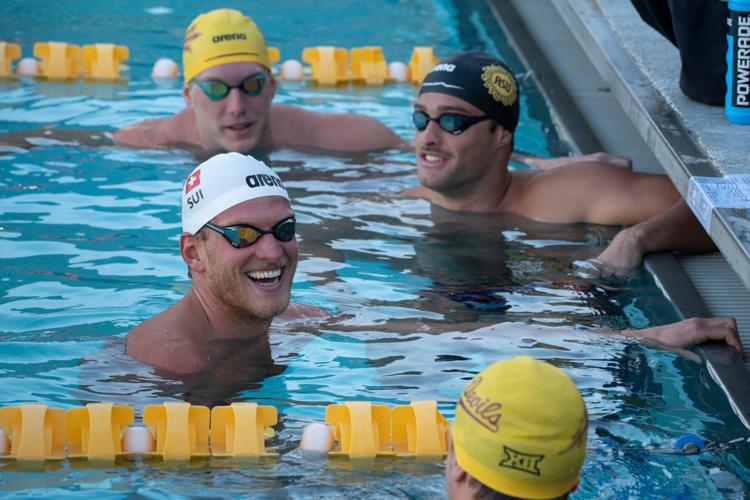
Grant House (right) with his good buddy Leon Marchand, the hero of the 2024 Summer Olympics in Paris. They were teammates at ASU, and House helped with the recruiting process.
“That’s what most people want and what most high-level athletes know they need: Teammates that are going to help them and push them to get that extra 1% out of themselves,” Behm said.
“Since his freshman year, he was really good about that. Talking to the athletes, talking to the parents about what we could get built here.
“It’s been pretty cool to see his journey because he played such a huge role in turning ASU from a team that was just kind of a team into, now, an elite team.”
In 2022-23, his senior season, House helped the Sun Devils to a Pac-12 title and a second-place finish at the NCAA championships, the best result in program history, and by the time the Arizona Republic spoke to House at the ASU pool in May, he was training alongside two Olympians and six national champions.

Grant House celebrates with his ASU teammates after his final college season in 2023. ASU finished second in the nation that season, the best finish in program history to that point. The next year, the Sun Devils would win the national championship.
Imagine what he could have done if he hadn’t been getting death threats.
What 'House v. NCAA' said and what it did
Few people understood it at the time, but House v. NCAA was about to drown the amateurism model that had always dominated college sports.
“People thought the ‘House’ in House v. NCAA was the House of Representatives,” Grant House said.
In fairness, it almost takes a law degree to organize the yearslong paper trail that led to a $2.8 billion settlement last summer along with a bevy of ongoing changes to college sports. And since the case was filed in 2020, it’s understandable that we were all a bit distracted by COVID-19, coast-to-coast race riots and “Tiger King” on Netflix.
News coverage centered mostly on how much was being paid to which players and who was transferring where to earn more.
The lawsuit, at its core, said the NCAA was wrongfully preventing student-athletes from receiving a portion of the billions of dollars generated annually from the games they played.
The case argued that players should be allowed to cash in on their own names, images and likenesses. Scholarships, the plaintiffs argued, weren’t enough in the modern era where college sports were big business.
The NCAA, meanwhile, argued that if student-athletes were paid, it would undermine education and competitive balance — while also harming sports that don’t generate enough money to sustain themselves, which was everything except football and men’s basketball.
House and his fellow plaintiffs, starting with a handful of others and later expanded to all Division I athletes, were saying the NCAA was in violation of the Sherman Antitrust Act, which the government used to take down railroad monopolies in the 1890s. House was named at the top of the suit because of his impeccable resume as both a swimmer and as a student.
Part of the plaintiffs’ argument was that the NCAA’s largest conferences were suppressing wages and preventing student-athletes from earning what they could on the open market.
As the case evolved, it was consolidated with others, swelling the financial stakes into the billions.
Eventually, a federal judge ruled in favor of House and the combined plaintiffs, prompting the NCAA to scramble for a settlement to limit potential damage claims, allowing every Division I athlete who had competed over the previous decade to seek compensation. The judge approved the settlement in June 2025.
The pay scale is tricky. But football and men’s basketball players are at the front of the line, with an opportunity for payouts ranging from $15,000 to $280,000 from broadcast NIL. There’s also a pay-for-play fund averaging about $40,000.
Most other athletes are looking at about $5,000 or $6,000 total.
Grant House, even as the lead plaintiff, fell into the latter category.
But he didn’t do it for the money. He did it because it was the right thing to do.
“The lawsuit for me, came from my time being a leader at Arizona State, and wanting to help athletes as much as I could,” he said.
He’s good with the outcome, even if the process left him for dead. “I feel like a lot more conversations have opened up, a lot more willingness to change has opened up, and that’s really exciting for me … It’s been a long five years (but) it’s really been unique and exciting to actually see forward progress, not just resistance against the inevitable.”
And lately, as he’s been competing on the nascent pro-swimming circuit, those boos he heard in Indianapolis have turned to cheers.
Haters gonna hate
Swim Swam, which bills itself as the world’s most popular online swimming media outlet, ran an article in December 2024 under this headline: “Grant House said he’s received death threats over House v. NCAA lawsuit.”
Some of the messages quoted included, “You are the worst human ever” … “You deserve the worst punishment in life” … “I will kill you.”
“It was quite shocking and it’s been emotionally challenging to work through,” House said at the time, speaking to Yahoo! Sports. “Never imagined it would escalate to that level.”
The Swim Swam comments section wasn’t much better.
“I am sorry you are getting death threats and being attacked, but you have destroyed every swimmer’s dream of swimming in college!” a user named Janet wrote. “So sad what has happened to all upcoming swimmers due to your selfish behavior and greed for money! Hope you do well with your compensation. So many swimmers trying to swim in the NCAA are now never going to be able to — thanks to you!”
A user named Charlie wrote, “He deserves it all (not gonna lie).”
A user called “Throw Out the X-Mas Tree” tried to be clever with, “Burn down the House!”
It’s unfortunate that a lot of the comments seem to be based on a false premise that Grant House received significant financial compensation from the $2.8 billion settlement.
The settlement will be shared by about 200,000 competitors across 360 schools and 24 sports in any given year − going back to 2016.
Grant House’s share as a swimmer wouldn’t pay for a semester at ASU.
Still, no good deed goes unpunished.
House took abuse that he never deserved and wasn’t ready for, straining his mind and, ultimately, his body.
The guy was a wreck by the time he stepped to the blocks in Indianapolis. It’s no surprise that he struggled that day.
Good thing he just doesn’t know how to quit.
“If you know that, then you know my son very well,” Grant’s father, Ray House, said.
Making a case for 2028
Grant House is always busy.
He has to be if he’s going to earn enough money to keep his Olympic dreams alive. There wans’t much for him in the settlement. And there isn’t much money in professional swimming unless an athlete has a major sponsorship, which House doesn’t.
These days, he helps create NIL opportunities for ASU swimmers as a part of the alumni board. He tours the nation speaking about House v. NCAA at colleges and universities. He trains young athletes. He runs the Swim Bros Podcast with his brother, Kyle. He trains with the U.S. national team. And he competes professionally, typically wearing a throwback jersey as a nod to the crowd in attendance.
Don’t be surprised if he shows up at IU-Indianapolis for the TYR Pro Swim Series event on Wednesday dressed like Reggie Miller.
And don’t be surprised if he ends up on a podium or two.
“Not to sound boastful, but I’m used to seeing him do well,” Ray House said.
“He usually rises to the occasion, you know? The stiffer the competition, the more he raises the bar.”
(Plus, as Sue House said, that’s one of his favorite pools.)
The public’s perception of House has changed, thanks in part to all of his recent exposure, and these days he’s back to getting cheered everywhere he goes. Just like when he was a kid.
But he isn’t done.
Grant House has one goal: Reach the 2028 Summer Olympic Games in Los Angeles.
“To make the team would be a lot,” he said.
“A lot of people say they had to overcome so many obstacles, but for me the obstacles came later in life. I always had a caring mother and father, a loving and supportive brother and sister, and family and a community beyond belief that transcended generations that I didn’t even know because of how great my parents were and the communities they built,” he said.
“It would be a testament to all the support, the commitment, the love and the joy that I’ve received in my life.”
His heart has healed, literally and figuratively. The AFib is no longer a problem. And the haters have mostly faded out as people have learned more about the case.
“I think healing the broken heart after disappointment is real,” House said. “It’s part of the athletic journey.”
As his good buddy Leon Marchand says, “Win or learn. There’s not really a loss in his mind,” House said. “The scoreboard will indicate differently (sometimes), but really taking every opportunity as ‘yes, you objectively won’ or ‘what did you learn?’ You kind of just stop it there and don’t let your mind run rampant.”
Aside from that, House refuses to let bitterness take root.
“I don’t believe hatred beats out hatred,” House said. “I believe love beats out hatred. We’ve seen that time and time again in history, and I think that’s the way God would want it to go. That’s the way that he teaches. … Love prevails over hate.”
The only thing left for House to complete his redemption arc is to qualify for Los Angeles in 2028.
He’d be one of the oldest competitors at the trials, but according to House and the people he trains with, he’s only getting faster.
“Grant’s right on the Olympic level,” said Behm, who still works with House.
“He’s right there in the mix with those guys. I think what makes him really good is just how driven he is. He’s been working super hard, daily, literally, since he was like 11 years old. That’s the biggest thing.

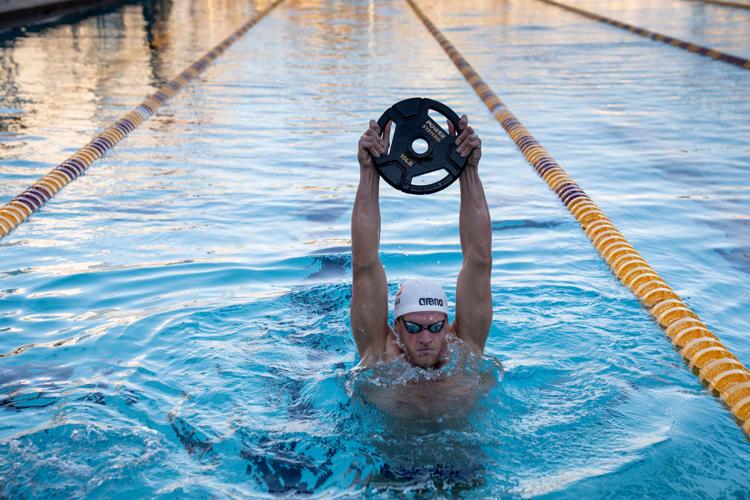
Grant House does the vertical kick drill during swimming practice at the Mona Plummer Aquatic Center, in Tempe on May 8.
“He’s a big guy. 6-foot-5, 6-6, maybe 215, 220, 5% body fat. He’s kinda got it all. … He’s doing everything; basically every moment is dedicated to this.”


 The recruiter’s dilemma: Ex-Cat Pastner adapts to new world of college basketball