

PHOENIX — It's taken half a century.
But with Democrats now in control of the state House and Senate, Arizona may finally join other states in ratifying the Equal Rights Amendment to the U.S. Constitution.
The proposal by Sen. Lauren Kuby, if approved, puts Arizona on record in support of the amendment, which declares that "equality of rights under the law shall not be denied or abridged by the United States or by any state on account of sex.''
Action in Arizona would mean that, at least on paper, 39 states have ratified the change, more than the three-fourths requirement for a constitutional amendment.
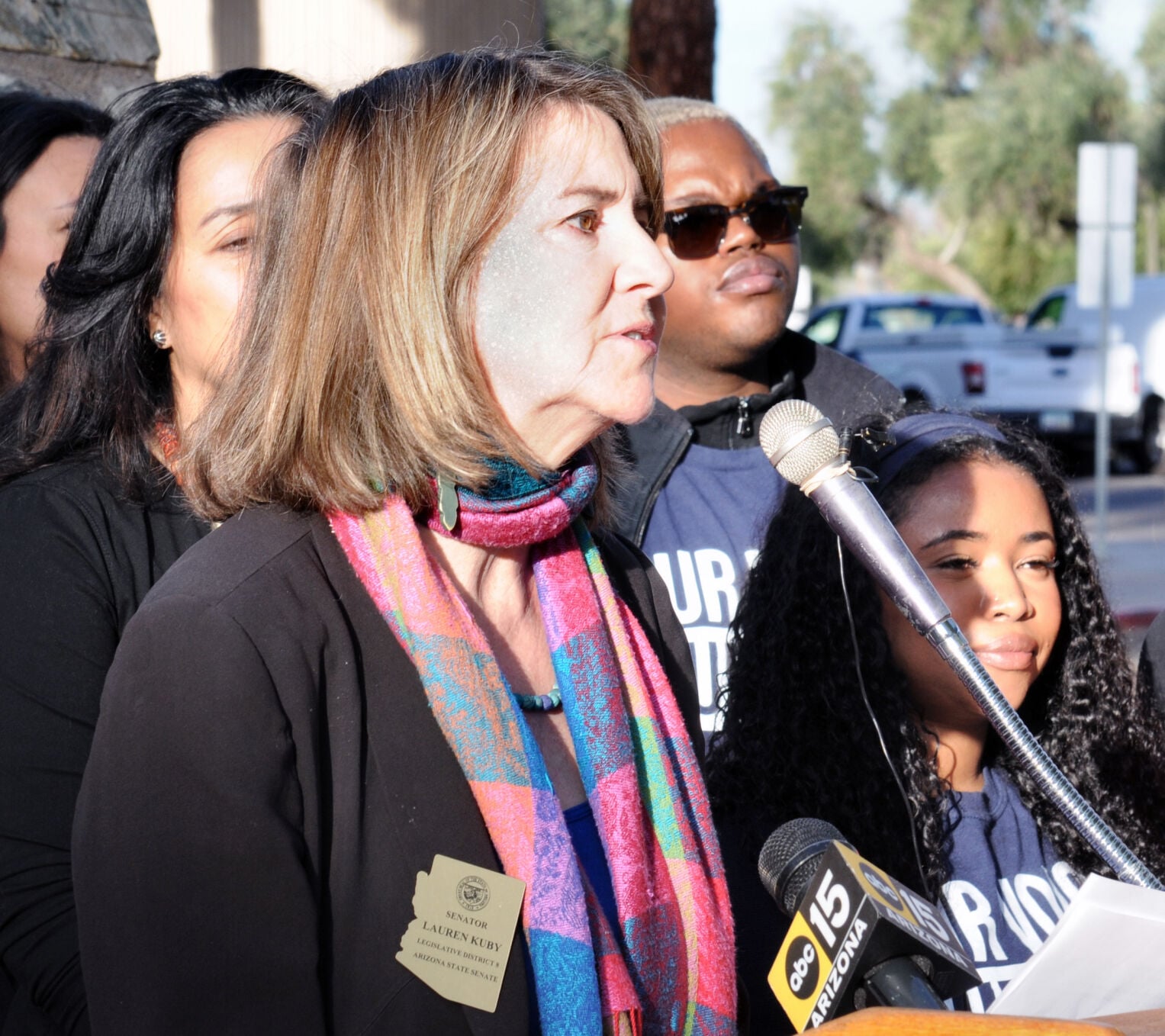
Sen. Lauren Kuby, seen here at a news conference in April 2026, is pushing a measure that Arizona join other states in ratifying the Equal Rights Amendment to the U.S. Constitution.
Only thing is, the deadline Congress had set a 1982 deadline for ratification. And by that point, only 35 states — short of the 38 needed — had given their legal blessing.
People are also reading…
Three other states have acted since then: Nevada, Illinois, and Virginia; Arizona would be the fourth.
But what also has happened is that five other states have since voted to rescind their ratifications, though the legality of that move has never been litigated. Nor has the validity of that 1982 deadline.
But Kuby, a Tempe Democrat, told Capitol Media Services none of that should deter lawmakers here from acting.
"Arizona should not allow an unresolved procedural dispute to determine whether it is willing to affirm equality as a constitutional principle,'' she said.
It's not that Arizona lawmakers — of both parties at one point — have not been trying for years since Congress approved the measure and sent it to voters in 1972.
Among the early supporters was the late Supreme Court Justice Sandra Day O'Connor. Then a Republican state senator, O'Connor voted in the Senate Judiciary Committee in 1974 — well within the deadline — to advance the measure to the full Senate.
Facing opposition, she agreed to back off and instead support sending it to the ballot for an "advisory vote.'' But that, too, failed in the Republican-controlled chamber.
Successive efforts since then, usually by Democrats, ended up being thwarted by members of the GOP majority who used procedural maneuvers to even block a roll-call vote.
Now all that has changed, with Democrats in charge. Still, don't expect the Republicans who remain in the House and Senate, now in the minority, to fall into line.
That starts with Senate Minority Leader John Kavanagh. His response, in essence: why bother.
"The drive has expired,'' he said, citing the 1982 deadline.
"So, if they want to make a public statement, they can,'' said the Fountain Hills Republican. "But it's not going to make any difference.''
Anyway, he said, a lot of Republicans believe the measure is unnecessary.
"Sex discrimination is already illegal,'' Kavanagh said. "I think it's already covered by law.''
That, Kuby said,may be true.
"But there's a fundamental difference between having laws that protect you from discrimination and having the Constitution explicitly recognize your equality,'' she said.
And there's a more practical reason.
"Laws can be repealed,'' Kuby said.
"Political majorities change,'' she continued. "Courts change.''
But constitutional principles, Kuby said, "are meant to endure.''
That's not dissimilar to what O'Connor wrote to constituents in 1974 when they told her they did not support having Arizona ratify the amendment, answering concerns she heard that it would "threaten family life as we know it'' or it would somehow "deprive women of their freedom.''
"On the contrary, the Equal Rights Amendment recognizes the fundamental dignity and individuality of each human being and rests on the basic principles that sex should not be a factor in determining the legal rights of men or women,'' O'Connor wrote. Anyway, she said, what's in the amendment affects only governmental actions and not "private actions or the private and personal relationships of families and husbands and wives.''
There are other issues, however, that continue to survive as objections.
"It would enshrine in the United States Constitution the right to abortion,'' said Peter Gentala, president of the Center for Arizona Policy. "It treats abortion like health care when it is not.''
Kuby concedes that point. In fact, she said, it was the lack of the ERA that forced abortion rights advocates to put Proposition 139 on the 2024 ballot to put that right into the Arizona Constitution after the U.S. Supreme Court overturned Roe v. Wade and its right of women to terminate a pregnancy.
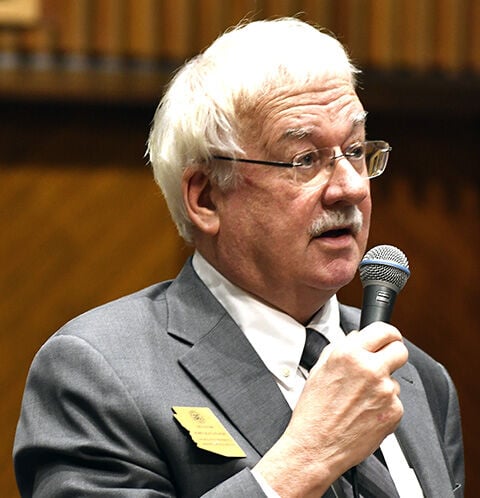
Kavanagh
But Kuby said that adoption of the ERA — and extending that right across the country — is a worthwhile goal.
"Constitutional equality cannot be fully realized if the government can impose unequal restrictions on people's reproductive lives due to their sex,'' she said. And Kuby said those who want to go back to the days when abortion was illegal should understand that's not what most people think as reflected by the fact that Prop. 139 was supported by voters in each of the state's 30 legislative districts.
Kavanagh has other concerns.
"It would subject women to the military draft,'' he said.
There is no actual draft now, though males from 18 to 25 are still required to register with Selective Service. And even without such requirements, the Department of Defense reports close to 18% of active duty military are women.
Yet some countries, like Denmark, Sweden, Norway, North Korea and Israel do have universal conscription. Kavanagh called that irrelevant.
"I don't think that we're in a situation like Israel where we have a shortage of males for the draft,'' he said.
"I don't think the public would be happy about having their daughters drafted,'' Kavanagh said. "I think if somebody goes to war, it's probably best to have males do that.''
Kuby said that misses the bigger point.
"I doubt the public wants anyone — man or woman — being sent off to fight more illegal wars,'' she said.
Kavanagh has one more objection, one he has raised repeatedly in regard to other issues: He does not want a constitutional amendment that would preclude setting aside separate facilities for men and women in bathrooms and locker rooms. And he said it even could be interpreted to preclude sex-segregated facilities in college dorms and prisons.
"What is it with Republicans and their obsession with bathrooms?'' Kuby responded. "We're talking about equality under the Constitution, and they keep returning to bathroom stalls.''
And all those issues, she said, are off the mark.
"Maybe they need to center their grandmothers, mothers, and sisters in their thinking and help remove discrimination from our laws,'' Kuby said. "That is what the ERA is all about.''
O'Connor, in her 1974 letter to constituents, also dismissed concerns about erasing lines between men and women.
She said when the U.S. Senate Judiciary Committee issued a report on the ERA, it concluded that "equality'' — the term in the amendment — does not mean "sameness.''
"The report states that the amendment would not prevent reasonable classifications based on characteristics unique to one sex, nor does it prohibit the states from requiring separation of the sexes under certain circumstances, as in public hospitals, institutions, or restrooms,'' O'Connor wrote.
Still, she acknowledged, there were "many sincere and genuine questions'' about the language.
"And these questions would, no doubt, require litigation to resolve them,'' O'Connor said.
Howard Fischer is a veteran journalist who has been reporting since 1970 and covering state politics and the Legislature since 1982. Follow him on X, formerly known as Twitter, Bluesky, and Threads at @azcapmedia or email azcapmedia@gmail.com.


