PHOENIX — Newly reelected Secretary of State Adrian Fontes sees the Democratic trifecta in Arizona as a once-in-a-generation opportunity to revamp state election laws.
Fontes says other states have made significant changes over the last few decades that make it easier for their residents to register and vote. But in Arizona, under the control of a Republican Legislature, he said the state has not only failed to keep up but in some areas actually gone backward.
So Fontes tells Capitol Media Services he has crafted an aggressive agenda for consideration by his fellow Democrats, who will control the Arizona House, Senate and Governor's Office, when the Legislature convenes in January.
People are also reading…
Among his proposals:
Automatically sending early ballots to all registered voters;
Allowing people to register to vote right up through Election Day;
Requiring counties to use vote centers versus allowing ballots to be cast only at local precincts.
Fontes also wants lawmakers to repeal a 2016 law that makes it a felony to take anyone else's ballot to a polling place, with a few exceptions. He also says lawmakers should scrap another statute, passed in the wake of Donald Trump's losing his 2020 reelection bid, that bars county election officials from accepting funds from private sources to help run elections, including get-out-the-vote efforts.
GOP officials say it would hurt their party
The proposals are drawing objections from Republicans.
State GOP Chairman Sergio Arellano said the laws Fontes wants to repeal are designed to prevent fraud. And those the secretary wants to add, he said, would only make fraud easier.
That's also the contention of Fountain Hills Republican Sen. John Kavanagh.
There may be little, however, that Kavanagh can do to stop what Fontes wants to do: The November election gave Democrats control of both the House and Senate for the first time since 1996.
Arellano and Kavanagh both conceded that at least part of what they don't like about Fontes' plan is their belief it will give Democrats a political edge in future elections.
Fontes: Remove hurdles to voting
If there's a theme to what Fontes is proposing, it's to remove what he says are hurdles to voting.
That starts with scrapping the 2016 "ballot harvesting'' law, he said.
Prior to that law, both political parties had engaged in some form of the practice, having activists go out, often to neighborhoods where each presumed they had more political support, to see if residents had mailed back their early ballots. If not — and, in particular, if it were close to Election Day when it was too late to mail — they would offer to take the ballots directly to the polling places.
But with Democrats apparently more successful with that strategy, the Republican-controlled Legislature voted to make it a felony to handle anyone else's early ballot, with violators subject to a year in state prison and a $150,000 fine.
The law contains exceptions for family members, those in the same household, and caregivers.
Proponents said the law is designed to preclude fraud, or even the potential of fraud.
Fontes countered, "That is a politically motivated way to subvert votes."
"My job is to help as many voters vote as possible to ensure that these fundamental rights are upheld,'' Fontes said. "And if that means neighbors can help neighbors now? Good!''
Going along with that, Fontes said, could be automatically mailing a ballot to all registered voters.
In some ways, that's not much of a stretch from what already exists in Arizona, where upwards of 80% of votes are cast by mail. Many of those voters have signed up to have a ballot mailed to them automatically each year.
Kavanagh said what Fontes wants is a step too far, however.
"This floods the state with ballots,'' he said. Combining that with letting anyone go out and pick up ballots, Kavanagh said, creates a partisan advantage.
"You wind up with having large money, often out-of-state groups, hiring people to harvest ballots in areas or amongst groups that are more likely to vote Democrat than Republican,'' he said. "That's putting the thumb on the scale of the election.''
Kavanagh has another reason for his opposition. "Giving the ballot to everybody, many of those people are disinterested voters who probably don't have that much information about who to vote for,'' he said. "And I'm sure these ballot harvesters will be more than glad to help them fill out the ballot.''

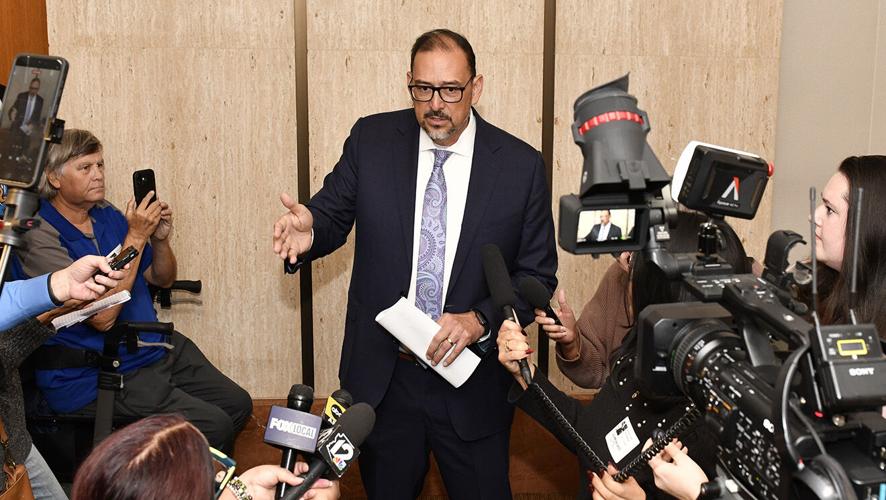
Secretary of State Adrian Fontes tells reporters following Monday's formal certification of Arizona's Nov. 3 election results that he wants more money to strengthen election security. He also has broad proposals for changes in state election laws.
Same-day registration
Kavanagh is no more enthusiastic about another Fontes proposal: allowing same-day registration, including on Election Day.
Fontes acknowledged that would not be a simple task, due to the need for additional staff and some important upgrades, if not a revamp, to the voter registration system, which currently sets a registration deadline 29 days before an election. But he said there are "so many checks and balances'' in the election system to ensure against fraud.
Kavanagh's concerns here, too, are political, as he envisions a conversation that could occur when an activist approaches an individual. "'Are you registered? Oh, I'll register you. And now let me drive you to the polls. And, oh, by the way, vote for these people','' Kavanagh said.
"It allows them to go out and target certain groups of people,'' the senator said, suggesting that these efforts would be focused on areas where there are more likely to be Democrats, such as where homeless people hang out and university campuses, he said.
Kavanagh did not dispute that the same option to go out and find voters would be available to Republicans.
Arellano, however, said that's not realistic — at least for members of his party.
"Even before 2016 ... when I went up to a Republican door and I tried to ask them to hand me their ballot because I work for the party and I'm knocking on doors, they pretty much run you off their step,'' he said. "We're not as successful on it.''
No evidence of fraud
Fontes said that backs up what he is saying: The concerns over things like ballot harvesting and whether more people should have access to ballots didn't arise until some Republicans were unhappy with election results and started to claim that Arizona needs greater security to prevent fraud.
That discussion came up as the legality of the ballot harvesting law was being debated in 2021 at the U.S. Supreme Court.
One of the arguments by foes of the restriction was that it would disproportionately affect minorities, which would bring changes in voting laws into question under the Voting Rights Act.
Attorney Michael Carvin, who was representing the Arizona Republican Party, which had been granted the right to intervene to help defend the 2016 law, was asked by Justice Amy Coney Barrett why his client was in the case.
"Because it puts us at a competitive disadvantage relative to Democrats,'' he acknowledged.
As it turned out, the Supreme Court upheld the law even though Justice Samuel Alito, writing for the majority in the 6-3 decision, acknowledged there was no evidence of fraud.
"But prevention of fraud is not the only legitimate interest served by restrictions on ballot collection,'' Alito wrote, saying then — as Kavanagh does now — that "third-party ballot collection can lead to pressure and intimidation.''
What Fontes wants to do is, in many ways, diametrically opposite of what Republicans have been pushing in recent years. They've wanted an earlier deadline to turn in early ballots, requiring all election equipment to be manufactured in the United States, and codifying standards for verifying signatures on early ballots. All were vetoed by Democratic Gov. Katie Hobbs.
Arellano said all were justified, claiming that "people on both sides of the aisle can agree that elections aren't fully verifiable.'' But he rejected the idea that any distrust in elections is due to GOP lawmakers and candidates sowing doubt.
That includes not just Trump's 2020 loss in Arizona — upheld despite multiple lawsuits challenging he results — but the unsuccessful lawsuit filed by Republicans Kari Lake and Mark Finchem, failed 2022 candidates for governor and secretary of state, respectively, who argued that machines used to tabulate votes are inherently unreliable.
Fontes said there's no reason to believe that changes in election laws will somehow lead to fraud.
He said nothing disturbs the 2004 voter-approved law that requires proof of citizenship before anyone can be registered to vote in state and local elections.
Nothing would preclude those who get a ballot mailed to them from instead voting at a polling place where they would, as now, be asked for proof of identification. And nothing changes existing law that says early ballots are verified by comparing signatures on the return envelopes with those that county officials already have on file.
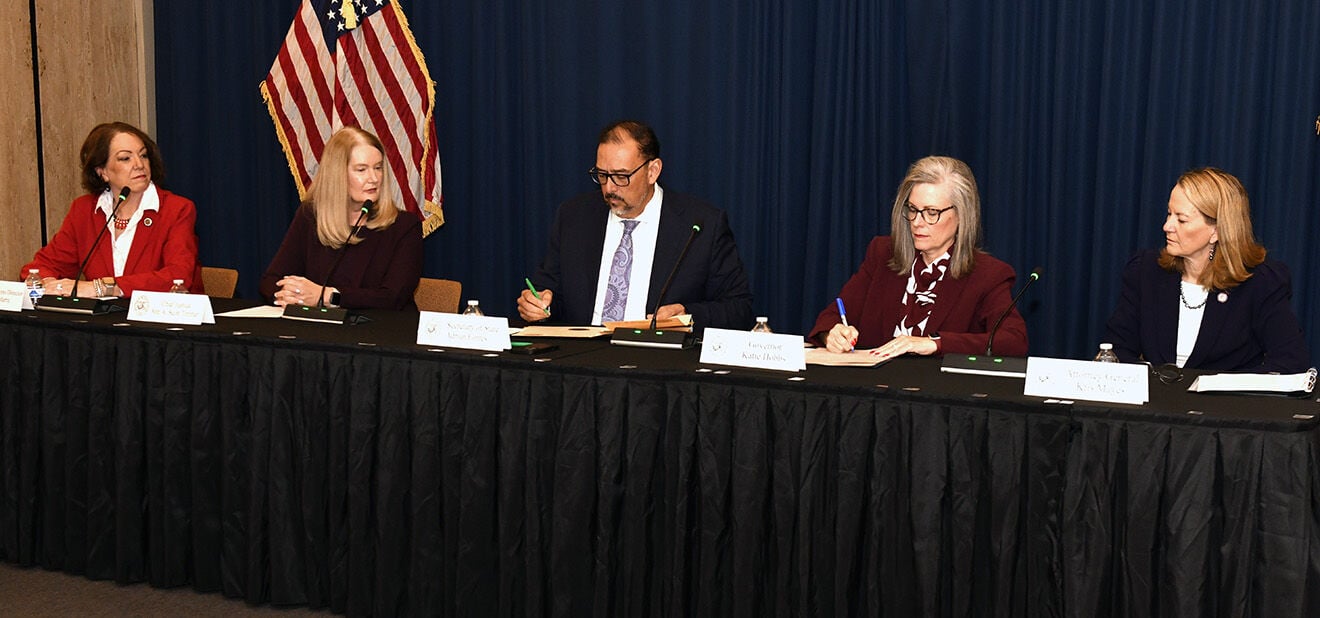
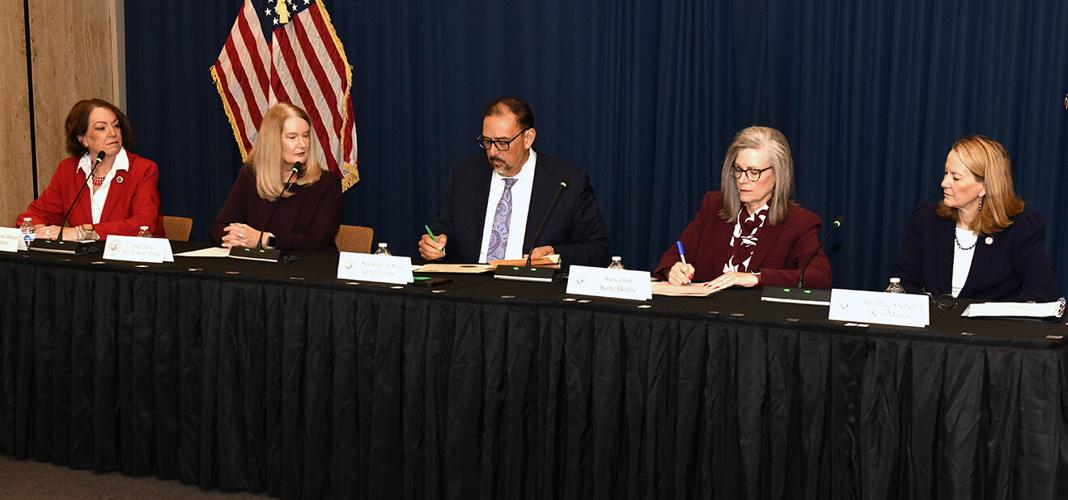
Arizona officials from left: Elections Director Lisa Marra, Supreme Court Chief Justice Ann Scott Timmer, Secretary of State Adrian Fontes, Gov. Katie Hobbs and Attorney General Kris Mayes shown Monday, certifying the results of the 2026 general election. The results showed a turnout of about 60% of Arizona's 4.37 million registered voters.
Get-out-the-vote funding
Fontes has another thing on his wish list: Repealing a law that makes it illegal for counties' election officials to take money from any private source to help run elections, including get-out-the-vote efforts.
That law followed disclosure that nine Arizona counties got more than $6 million in the 2020 election — the one that Trump lost — from the Center for Tech and Civic Life. That group reported it had received $400 million from Mark Zuckerberg, CEO of what then was Facebook but is now Meta.
Here, too, proponents of the ban argued that Zuckerberg was seeking to turn out Democratic voters.
Jennifer Marson, executive director of the Arizona Association of Counties, told lawmakers who were debating the 2021 proposal that the grants were to help defray some of the costs of running an election during the COVID pandemic. And she pointed out that four of the nine counties that received grants had Republican majorities.
That didn't stop GOP lawmakers from voting to approve the measure. Republican Doug Ducey, who was then governor, signed the measure even though he rejected claims that the money was a secret effort to turn out more Democrats.
"We are grateful for the assistance we received in 2020,'' Ducey said. "Nothing in this law should be interpreted as being unappreciative.''
Fontes said there's no reason to block nonpartisan charities like the Center for Tech and Civic Life from providing help.
"You're talking about a Legislature that has consistently and continuously thwarted efforts for election officials to reach out, to inform voters about how it is that they can vote and make sure that voters are aware of deadlines,'' Fontes said.
He said the restrictions on accepting aid "are based on conspiracies and lies.''
Howard Fischer is a veteran journalist who has been reporting since 1970 and covering state politics and the Legislature since 1982. Follow him on X, Bluesky and Threads at @azcapmedia or email azcapmedia@gmail.com.