A key proponent of Proposition 144 argued in a debate that the multiple provisions it would put into the Arizona Constitution are simply designed to enhance election security and lead to faster results.
That will improve voter confidence in the system, said Greg Blackie, deputy director of policy at the Arizona Free Enterprise Club, presenting the pro-144 side in Thursday night's debate.
But Randy Keating, representing Prop. 144 opponents at the debate, called the changes little more than "window dressing'' for what he contends is the real goal: Wiping out the ability of Arizonans to cast early ballots.
"This is a clever attempt to trick us into surrendering or voting away one of our most fundamental rights,'' Keating said. "The politicians who wrote this Trojan Horse constitutional amendment did so in a misleading way because they didn't want voters to actually see what its implications would be.''
People are also reading…

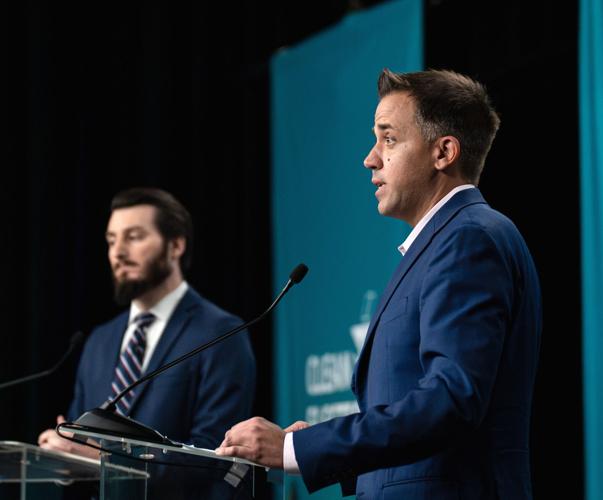
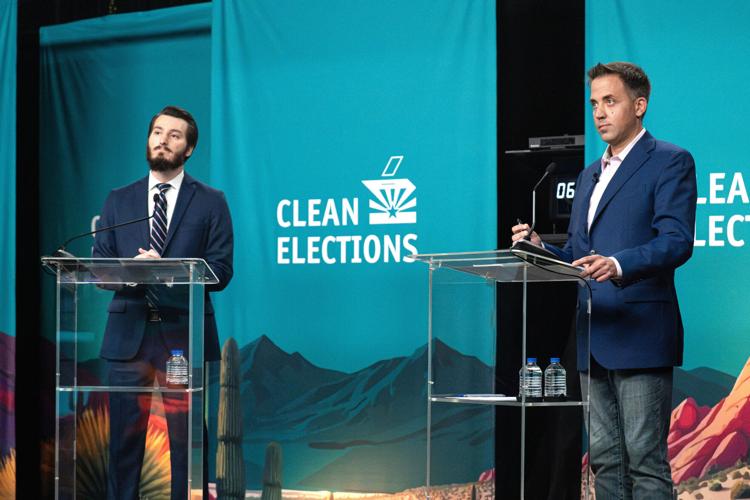
Greg Blackie, left, a supporter of Proposition 144, debates proposition opponent Randy Keating Thursday night.
Blackie agreed that the measure, placed on the ballot by the Republican-controlled Legislature, would impose a first-ever requirement that those who vote early also must "show valid government-issued proof of identity before casting a ballot in each election.''
That ID requirement now exists only for those who vote in person. Early ballots, by contrast, are verified by election workers who compare the signatures on the outside of the envelope with the voters' signatures they have on file.
But Blackie, whose organization was involved in crafting the ballot measure, acknowledged Prop. 144 doesn't explain to voters exactly how people who vote early — more than 80% of Arizona voters — would be able to provide that proof. Instead, he said, approval of the ballot measure would leave that up to future legislators.

Greg Blackie, left, gives the pro-Prop. 144 side in a debate Thursday night with anti-144 representative Randy Keating.
For example, he said, lawmakers could decide that voters must provide some sort of information on the ballot envelope, such as writing in a four-digit code that could be a Social Security number and then covering it with some sort of privacy shield so that election officials could not trace a specific ballot to a specific person.
"Or, who knows?'' Blackie said. "In the future maybe you can go to 'my.arizona.vote' and upload a picture of your ID, and then your ballot is verified.''
Leaving that to chance is not acceptable, said Keating.
He said if lawmakers want voters to enact a requirement for ID for early ballots, they should have put the details into Prop. 144 "so we could know exactly what we're voting on'' rather than simply leaving it to future lawmakers.
Other provisions
Keating, a member of the Tempe City Council, filed an unsuccessful lawsuit to have Prop. 144 tossed off the ballot based on arguments it was trying to get voters to approve too many unrelated issues as a single take-it-or-leave-it package.
He also was behind a separate petition drive to put a competing measure on the November ballot, one that would have enshrined the right to vote early into the Arizona Constitution, regardless of whether Prop. 144 was approved. It fell short of the 383,923 valid signatures needed to send it to voters.
Blackie spent much of his time in the hour-long debate talking not about early voting but instead about other provisions in the measure.
One, for example, would spell out that only citizens can register to vote in Arizona.
Keating pointed out that already is state law. And he called that provision in Prop. 144 "a blatant attempt to fool voters'' into approving the more far-reaching provisions — including the ID requirement — that he said could pave the way for lawmakers to kill early voting.
He noted this isn't the first bid by GOP lawmakers to impose new requirements.
They referred a measure to the ballot in 2022 that would have mandated that those voting by mail must provide their date of birth and state-issued voter identification number on the ballots. It was defeated, albeit narrowly, by a margin of 50.4% to 49.6%.
Blackie countered that fears Prop. 144 would lead to killing early voting are overblown. State lawmakers could kill the process right now if that was the goal, he said.
It's true that they have that authority.
Prior to 1991, Arizonans who wanted to vote early had to provide an excuse, such as a disability or being away from the voting precinct on Election Day.
But a new law that year passed by the Republican-controlled Legislature created no-excuse early voting. That law can be repealed at any time — assuming lawmakers could get the consent of whoever is governor at the time or, in the alternative, a two-thirds vote of the House and the Senate to override a veto.
Keating said there's a good reason no one has moved to repeal the popular voting method, even in years when there was a Republican governor and GOP-controlled Legislature, because no one saw it as a problem.
What changed, he said, is that Republicans only got concerned about early voting after Democrat Joe Biden won the 2020 presidential election and there were claims of irregularity — none of which were ever proven.
He said a constitutional amendment requiring ID for early ballots could be used by a future Legislature in ways to make the process so difficult as to effectively kill mail voting.
There are reasons to question whether at least some Republicans — including state Rep. Alexander Kolodin, who wrote Prop. 144 — are looking to curtail early voting.
In 2022, before being elected to the Legislature, Kolodin filed suit on behalf of the Arizona Republican Party asking courts to declare that the only form of voting specifically authorized by the state constitution is in person, and on Election Day. He argued that any other method — including the current system of no-excuse early ballots created by the Legislature — is illegal.
That lawsuit went nowhere, however.
Early voting aside, Blackie said there are other reasons for voters to approve Prop. 144.
One, he said, would close a loophole in Arizona law. While the statute currently bans foreign nationals from spending money to affect who is elected, there is no such prohibition on foreign money being used to fuel campaigns for or against ballot measures.
Keating countered that if that is a real problem, lawmakers could take care of that right now by enacting a simple amendment to state law. But, here too, he said this is just something inserted into Prop. 144 to get people to vote for the entire package — including the language on early voting.
Blackie took much of his time to tout another provision, which would allow people who get early ballots to take them to polling places and have them instantly verified by providing identification.
Under current law — at least unless Prop. 144 passes with its voter ID provisions — those ballots dropped off on Election Day are set aside to be verified later, only after ballots cast in person are counted. That's the process that involves comparing signatures on envelopes with those on file.
That procedure, however, has resulted in delays in getting final election results, especially in close races.
"I think that many Arizonans don't like that it takes a couple of weeks to get election results when they see other, larger states have the results posted the night of or the next day,'' Blackie said.
Under existing law, Arizona counties are permitted to allow on-site tabulation. And in this year's primary election, 23,400 voters in Maricopa County chose that option.
Prop. 144, however, would mandate that all counties offer on-site tabulation, though no voter would be forced to use it.
Blackie said earlier returns, coupled with "everybody proving who they are,'' will raise confidence in the election system.
Keating countered that any doubts about the security of elections is an issue manufactured by Republicans.
"The fact of the matter is, if Donald Trump had won in 2020, we wouldn't be standing up here today talking about it,'' he said.
Keating also said voters should be concerned by another provision in Prop. 144. It would allow lawmakers to enact election laws "provided such laws are rationally connected to a legitimate state interest including timely and accurate election results, efficient election administration, election security, and preserving public confidence in the integrity of elections.''
He said that would limit the ability of voters to get state courts to challenge the validity of election laws because it would provide additional constitutional cover for whatever changes lawmakers enacted.
"When it is passed the Legislature will have carte blanche,'' Keating said, whether it is to expand voting or "maybe they create more restrictions.''
"This is a sloppy, blunt attempt to amend our constitution to give the partisans at the state Capitol unprecedented power over our voting rights,'' he said.
Blackie said all the language does is set a baseline for state courts to decide the validity of election laws. And he said if something approved by the Legislature runs afoul of individual rights, people still could take their case to federal court.
The debate, held in Scottsdale, was sponsored by the Citizens Clean Elections Commission.
Howard Fischer is a veteran journalist who has been reporting since 1970 and covering state politics and the Legislature since 1982. Follow him on X, Bluesky and Threads at @azcapmedia or email azcapmedia@gmail.com.