

Discussions about the greatest coach in any sport are often subjective and based on some arbitrary metric suited to fit an argument someone is making on behalf of a given coach. It is a fun game to play, but there generally isn't a right answer as there are multiple coaches who have a resume worthy of being deemed the greatest.
John Wooden has long been considered the standard for college basketball coaches and often called the greatest of all time. That argument is largely based on the fact that he won 10 national titles in 12 years as the head coach at UCLA. He also oversaw the longest — 88 games — winning streak in college basketball history and got to 12 Final Fours.
That's an impressive resume, no doubt, but Wooden is no longer the right answer when it comes to college basketball's greatest coach.
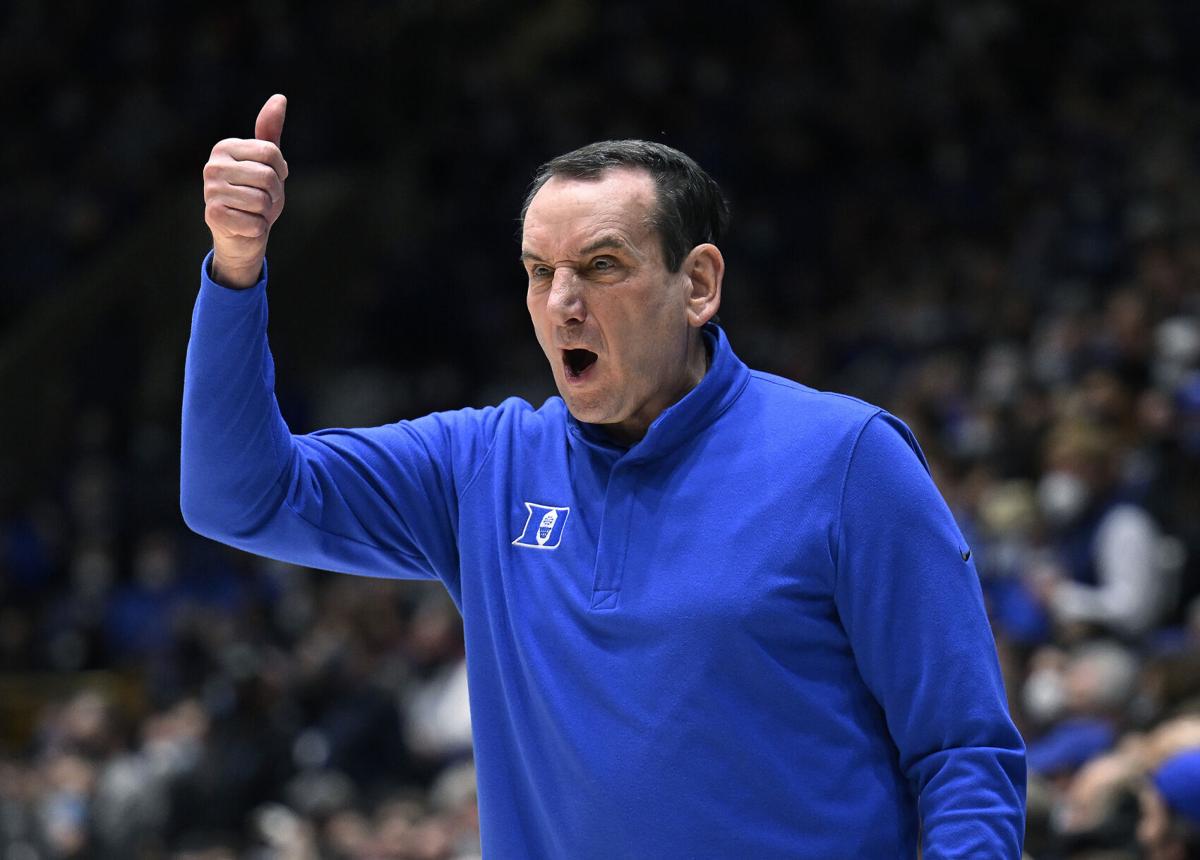
The right answer is Duke coach Mike Krzyzewski, aka Coach K, who is currently doing his farewell tour as he is set to retire at the end of this season. Tuesday night he will coach his final road game, and it just so happens it will be at the Petersen Events Center against Pitt.
People are also reading…
Hopefully Pitt fans give him a proper ovation and send off and understand what an incredible career he has had. He is and has been college basketball for at least the past two decades, and his career will never be duplicated.
His successor, Jon Scheyer, seems like a really intelligent man. He is one of Coach K's former players and assistant coaches, so his pedigree is impeccable. He isn't Coach K, though, but if he is able to have a fraction of his predecessor's success he will have an incredible career himself.
People who argue for Wooden would say, "10 national titles to Coach K's 5, end of discussion." But that is shortsighted and also shows a certain ignorance of the history of college basketball and how much the sport has changed since Wooden coached.
Wooden didn't have to navigate through 64- and now 68-team NCAA Tournament fields, so let's start there. He also didn't have to navigate, mostly, through balanced fields that were seeded based on the power of the teams and not geography. He didn't have to deal with an era where the best guys didn't go to school or the one-and-done era, and he didn't have to deal with the epidemic of transferring that led us to the transfer portal.
College basketball — because of the expanded tournaments — also has become far deeper in teams with players talented enough to beat the best teams. Plus, players have figured out they can get to the NBA from anywhere, so they don't need to go to a powerhouse and wait their turn.
How many titles would John Wooden have if Kareem Abdul-Jabbar or Bill Walton skipped college and went straight to the NBA? Or if those two or any of his other future NBA players stayed a year then left, and he had to continually change his roster, recruit new stars and develop them every year only to have them leave?
And then there is that little thing about Wooden and UCLA's dynasty being at least partially built by cheating and that he didn't start to have his otherworldly success until Sam Gilbert gave him some help.
This is in no way meant to disparage what Wooden accomplished — it is utterly amazing. He is incredible and should be held as one of the greatest of all time as what he did is amazing. But in context and based on the era they coached in, what Coach K has accomplished is more impressive, tougher and greater than Wooden.
Coach K has as many Final Fours as Wooden and might pass him on that list this year. He has about 500 more wins than Wooden, and he has won 15 ACC Tournament and 12 ACC regular season titles. He has done it through at least three different eras of college basketball and has evolved and adapted to stay on top.
The fact that he has gotten to 12 Final Fours in this modern era of college basketball is ridiculous. It is so hard to do given all the road blocks there are to building a roster to stay on top for more than a year or two. You add all of the stuff he has done with USA Basketball and the fact he essentially fixed the US Olympic program and to me there is no question he is the greatest the sport has ever seen.
He turned Duke basketball into a brand and a brand that is second to none, and his career has been marked by greatness at every turn.
It isn't often you get to say goodbye to a true legend that is somewhat larger than life, but Pitt fans will get that chance Tuesday night. Coach K is a once in a lifetime national treasure — one every basketball fan should respect and understand just how much he has contributed to the game.
5 things to know about Jon Scheyer, who will succeed Mike Krzyzewski as Duke coach
1. He beat out Derrick Rose, among others, to be Mr. Basketball of Illinois in 2006.

Scheyer finished his career at Glenbrook North as the No. 4 scorer in state history, and he led the Spartans to berths downstate in three of four seasons, including the Class AA state title as a junior in 2005.
As a senior, the 6-foot-5 shooting guard scored an incredible 21 points in 75 seconds while trying to lead the Spartans back in a loss to Proviso West in the Proviso West Holiday Tournament. He finished with 52 in that game, averaged 32 as a senior and took Glenbrook North back downstate.
In the Class AA quarterfinals, the defending champion Spartans lost to eventual state champ Simeon, led by junior point guard Derrick Rose. But when it came time for voting on the state’s Mr. Basketball award, it was Scheyer in a landslide. He received 217 first-place votes — 200 more than the next-closest player.
2. He won a national championship in his final college game.

Scheyer chose Duke over finalists Illinois, Wisconsin and Arizona, and he played in 144 games over four seasons for the Blue Devils, including 108 starts.
He averaged double-digit scoring all four years, topped by an 18.2-point average as a senior in 2009-10, when he was a first-team All-ACC and second-team All-America selection and the Blue Devils reached their first Final Four in six years.
Scheyer scored a team-high 23 points in Duke’s semifinal win over West Virginia, setting the stage for the national championship game against Butler.
In a memorable final that came down to a half-court heave by Butler’s Gordon Hayward that rimmed out, the Blue Devils prevailed, 61-59, with Scheyer scoring five of their last 10 points and finishing with 15.
3. An eye poke during an NBA Summer League game left him legally blind in his right eye.

After going undrafted, Scheyer was playing for the Miami Heat Summer League team in Las Vegas when the Golden State Warriors’ Joe Ingles accidentally poked him in the eye.
According to a Sporting News story, Scheyer suffered optic nerve damage, a slightly torn retina and a scratched cornea.
“I think my whole body went into shock,” Scheyer told Sporting News. “Some of the sight returned within hours, but not all of it.”
The injury wasn’t career-ending, though. Scheyer returned to play in the NBA D-League and overseas in Israel and Spain.
4. He replaced fellow Glenbrook North alumnus Chris Collins on the Duke coaching staff.

Collins, also Mr. Basketball of Illinois (1992) at Glenbrook North, was instrumental as a Duke assistant coach in recruiting Scheyer to Durham.
After Northwestern hired Collins in March 2013 to be its head coach, Krzyzewski brought Scheyer back to Durham in a special assistant role. Scheyer became a full-time assistant coach a year later when Steve Wojciechowski took the head coaching job at Marquette, and he was promoted to associate head coach after the 2017-18 season.
Collins, Wojciechowski and Jeff Capel were all seen as possible heir apparents to Coach K at one time or another, but it’s the younger Scheyer who wound up getting the call.
“He is clearly ready for this opportunity and has shown it repeatedly throughout his playing career and as a coach on our staff the past eight seasons,” Krzyzewski said in a statement Wednesday.
5. He’s a member of the National Jewish Sports Hall of Fame.

Scheyer’s father, Jim, is Jewish, and Scheyer was raised in the faith. The 2005 Glenbrook North team that won state featured an all-Jewish starting lineup.
Scheyer was inducted into the National Jewish Sports Hall of Fame in 2006.
When he played professionally for Maccabi Tel-Aviv in Israel, Scheyer’s faith allowed him to become an Israeli citizen so he wouldn’t count against the team’s maximum of four foreign players.


