

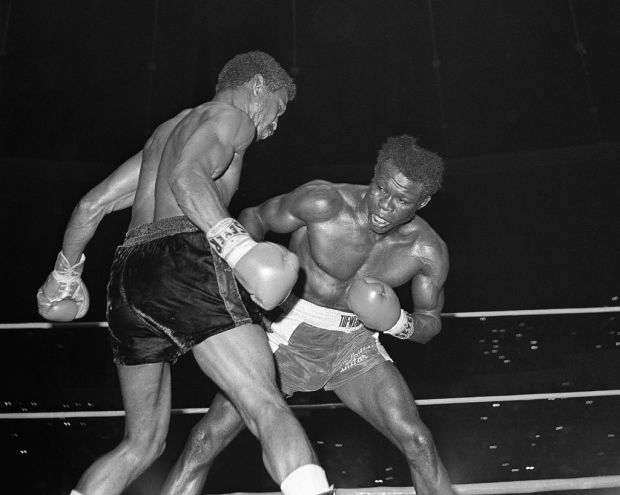
Inside the smaller theater at Madison Square Garden about five years ago, shortly before a world title fight, Emile Griffith was introduced one more time to the crowd. He rose shakily from his seat, waved ever so briefly and then sat down.
The applause kept going.
Revered in retirement perhaps more than during his fighting days, Griffith died Tuesday at 75 after a long battle with pugilistic dementia. The first fighter to be crowned world champion from the U.S. Virgin Islands, Griffith required full-time care late in life and died at an extended care facility in Hempstead, N.Y.
"Emile was a gifted athlete and truly a great boxer," Hall of Fame director Ed Brophy said. "Outside the ring he was as great a gentleman as he was a fighter."
An elegant fighter with a quick jab, Griffith's brilliant career was overshadowed by the fatal beating he gave Benny "The Kid" Paret in a 1962 welterweight title bout. The outcome darkened the world of boxing, prompting some networks to stop showing live fights.
People are also reading…
It also cast him as a pariah to many inside and outside the sport.
He went on to have a successful career after that fatal fight, but Griffith admitted later that he was never the same boxer. He would fight merely to win, piling up the kind of decisions that are praised by purists but usually jeered by fans hoping for a knockout.
Griffith often attended fights in his later years, especially at the Garden, where he headlined 23 times. He was also a frequent visitor to boxing clubs and "always had time for boxing fans," Brophy said, when visiting the sport's Hall of Fame in Canastota, N.Y., where he was inducted in 1990 with a record of 85-24-2 and 23 knockouts.
He was not received that well after March 24, 1962, when he fought Paret before a national TV audience at the Garden. Griffith, taunted by Paret with homosexual slurs before the fight, knocked out his bitter rival in the 12th round to regain his own welterweight title. Paret went into a coma and died from his injuries 10 days later.
"People spit at me in the street" afterward, Griffith said. "We stayed in a hotel. Every time there was a knock on the door, I would run into the next room. I was so scared."
The Paret fight left a cloud over the sport for many years. NBC halted its live boxing broadcasts, and then-New York Gov. Nelson Rockefeller created a commission to investigate the bout and the sport. The referee that night, Ruby Goldstein, never worked another fight.
The fight became the basis for the 2005 documentary "Ring of Fire: The Emile Griffith Story." One of the final scenes shows Griffith embracing Paret's son.
"I was never the same fighter after that," Griffith said. "After that fight, I did enough to win. I would use my jab all the time. I never wanted to hurt the other guy."
He retired in 1977 after losing his last three fights.


