Anastasiia Semenova desperately wanted to play college basketball in the United States.
The fifth-year forward for the Arizona women’s basketball team, who spent her first four seasons of college at Boston University, grew up in Saint Petersburg, Russia.

Michael Lev is a senior writer/columnist for the Arizona Daily Star, Tucson.com and The Wildcaster.
Her older brother, Andrey Semenov, scored more than 1,200 points for James Madison from 2008-14. Semenova wanted to follow his path.
She couldn’t showcase her skills in the U.S. because of COVID, so Semenova did the next-best thing: She compiled the email addresses for about 1,200 coaches across NCAA Division I and sent them her résumé and highlights.
“No one helped me,” Semenova said proudly. “It was my little summer project.”
People are also reading…

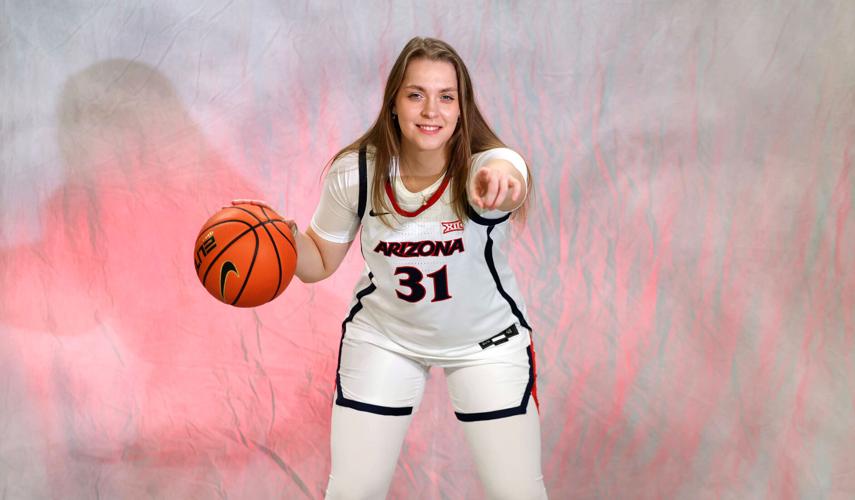
Forward Anastasiia Semenova (31) poses for a portrait on Arizona women’s basketball media day, Oct. 9, 2026, in Tucson.
It worked. Semenova signed with Boston U. and will finish her college career at Arizona, where she’s pursuing a master’s in business analytics.
“I feel like it's been everything I ever imagined it would be,” Semenova said of her coming-to-America adventure.
Semenova is one of thousands of international student-athletes who participate in NCAA athletics every year. Many have similar stories: They wanted to come to the States to play their sport, get an education and experience a different part of the world.
In some ways, it’s a classic American tale: Come to the land of opportunity and make your dreams come true.
Unfortunately, some want to spoil that dream.
Overall international enrollment at U.S. colleges declined by almost 20% from 2024 to ’25, with another 9% drop this year, according to reports. Per a survey conducted by NAFSA: Association of International Educators and others, 84% of U.S. universities surveyed cited “restrictive government policies” as the biggest obstacle for international students.

Head basketball coach Tommy Lloyd, left, and former Wildcat Steve Kerr share a laugh as they discuss how their experiences from living and traveling abroad have impacted their lives, on and off the court, at Bear Down Gymnasium in Tucson, Sept. 17, 2026.
Meanwhile, two Republican lawmakers last month introduced a bill that would severely limit the number of international athletes who could compete in varsity sports. The bill — dubbed the “TEAM USA Act” — states that “increasing recruitment of international student-athletes has reduced roster and scholarship opportunities for American student-athletes.”
That’s undeniably true. But is it actually a problem?
The greater good
Arizona men’s basketball coach Tommy Lloyd is among the pioneers of international recruiting in his sport. As an assistant at Gonzaga, he helped the Bulldogs land countless international players who helped the program become a national power.
Lloyd has continued that practice at Arizona. Nearly half of this year’s team (7 of 16) consists of international players. The rotation for last season’s Final Four squad featured players from Lithuania (Motiejus Krivas), Germany/Russia (Ivan Kharchenkov), Australia (Anthony Dell’Orso) and the Netherlands (Dwayne Aristode).
I asked Lloyd whether restrictive visa policies — which impacted two of his recent players, Sidi Gueye and Mabil Mawut, in different ways — and the proposed international roster cap concerned him. He was noncommittal at first. But the more he talked, the more his true feelings emerged.

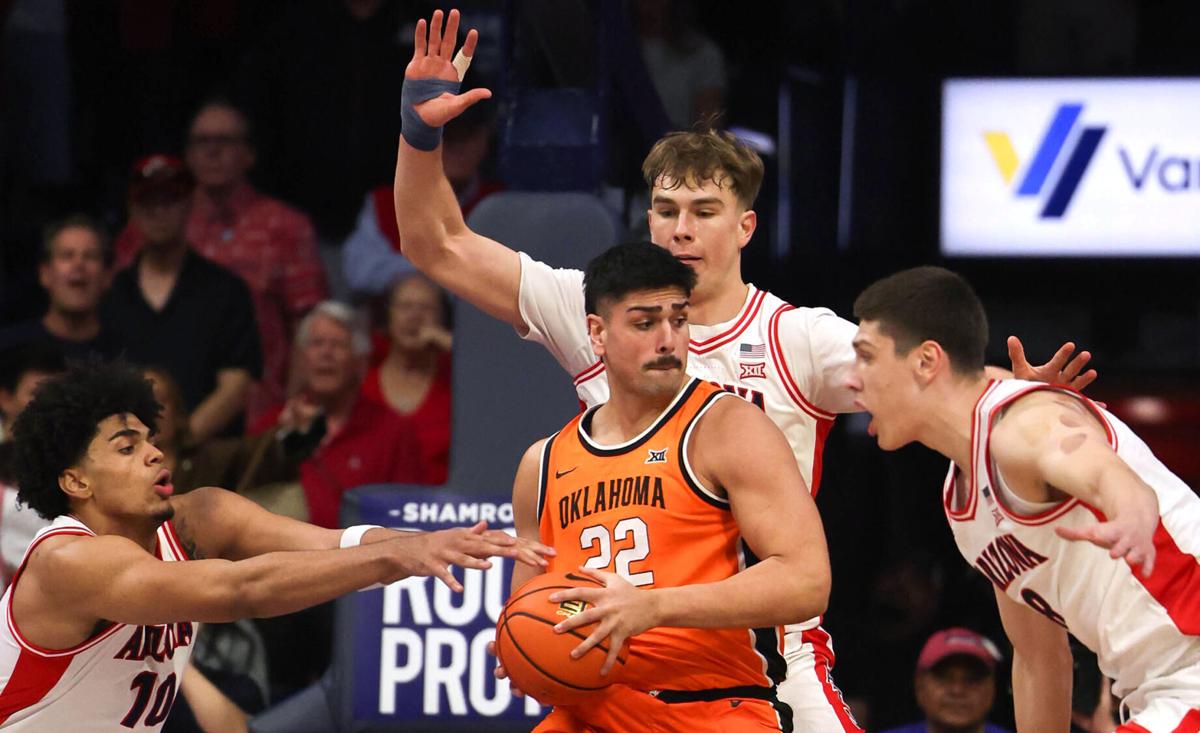
Arizona's Koa Peat (10), Motiejus Krivas (13), and Ivan Kharchenkov (8) swarm Oklahoma State forward Parsa Fallah (22) during a game at McKale Center, Feb. 7, 2026.
“Why would a country of immigrants be limiting others for opportunities? I don't know what we're gonna accomplish (with) that,” Lloyd said. “Having a worldview and world experiences and meeting others from other cultures is so valuable. That's more valuable to more Americans than withholding others' opportunities so they can be saved for Americans. It's a privilege when we get to meet people from other cultures and learn about them.”
That was the prevailing sentiment expressed by the two coaches I spoke to in subsequent interviews.
Jim Anderson has been Arizona’s men’s golf coach since 2012. He has seen the sport grow and change.
In each of Anderson’s first 11 seasons, at least 69% of his players were from the United States. Over the past four seasons, that number has shrunk. The average from 2023-24 to 2026-27 is 47.4%. Just four of the 10 players on the ’26-27 squad are Americans.
That reflects a nationwide trend. An NCAA study showed that 26% of first-year Division I men’s golfers in 2022 were international, up from 21% in ’17. For women, both numbers were over 30%.
“I don't start the year saying we have to get a percentage of either international or domestic (players),” Anderson said. “The game of golf has become increasingly more global. You see that. The other thing is, there are people from all over the world who now see the value that college — and specifically college golf — in the United States presents.
“Around the world, people know this is the place for 18- to 22-year-olds to develop as players and earn a degree. Consequently, that's why you're seeing a bigger shift of international players coming to the U.S.”

Jim Anderson, Arizona men’s golf head coach, watches his players at the 18th hole during the second round of the NCAA Marana Regional at The Gallery Golf Club, May 19, 2026.
The UA women’s golf team consists of six international players and two Americans. It hasn’t had a U.S. majority since 2017. It flipped the next year, and the Wildcats won the national championship.
Of course, the two greatest UA women’s golfers are Annika Sorenstam (Sweden) and Lorena Ochoa (Mexico). The 2025-26 men’s team, which tied for third nationally, featured Arizona’s first first-team All-American since 2004: Filip Jakubcik of the Czech Republic.
Last season’s team featured two Czechs; players from China, Japan and Sweden; and U.S. players from Arizona, California and Illinois.
Team meals were — and still are — opportunities to learn and bond.
“I love meals because that's when we do our best talking as a team,” Anderson said. “We play a game where you're largely by yourself, especially in the team setting, and not until you get to the table and have a meal together do you get to talk about the round or (what’s) going on or what have you. Oftentimes those meals are so important to the (team) culture.”
Having a diverse roster forces student-athletes — and even coaches — out of their comfort zone. That’s usually a good thing.
“We all have a much better understanding and a much better ... tolerance for differences,” Anderson said. “It creates a level of necessity of understanding, and that goes top to bottom within the organization.
“It's been incredibly positive to have so many different cultures woven throughout our program because you learn and laugh together (while) learning about each other. It’s such a great environment for personal growth.

Arizona senior Jay Friend and head coach Clancy Shields share a moment after the Wildcats won their Sweet 16 match against Oklahoma at LaNelle Robson Tennis Center, May 9, 2026.
“I'm talking about myself, too. I grew up in South Dakota. Now I've got players from Japan and China and Czech Republic and Ireland. We've recruited kids from South America. It's incredible to see all these people come together. We definitely have differences. But in the end, we collectively have goals as a team together.”
‘Playing for the badge’
The greatest moment in Arizona men’s tennis history took place May 10, 2026. In front of a packed house at the LaNelle Robson Tennis Center, No. 1 singles player Jay Friend clinched a 4-3 win over Oklahoma State to send the Wildcats to the Elite Eight for the first time.
“Do you think anybody in our crowd watching Jay Friend clinch that match ... looked at him and thought any less of him not being an American?” UA coach Clancy Shields wondered months later.
Of course not. Most probably didn’t know where Friend was from. (For the record, he was born in Japan and has lived in New Zealand, Singapore, Australia, Spain and the Netherlands.)
More to the point: Most probably wouldn’t have cared even if they did. Because Friend was representing the Block A that day.
“When you see the pride and the joy of him playing for Arizona at the end of the match, nobody looked at him as being an American citizen or anything else,” Shields said. “He's playing for the badge. He loves Arizona, and he'll always love Arizona.”
Shields has leaned heavily into international recruiting while transforming the UA men’s tennis program into a regular Sweet 16 participant. The Elite Eight team featured only one U.S.-born player. Same with the current team. Shields has never had more than four Americans or fewer than seven internationals on any of his 11 UA rosters.

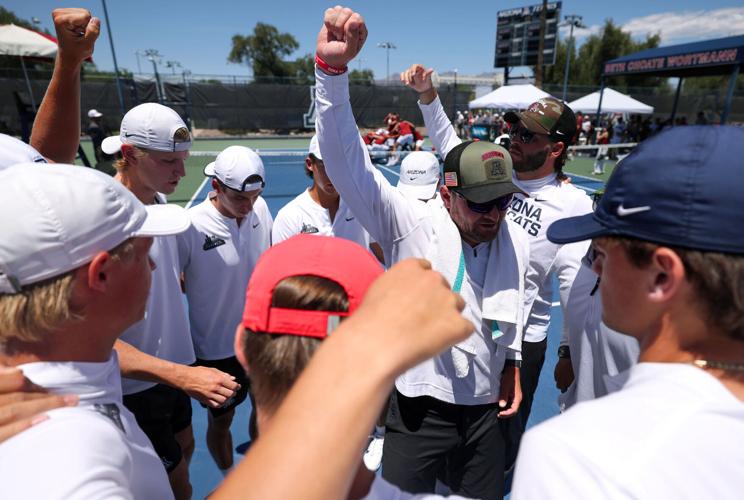
Arizona head coach Clancy Shields leads his team in a chant before the Wildcats faced Oklahoma in a Sweet 16 match at LaNelle Robson Tennis Center, May 9, 2026.
International players comprised 61% of men’s tennis rosters across Division I in 2017. By 2022, that number had grown to 64%.
For women’s teams in those years, the figures were 60% and 61%. The UA women’s team’s composition has fluctuated over the past decade-plus. The current squad features seven international players and one American.
All of which has Shields feeling somewhat conflicted.
He is pro-melting pot. Like Anderson, Shields relishes team meals and car rides where he and his players can learn about one another’s backgrounds and cultures and “stories of adversity.” Junior Zoran Ludoski, for instance, hails from Zrenjanin, Serbia, where his father is a cabbage and potato farmer.
“The conversations at dinner are awesome because the kids build these relationships,” Shields said. “Then in the summers ... they're going to see each other in Sweden, or they're going to visit another teammate in Spain, or they're coming back here. I think that's really important.”
Shields is also an American who cares about American tennis and wants it to thrive.
Shields understands Patrick McEnroe’s viewpoint. McEnroe spoke to Congress last month on behalf of the TEAM USA Act. In a subsequent interview with OutKick, McEnroe said: “We’re losing a pathway of dreams and opportunities for American kids. I think of it as the rungs on a ladder. If you keep taking away the rungs, the kids will eventually give up."
Regarding the bill’s proposal to cap international roster spots at 20% — basically the inverse of the current UA men’s and women’s tennis rosters — McEnroe said: “I’m completely in favor of international athletes participating, but there needs to be a reasonable limit. ... The system needs guardrails so American kids have an opportunity to play."

Arizona’s Jackson Cook poses for a photo during the team’s picture/video day in Tucson, Sept. 9, 2026.
Shields disagrees with the notion that reduced scholarship opportunities are discouraging American tennis players. He sees it as more of a grassroots issue. Plus, tennis simply isn’t as popular as it once was in the U.S.
“Being an American,” Shields said, “I want to have more opportunities for Americans.”
Then why not recruit more Americans? Shields also wants to win. He’s going to pursue the best players, regardless of where they were born and raised. Same with Anderson, who made a great point about what’s supposed to be a pillar of American society: “If we truly want to have the most competitive environment where the best get to the top because of their performance, then why would we want to restrict the pool?”
Learning and sharing
I’m pro-melting pot. When student-athletes from all over the world come together to form a team — living and working side by side for a common cause — it’s a wonderful thing. It’s an opportunity to learn and grow and open your mind to new ideas.
Jackson Cook, a senior walk-on for the UA men’s basketball team, has lived that life. Cook was born in Oxford, England. He moved to the U.S. at age 14 to play basketball and get a better education.
First at Montverde Academy in Florida and now here, Cook has met people “from all over the world.”
“It's been life-changing, man,” he said.
In what ways?
“Just as a person, the ways I've grown and developed from being in a new environment, meeting new people, learning new things,” Cook said.
“It gave me a lot of empathy. (I’m) able to put myself in other people's shoes, see what other people are going through. And just sharing my story as well to other people.
“There's truly nothing better than learning about other things that you might not know about and sharing your experiences.”
That’s what college is supposed to be about, no matter where you’re from.
Contact sports reporter/columnist Michael Lev at mlev@tucson.com. On X (Twitter): @michaeljlev. On Bluesky: @michaeljlev.bsky.social

Michael Lev
Sports Reporter/Columnist


 Cats Stats: 10 areas to watch as Arizona football enters 2nd half of season