“I think stats are for losers, to be honest with you,” Arizona offensive coordinator Seth Doege said a few weeks back. “You can justify stats any different way. Did you win or did you not?”
While we deeply respect Coach Doege’s football acumen, Sean McVay-esque recall and flair for storytelling, we take umbrage at his sentiment toward statistics. It’s the foundation upon which our business has been built at Cats Stats Inc. It’s right there in the name!

Despite Doege’s disparagement, we’re all systems go for the second half of the UA football season. After all, we’re here to serve you, our fellow fans of facts and figures.
Here are 10 sets of numbers to monitor over the final six regular-season games:
Fifita’s record pursuit
Quarterback Noah Fifita became Arizona’s all-time leader in passing yards earlier this year. He became the Wildcats’ all-time leader in passing touchdowns last year.
People are also reading…
But wait. There’s more.
Fifita is on pace to break two of his own single-season UA records.
Fifita has 16 TD passes in six games. If he can match that total in the second half, he’ll have 32. Fifita threw a program-best 29 TD passes last season.
Fifita set Arizona’s record for completion rate in 2023 at 72.4%. He’s currently at 73.3%, the third-best mark in the nation.

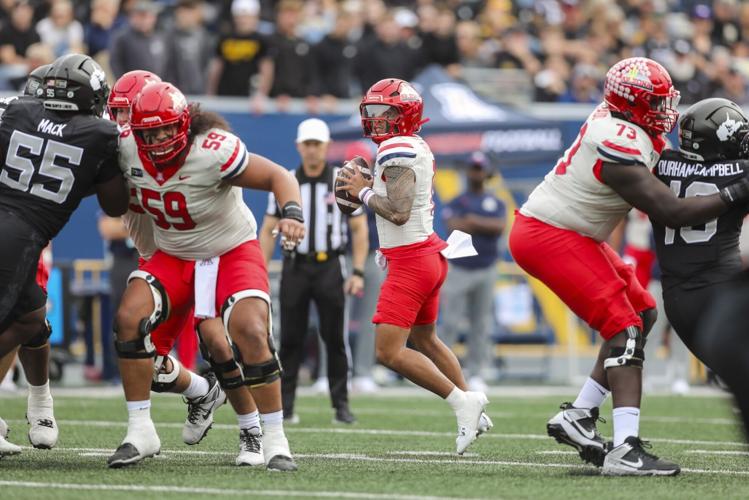
Arizona quarterback Noah Fifita drops back to pass during the first quarter of a 52-31 victory over host West Virginia on Oct. 10, 2026.
Of course, there’s no guarantee Fifita will be able to sustain his pace in either. Starting with Iowa State on Saturday, Arizona faces three of the Big 12’s top five pass defenses in the next five weeks. (Kansas State and TCU are the others.) Additionally, Utah leads the conference in completion rate at 49.3%.
Sacks allowed
Fifita excels at escaping the pocket, buying time and making plays off script. We’ve seen him do it countless times.
The numbers tell a different tale. (Damn you, Doege!)
Arizona has allowed 16 sacks, second most in the Big 12. Meanwhile, Fifita has the highest pressure-to-sack rate of his career at 28.3%, per Pro Football Focus. That means he’s not eluding pressure nearly as often as we think.
That 28.3% rate is the second highest in the Big 12 (minimum 106 dropbacks). Fifita’s career rate entering this season was 16.6%.
“We don’t want to take sacks,” UA coach Brent Brennan said Monday.
He added that Fifita generally makes sound decisions and protects the ball; taking a sack is sometimes better than forcing a pass into coverage.
Still, that raw number (16) is one Arizona needs to reduce. You never want to see the face of the franchise getting face-planted into the turf.
WR target distribution
Tre Spivey leads Arizona with 29 pass targets. Unfortunately, he’s out for the season because of a foot injury. So a new leader will emerge.
Chris Hunter (who’s also hurt) and Isaiah Mizell are tied for second with 25 targets apiece. Mizell is the one to watch here as Hunter remains out because of a lower-body injury.

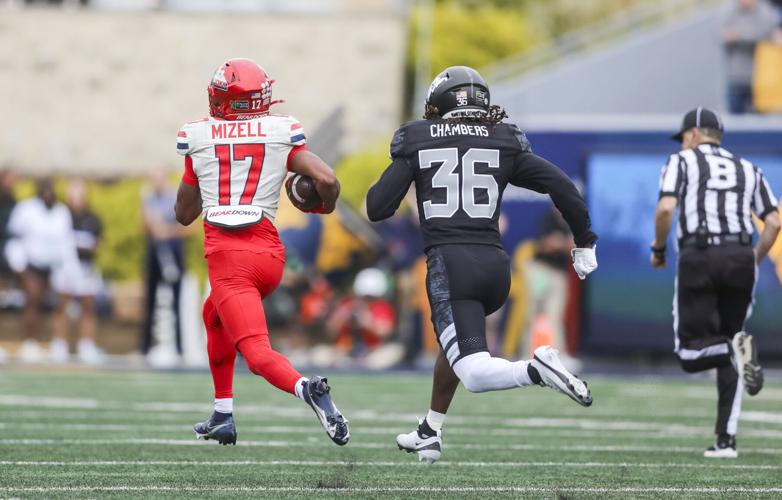
Arizona wide receiver Isaiah Mizell makes a catch and runs for a touchdown during the third quarter against West Virginia at Milan Puskar Stadium, Oct. 10, 2026, in Morgantown, W.Va.
After being thrown to just two times in the first two games, Mizell has been targeted 23 times over the past four games — 13 in the past two. He looked the part of a go-to guy against West Virginia.
While Mizell led the way with seven targets vs. the Mountaineers, Brandon Phelps ranked second with six. Expect that trend to continue as long as Giovanni Richardson (hamstring) remains out of the lineup.
Whenever Richardson returns, he could shoot up the leaderboard. Richardson accumulated 16 targets in about six quarters — if that. He and Fifita have great chemistry. They should be able to pick up where they left off once Richardson is healthy enough to play.
RB carry distribution
The running backs’ roles also should continue to evolve.
Kedrick Reescano has by far the most rushing attempts with 72. Quincy Craig and Antwan Roberts have 24 and 23, respectively.
But Roberts’ role has expanded of late. The transfer from Marshall had seven carries in the first three games. He’s had 16 in the past three. And he’s done a lot with them, averaging an absurd 9.8 yards per carry for the season. He’s too much of a big-play threat to keep on the bench.
Craig averages 5.3 touches per game between carries and receptions. He’s a tough, quick-footed, change-of-pace back who can hit home runs or do the little things that go unnoticed, such as blocking a blitzing defender. We don’t see his role changing unless Reescano or Roberts get hurt.
Reescano isn’t as efficient as the other two — he’s averaging just 3.6 yards per carry — but he’s a physical tone-setter and a short-yardage specialist. Which leads us to our next category ...

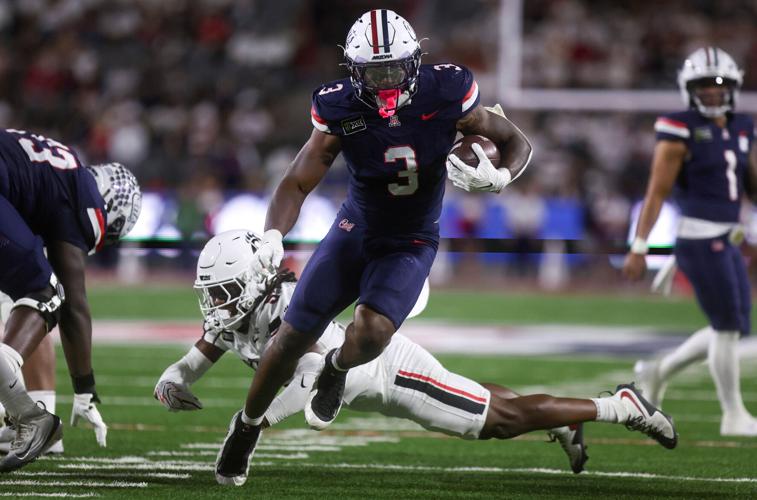
Arizona running back Kedrick Reescano weaves through Cincinnati defenders during the game at Casino Del Sol Stadium, Oct. 3, 2026.
Red-zone TD percentage
Arizona is performing exceptionally well in the so-called “red area.” The Wildcats have scored touchdowns at a 73.9% clip inside the red zone, the fifth-best mark in the Big 12 and tied for 22nd best in the country.
Red-zone offense was a weakness during Doege’s first season. The Wildcats had a 54.4% TD rate, which ranked 14th in the conference and 105th nationally.
What’s changed? For starters, Arizona has that battering-ram back in Reescano, who has scored all four of his touchdowns in the “Ked Zone.”
Reescano had seven red-zone scores among his nine rushing TDs last season, so there must be more to it. Fifita’s decision-making is probably the X-factor.
Fifita has nine passing touchdowns in the red zone. Critically, he has zero interceptions. His red-zone TD-INT ratio last season was 16-2 — very good but not flawless.
Fifita also is a threat with his legs. He has two red-zone rushing touchdowns. He had three last season.
Takeaways
As we surmised before the season, Arizona’s takeaway rate has fallen off. Regression to the mean is an inevitability.
After leading the nation in takeaways per game last season (2.38), the Wildcats have forced only five turnovers through six games. It’s the sort of thing that keeps defensive coordinator Danny Gonzales up at night.
It’s possible Arizona is due for some regression the other way in the second half. There’s also a different way to look at this stat.

Arizona defensive coordinator Danny Gonzales talks to quarterback Noah Fifita against Baylor at Casino Del Sol Stadium in Tucson on Nov. 22, 2025.
Gonzales counts fourth-down stops as takeaways. It is, after all, a literal turnover on downs.
Arizona has 12 fourth-down stops so far — tied for second most in the country. Only Tulsa (13) has more.
Third-down defense
Speaking of things that keep Gonzales up at night ...
Despite playing well overall defensively, the Wildcats have struggled on third downs. They’ve allowed a 40.7% conversion rate, second worst in the Big 12.
Last season, Gonzales’ first as DC, Arizona yielded a 34.1% conversion rate. Anything below 35% is considered good.
The 2026 Wildcats get closer to that number if you take out the BYU game. The Cougars are the only team to convert more than 50% (6 of 11) against the Cats. Take that game — which is also Arizona’s only loss — out of the equation, and UA opponents convert at a 38.8% clip.
BYU, which climbed to second in the AP poll after knocking off Notre Dame, ranks third nationally in third-down conversion rate on offense. The top four are all from the Big 12: Houston, Kansas State, BYU and Arizona.
Opponent chunk plays
Arizona allowed the fewest scrimmage plays of 10-plus yards in the Big 12 last season (122), per CFBStats.com. The Wildcats ranked fourth nationally in that category.
They’ve been a bit more vulnerable to “chunk” plays so far this season. Arizona has yielded 70 plays of 10-plus yards. That ranks sixth in the conference and tied for 34th nationally.
The biggest change has come in pass defense. Arizona has yielded 45 plays of 10-plus yards vs. opposing passing attacks. The Wildcats surrendered 74 last season, second fewest in the nation behind Ohio State.

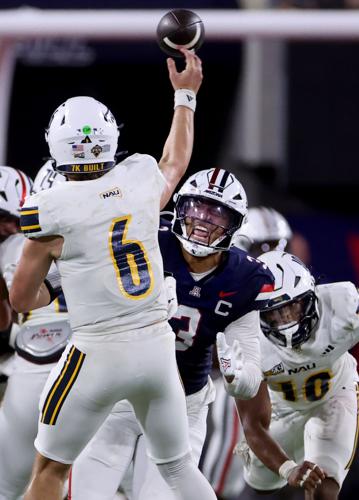
Arizona defensive lineman Tre Smith (3) storms in to pressure Northern Arizona quarterback Ty Pennington into a bad throw in the third quarter on Sept. 5, 2026, in Tucson.
It’s not surprising that Arizona has fallen off a bit in that area after losing five defensive backs to the NFL. It’s also worth noting that the UA pass defense played some of its best ball over the second half of last season.
Tre Smith’s ‘counting stats’
Sixth-year defensive end Tre Smith is unquestionably one of Arizona’s best defensive players. But you have to go under the hood to find the numbers that illustrate his effectiveness.
Smith ranks just 10th on the team in tackles (10). He’s tied for eighth in stops for losses (two). He doesn’t have a sack.
Smith also has yet to miss a tackle this season, according to PFF. His nine QB pressures are tied for third on the team. He’s solo third in defensive stops, which PFF defines as a tackle that constitutes a “failure” by the offense.
In run defense, Smith has a stop rate of 12.5%. That’s the fifth-best mark among all defensive linemen in the Big 12, per PFF (minimum 51 run-defense snaps).
Because of the role he plays, Smith likely won’t get the postseason recognition he deserves. But UA coaches understand his value. NFL teams do, too.
MSM’s FG percentage
Junior kicker Michael Salgado-Medina hasn’t had the breakout season we predicted. He has made 6 of 9 field-goal attempts for a success rate of 66.7%, next to last among 14 qualifying kickers in the Big 12.
Interestingly, all three of Salgado-Medina’s misses have happened in road games. For his career, Salgado-Medina is 11 of 21 (52.4%) in away/neutral-site games and 14 of 19 (73.7%) at home.
The good news: Four of Arizona’s final six regular-season games are in the friendly confines of Tucson.
Contact sports reporter/columnist Michael Lev at mlev@tucson.com. On X (Twitter): @michaeljlev. On Bluesky: @michaeljlev.bsky.social

Michael Lev
Sports Reporter/Columnist


 The case for (and against) international recruiting at Arizona, elsewhere | Michael Lev