

It’s the matchup of the week.
It’s the factor that likely will decide the game.

As they say in football parlance, it’s good-on-good.
Maybe even great-on-great.
Cincinnati (4-0, 1-0 Big 12) will bring a prolific rushing attack to Casino Del Sol Stadium on Saturday night. Arizona (3-1, 0-1) will counter with a much-improved rushing defense.
Just how potent is the Bearcats’ ground game?
How much better is the Wildcats’ run defense and why?
Those are the questions we will answer in “Cats Stats” this week ahead of the UA’s Big 12 home opener.
People are also reading…

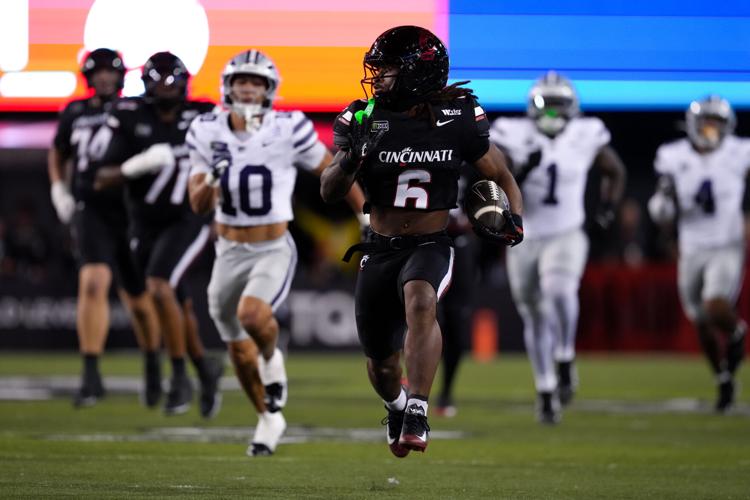
Cincinnati running back Gi'bran Payne runs with the ball against Kansas State in the first half at Nippert Stadium, Sept. 26, 2026, in Cincinnati.
Big-play Bearcats
Cincinnati ranks seventh nationally at 270 rushing yards per game. Three of the six programs ahead of the Bearcats are the military academies. One of the others is Rich Rodriguez-coached West Virginia, which leads the country in rushing attempts.
Arizona defensive coordinator Danny Gonzales made it very clear Tuesday: “If they come in here and run for friggin’ 270 yards, then we failed.”
The Big 12’s other Wildcats know the feeling. Kansas State visited Cincinnati last week. KSU had allowed an average of 96 rushing yards per game and 2.82 yards per carry.
The Bearcats steamrolled their way to 271 yards — just 17 fewer than K-State had yielded in its first three games combined — at 7.13 yards a pop.
In so doing, they dispelled any notion that their rushing prowess was fluky — or misleading because of a 418-yard performance vs. FCS Western Carolina in Week 2.

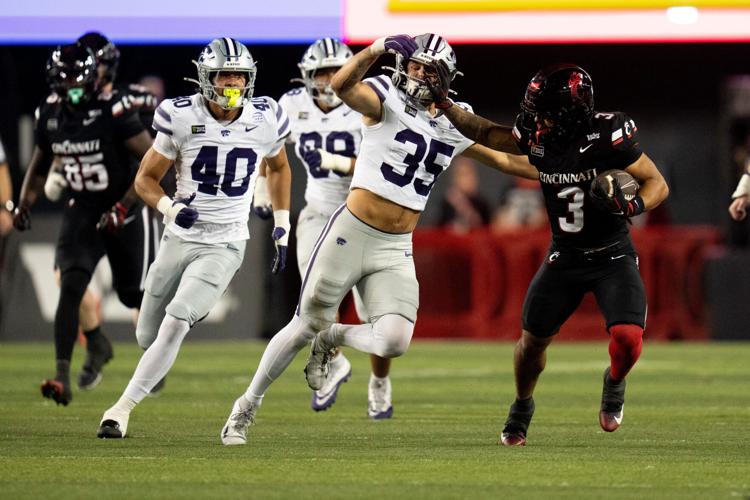
Cincinnati running back Cole Tabb stiff-arms Kansas State linebacker Gabe Powers in the second quarter at Nippert Stadium in Cincinnati on Saturday, Sept. 26, 2026.
Cincinnati also ranks seventh nationally in average per rush at 6.51 yards. (To keep things simple and consistent, we’re not adjusting for sacks as part of this exercise.) The Bearcats are third in the country with 16 rushing touchdowns.
No Bearcat averages as many as 100 yards per game. But two tailbacks, Gi’Bran Payne (92 yards) and Cole Tabb (77.8), average more than 75. Quarterback JC French IV averages 41 and has scored four touchdowns.
It’s the running backs’ average per attempt that truly jumps off the stat sheet.
Payne, a former four-star recruit who began his college career at Notre Dame, averages 7.2 yards per attempt. Tabb, a former four-star via Stanford, averages 11.1. Basically, every time Tabb touches the ball, it’s a first down.
They both went off against KSU, rushing for a combined 250 yards — 126 for Payne, 124 for Tabb. Payne had a long run of 53 yards; Tabb had a long of 30.
The UC backfield is a big play waiting to happen.
Cincinnati is tied for first in the nation with Army with 34 rushes of 10-plus yards, per CFBStats.com. UC is also tied for first in rushes of 20-plus yards with 12 (along with Indiana and UCLA).
The Bearcats rank second in runs of 30-plus yards (eight, one behind UCLA) and are tied for fifth in runs of 40-plus yards (four).
Cincinnati leads the Big 12 in all of the above. Meanwhile, Arizona has just three runs of 20-plus yards and only one of 30-plus (by quarterback Noah Fifita).
Strength in numbers
While their rushing attack has been inconsistent at best, the Wildcats’ run defense has been stellar.

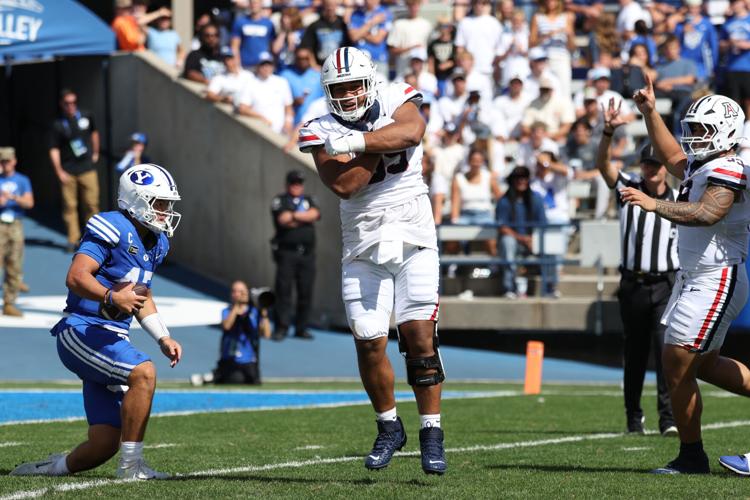
Arizona defensive lineman Leroy Palu reacts after a sack of BYU quarterback Bear Bachmeier during the second quarter at LaVell Edwards Stadium, Sept. 12, 2026, in Provo, Utah.
Arizona ranks third in the Big 12 in that category, allowing 80.25 yards per game. That’s more than 60 fewer yards than last season (143.23).
The Wildcats are yielding 3.06 yards per attempt, down from 3.94 a year ago.
Similar to Cincinnati’s rushing offense, Arizona’s run defense has one outlier game: The Wildcats yielded a net of minus-7 rushing yards in the season opener vs. NAU.
But even if you take that game out of the mix, Arizona is surrendering just 109.3 yards per contest.
Only one team, BYU, has eclipsed 100 yards against the Wildcats. But the Cougars’ 148 yards in Week 2 were less than half of what they rushed for in each of their other two games (308 vs. Utah Tech, 332 vs. Colorado State).
Gonzales believed Arizona’s run defense would be better this season. The Wildcats brought back the core of the front six and enhanced it with some talented transfers and freshmen.
Arizona doesn’t have a bunch of 300-plus-pound defensive linemen. Instead, the Wildcats rely on movement and come at opponents in waves. They played 11 defensive linemen in last week’s win at Washington State.
“That's like a dream because that means they're all good enough to play,” Gonzales said. “If they're not good enough to play in a game that we're not significantly up, they ain't playing. So I think that gave us a great benefit.”
Eleven defensive linemen have played at least 22 snaps through four games, per Pro Football Focus. All are averaging at least 7.3 snaps, and none is playing more than 34.7 per game. That allows Arizona to keep its linemen fresh and enables them to hustle to the ball wherever it might be.
Last year, the Wildcats basically had a seven-man rotation along the defensive line after Tre Smith suffered a season-ending injury. Two players, Tiaoalii Savea and Leroy Palu, averaged more than 37 snaps per game.
That group faced Cincinnati last November and found out what Scott Satterfield’s club is capable of producing via the ground game. With an entirely different backfield, the Bearcats rushed for 140 yards in the first quarter, including runs of 39, 21 and 54 yards.
They had just 50 rushing yards the rest of the way as Gonzales’ defense did what it does best — decipher the opposition’s attack and make in-game adjustments.
Arizona’s defense kept explosive rushing plays to a minimum last season, ranking no worse than fifth in the Big 12 in runs allowed of 10-, 20-, 30- and 40-plus yards.
So far this season, Arizona ranks ninth in runs allowed of 10-plus yards (13) and 11th in runs allowed of 20-plus yards. The Wildcats have yet to yield a rush of 30-plus yards.
Kansas State — the only Big 12 team that has faced Cincinnati — ranks last in runs allowed of 10-plus yards (25), 20-plus yards (six) and 30-plus yards (three, tied with West Virginia).
Limiting big plays is one portion of the game plan. Playing from ahead is another. Cincinnati’s worst rushing performance this season came in Week 3 against Miami (Ohio). The Bearcats trailed by 21 points at halftime and had their fewest overall rushing attempts (33) and yards (137).
Contact sports reporter/columnist Michael Lev at mlev@tucson.com. On X (Twitter): @michaeljlev. On Bluesky: @michaeljlev.bsky.social
Michael Lev
Sports Reporter/Columnist


 5 takeaways from Arizona football’s 34-24 victory over Washington State | Michael Lev