Roger Daltrey made a concert feel personal at the Lobero Theatre — a rarer trick than it sounds.

Dr. Barton Goldsmith
This wasn't The Who. It was Daltrey at 82, surrounded by a superb band, talking about the songs, the people behind them and the life he's spent inside the music. By the end of the night, I'd been on my feet for nearly an hour, which I don't do anymore, and I was genuinely moved.
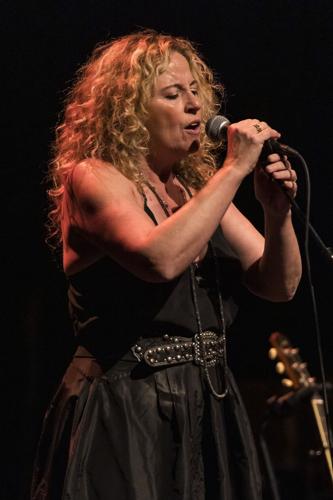
Amy Helm opened, and opened well. The daughter of The Band's Levon Helm, she brought a rootsy, soulful set and a voice that swung easily from warmth to outright power — a good match for this audience and this room, and the right way to set the tone for an unusually intimate evening.

Amy Helm performs Sept. 1 at The Lobero Theatre.
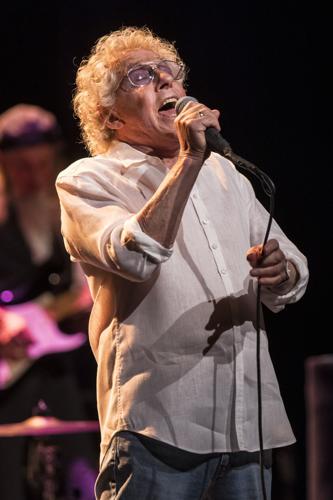
Then, Daltrey walked out and reminded everyone why that voice remains one of rock's most recognizable instruments.
But the show belonged as much to the band around him, and no one on that stage carried more history than Simon Townshend. He's Pete Townshend's younger brother, though that description undersells him. Simon has spent years playing alongside Daltrey and The Who, and at the Sept. 1 show he was far more than a family connection filling a slot. On guitar, vocals and, later, mandolin, he was one of the musical anchors of the night, someone who plainly understands these songs from the inside out.
People are also reading…
Hearing Daltrey sing this material with Simon Townshend beside him carries an obvious weight — the connection to Pete and to The Who's history isn't something you can set aside. But Simon never played like a substitute for his brother. He brought his own musicianship, his own presence and a familiarity with Daltrey that gave the whole performance an ease you can't fake.

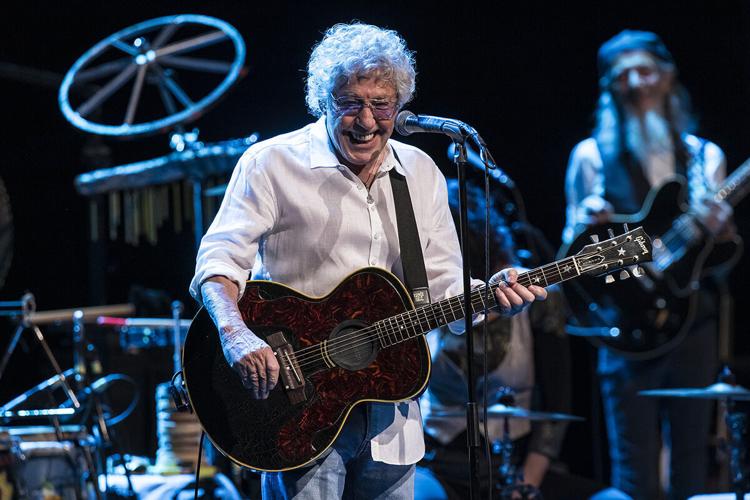
Roger Daltrey performs Sept. 1 at The Lobero Theatre in Santa Barbara, Calif.
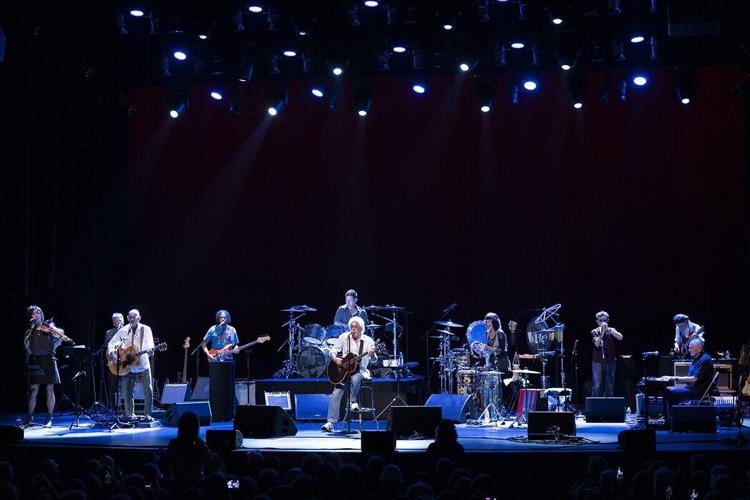
The rest of the band matched him. Doug Boyle offered a strong second guitar voice, Billy Nicholls doubled on mandolin, John Hogg anchored things on bass, Scott Devours drove it from the drums. Jody Linscott added percussion, Geraint Watkins moved between keyboards and accordion, Steve Weston brought harmonica, and violinist Katie Jacoby would turn out to be one of the night's real stars. This wasn't a set of hired hands behind a star — it played like a band, and Daltrey gave them room to prove it.
"Fire Still Burns" got the evening's best guitar solo, courtesy of Boyle, who took the song somewhere past the arrangement without ever turning it into a display.
One of the real pleasures of the night was hearing Daltrey talk between songs. He told stories, offered opinions and gave the songs context. At one point he brought up Paul Simon's decision to travel to South Africa during apartheid to explore the music there, a controversial trip that eventually produced "Graceland" but got Simon's own tour canceled — a slot The Who ended up filling. Daltrey's point seemed to be about musicians following the music wherever it leads, often before anyone else understands why.
He also talked, movingly, about Wilko Johnson, the late Dr. Feelgood guitarist. Daltrey and Johnson recorded together after Johnson had been diagnosed with what doctors believed was terminal pancreatic cancer. The album, "Going Back Home," became a hit in Britain, and Johnson lived years past his original prognosis. That history gave real weight to the songs that came out of it.

Roger Daltrey performs Sept. 1 at The Lobero Theatre in Santa Barbara, Calif.
"Keep It to Myself" was a highlight, Weston's harmonica giving it exactly the rough edge it needed. Daltrey clearly has real affection for the blues-harp tradition. John Fogerty's "Who'll Stop the Rain" followed, and I found myself singing along; the arrangement worked, and another sharp guitar turn lifted the song without trying to reinvent it.
"Without Your Love" was one of the emotional high points of the night. Daltrey's voice cracked slightly — maybe the only time all evening — and the song was better for it. At this stage of his career, perfect pitch would be less interesting than hearing the years inside the voice, and that small fracture gave the performance more, not less. Simon Townshend switched to mandolin here, changing the texture entirely; the ending was restrained and beautifully judged, another example of his instinct for what a song actually needs.
Then, Katie Jacoby's violin opened "Baba O'Riley" — still "Teenage Wasteland" to a couple of generations of fans — and she owned the moment before Daltrey ever came in. When he did, he didn't try to sound like the 27-year-old who first sang it. He sang it as the man who's carried it for more than 50 years, which is a very different thing, and a more interesting one. There was no pretense of being the Daltrey of 1971 up there this night — just the Daltrey of 2026, and that turned out to be plenty.

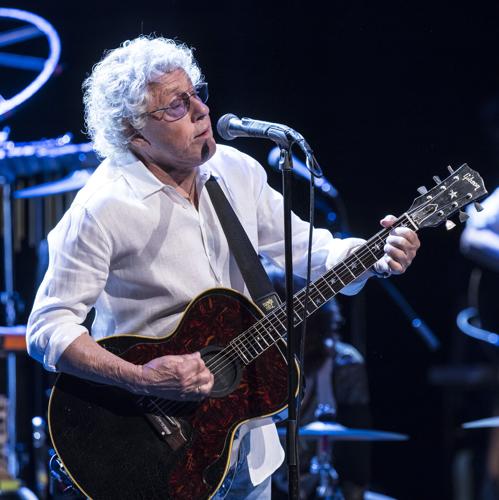
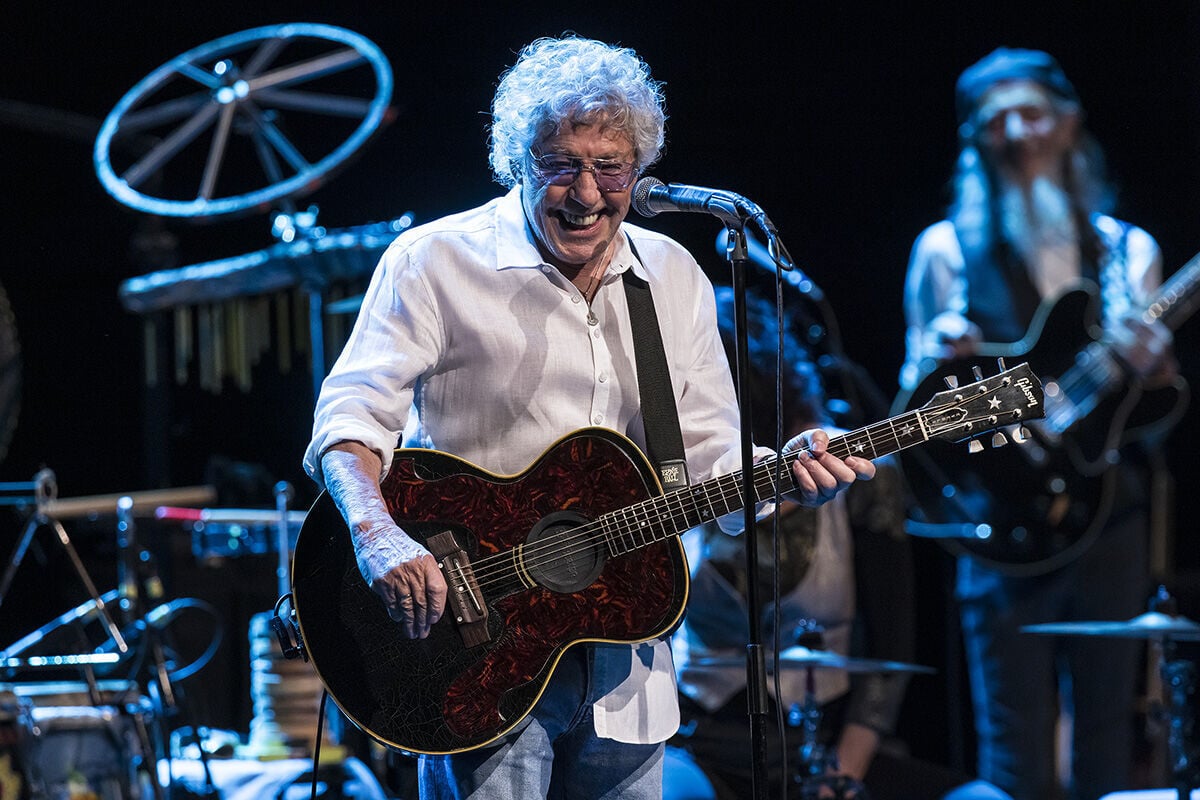
Roger Daltrey and band members perform Sept. 1 at the Lobero Theatre.
The band tore into Neil Young's "Rockin' in the Free World," and the room got back on its feet — Townshend, Boyle, Hogg, Devours and the rest pushing hard without ever burying Daltrey's voice under it. By then, I realized I'd been standing for most of the final hour, which, again, I don't do.
After all that power, Daltrey came back out alone, carrying a Gibson Everly Brothers acoustic — a distinctive, collectible guitar any player would recognize on sight. It made for a striking image: one of rock's great frontmen with nothing left between himself and the crowd but an acoustic guitar. He closed with Ray Davies' "Days," a song of gratitude and farewell, and there wasn't a better way to end the night. No pyrotechnics, no attempt to top what came before — just Daltrey, the guitar, and a song about being thankful for the time we get with each other.
Daltrey built a career partly on the line about hoping to die before he got old. He didn't. What he's found instead, with Simon Townshend and this remarkable band behind him, is more interesting than the line ever was. At the Lobero, growing older didn't sound like decline. It sounded like gratitude, and one hell of a rock-and-roll band.
It was the best show of the season.