
The University of Arizona finally gets the green light from DHS to study the effectiveness of Border Patrol checkpoints and their impacts on nearby communities.
The UA’s National Center for Border Security and Immigration Research will begin a two-year study in 2011 under $500,000 in federal funding. The news comes a year after Department of Homeland Security officials first said the UA would be brought in to help with metrics that have twice been labeled insufficient by the Government Accountability Office, in 2009 and 2005.
People are also reading…
Here's the story I just filed today:
The University of Arizona will evaluate the effectiveness of Border Patrol checkpoints and their impacts on nearby communities under a $500,000 contract.
The UA’s National Center for Border Security and Immigration Research will start the two-year study in 2011, said executive director Elyse Golob.
The Center, which opened in September 2008, is funded by the U.S. Department of Homeland Security and co-led by the UA and the University of Texas-El Paso. UTEP will also get $500,000 to study checkpoints, Golob said.
“We’re really excited to be given the opportunity to utilize our capabilities and our research capacity to assist Border Patrol in addressing a very real challenging area,” Golob said. “To provide our academic brainpower to help them address some of the issues that emerged from the GAO.”
The Border Patrol's current evaluation measures have twice been labeled insufficient by the Government Accountability Office, the investigative arm of Congress.
An August 2009 GAO report found that the Border Patrol’s self-reported data wasn't sufficient to determine if the highway checkpoints were efficient or effective and that the agency overstated checkpoint results as a result of a lack of management oversight and inconsistent data-gathering and data- analyzing throughout the agency. The GAO had similarly criticized the agency's method for gauging checkpoints in a 2005 study.
The two-year study will be broken down into four phases, Golob said:
• Phase One: Assess current methods used by Border Patrol agents to collect data at checkpoints in order to create standardized ways for agents to collect data at all checkpoints across the nation.
• Phase Two: Analyze the impact checkpoints have on nearby communities. This will include negative effects such as real estate values, traffic flows and crime, and positive effects such as having more law enforcement nearby as first-responders and removing drunk drivers from the road.
• Phase Three: Determine how effective checkpoints are within the agency’s overall border security strategy.
• Phase Four: Create a simulation model using the data collected in the first three phases to give Border Patrol field managers better information about what works at checkpoints, which will help them determine how to best allocate resources and plan special operations.
About 20 people from the UA will work on the project, including researchers, post-doctoral researchers and PHD students, Golob said.
“Our students are very excited about having a chance to participate,” she said.
They will likely choose a few checkpoints around the country to focus on in the study, one of which will be checkpoint south of Tucson on Interstate 19, she said.
A proposed permanent checkpoint on I-19 north of Tubac has been at the center of a heated debate for more than a decade. Officials in the Border Patrol's Tucson Sector — the only one of nine on the U.S.-Mexico border without permanent inspection stations — say the checkpoint is vital to slowing the flow of people and drugs in the Southwest border's busiest stretch.
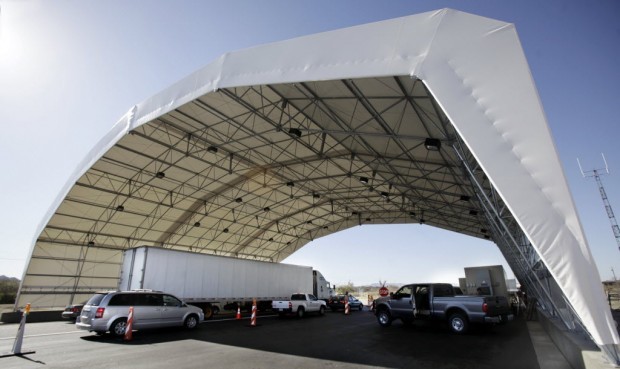
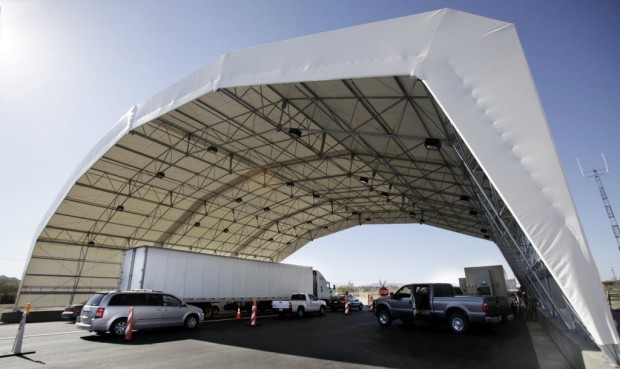
In April, the Border Patrol opened a $1.5-million interim checkpoint facility about 25 1/2 miles north of the border between the Agua Linda and Chavez Siding exits. The facility has three northbound lanes of traffic under a lighted, 105-by-115-foot canopy. The agency has long term plans to build a $25 million facility in the area.
Many residents in the I-19 corridor oppose the current checkpoint and the idea of building permanent one because they say it pushes smuggling activity around the checkpoint and into their neighborhoods. They also question the effectiveness of the agency’s checkpoints.
Department of Homeland Security officials first made it public that they would have the UA help them create metrics to evaluate their highway checkpoints in September 2009 but it too a year to finalize details of the project.
Contact reporter Brady McCombs at 573-4213 or bmccombs@azstarnet.com.