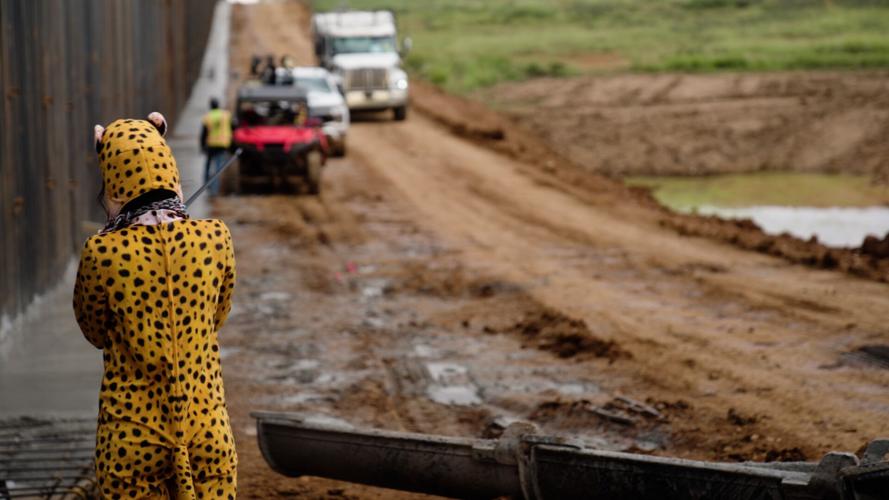
Three people were arrested Monday after protesters dressed as endangered animals sought to disrupt ongoing wall construction along the U.S.-Mexico border in the San Rafael Valley, about 100 miles southeast of Tucson.

A protester in a jaguar costume tries to stop construction of the border wall in the San Rafael Valley, about 100 miles southeast of Tucson.
According to the Cochise County Sheriff’s Office, Alex Chabbott, 45, and Hannah Lee Graham, 36, of Santa Barbara, California, and Anwehn Teralee Kraus, 23, of Eugene, Oregon, were booked on charges of disorderly conduct for allegedly entering a restricted area and accessing “construction materials intended for use in the border wall project.”
These were the first arrests reported in connection with protests at the border in Arizona since July 27, when the Santa Cruz County Sheriff’s Office booked a man from Tucson on suspicion of criminal trespassing after he allegedly interfered with border wall contractors in the almost-ghost town of Lochiel.
People are also reading…
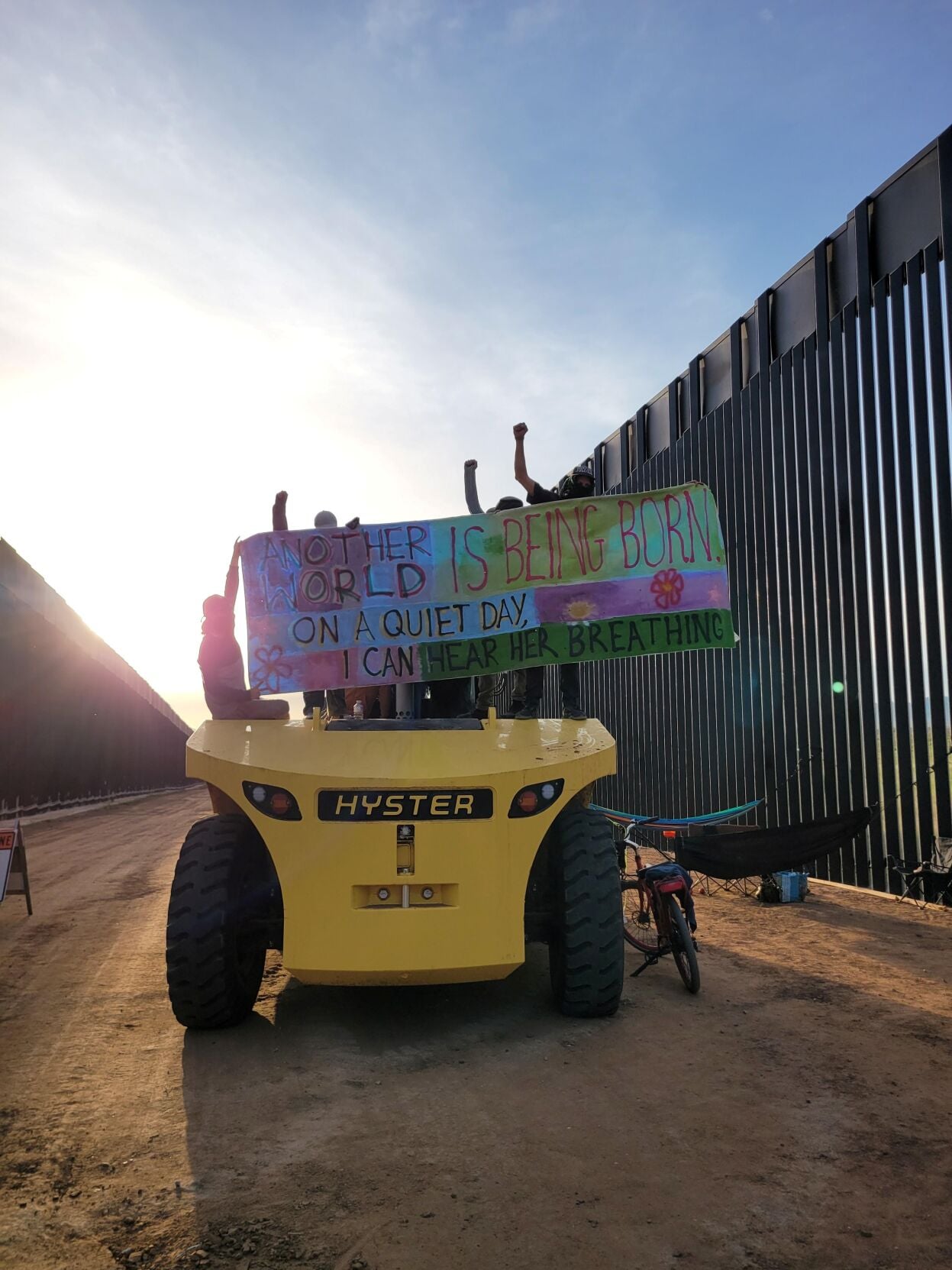
Protesters hold a banner atop a vehicle temporarily abandoned by border wall contractors in the San Rafael Valley.
Chabbott, Graham and Kraus were released on their own recognizance Tuesday morning by a justice of the peace in Bisbee.
“The Cochise County Sheriff’s Office respects the right of individuals to peacefully protest and express their views,” said Sheriff Mark Dannels in a written statement. “That right, however, does not extend to trespassing, damaging property, interfering with lawful operations or creating a safety hazard, and we take a zero-tolerance approach to these actions.”
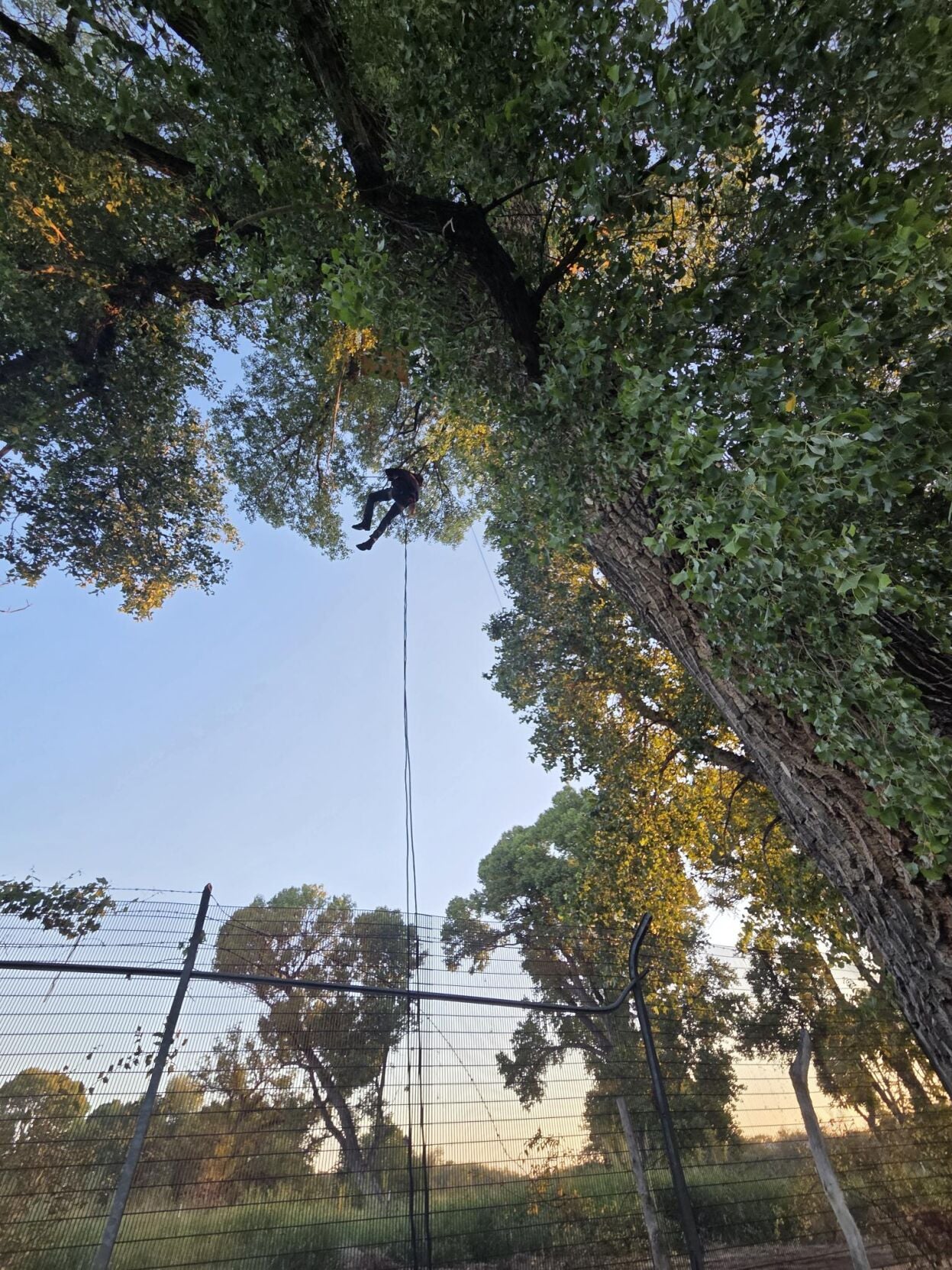
A tree sitter climbs a Fremont cottonwood on the Mexican side of the border as part of a border-wall protest that is now binational.
An Instagram video posted by the protest group shows the trio of “land defenders” — including one in a jaguar costume and another dressed as a yellow-billed cuckoo — being led away in handcuffs at the border wall work site at the western edge of Cochise County.
The group said the costumes were meant to highlight the significance of the San Rafael Valley as a biodiversity hotspot and “the most significant wildlife corridor remaining along the Arizona-Mexico border.”
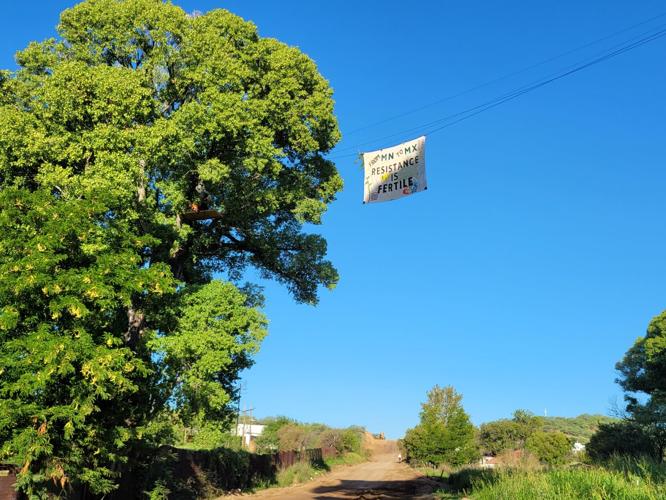
The protest activity is part of a demonstration that began a month and a half ago in Lochiel, where activists have been camping day and night in the branches of a mature Fremont cottonwood tree just inside the U.S. since July 29 to save it from being knocked down by border wall contractors.
Since then, demonstrators from the encampment have begun sitting in a neighboring cottonwood on the Mexican side of the border.

A banner hangs between Fremont cottonwood trees on both sides of the U.S.-Mexico border at Lochiel, Arizona, as part of a tree-sit protest against border wall construction.
The protestors have also spread out along a 15-mile stretch of the border to try to stop construction of primary and secondary barriers ordered by the Trump administration and funded by Congress last year to the tune of $46.6 billion.
The work now underway in the remote San Rafael Valley is part of a $1.5 billion contract awarded in December to North Dakota-based Fisher Sand and Gravel to build 21 miles of primary wall and 91 miles of secondary wall from west of Sasabe to Coronado National Memorial south of Sierra Vista.
In late August, protesters said Border Patrol officers showed up in force and threatened trespassing charges against anyone not authorized to be on the patrol road or elsewhere within the Roosevelt Reservation, a 60-foot-wide strip of land controlled by the federal government along the southern border.
But that hasn’t stopped demonstrators from trying to block the work, sometimes by placing themselves directly in the path of heavy construction equipment.
"Last night I slept over the metal arms of a large forklift that is meant to lift 10 of the metal bollards used to construct the wall,” said one activist who the protest group identified only as Tanager. “The machines were silent and I could hear the birds, the sounds of laughter far off down the road, and watch the night sky illuminate the valley."
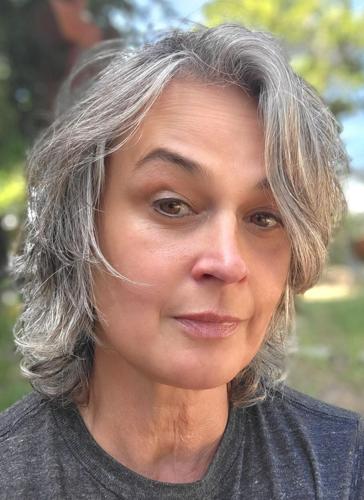
The ongoing protest has drawn attention and support from well-known tree-sitter Julia Butterfly Hill, who spent 738 days camped in a 200-foot-tall Northern California redwood tree in the late 1990s that she ultimately saved from loggers.

Julia Butterfly Hill
In a recent op-ed in the Star, Hill called the protest in Lochiel the first binational tree sit in history and the first ever mounted to stop border wall construction.
“Peaceful, direct action begins with a moral question: If the law permits an irreversible wrong, what responsibility do ordinary people have? The tree sitters in Arizona have answered that question with courage, patience and remarkable restraint,” she wrote. “Whether or not you think you agree with them, I ask that you recognize that they're compelled by love for a living world that cannot speak for itself as well as for future generations.”
Sheriff Dannels said his office will keep working with federal authorities, construction contractors and their private security personnel to enforce restrictions and public safety concerns in and around the border wall building sites.
“No one is above the law. We will continue to respond to these incidents in a coordinated, professional and deliberate manner,” he said. “Our expectation is simple: Individuals may exercise their lawful rights, but they must also comply with the law.”