
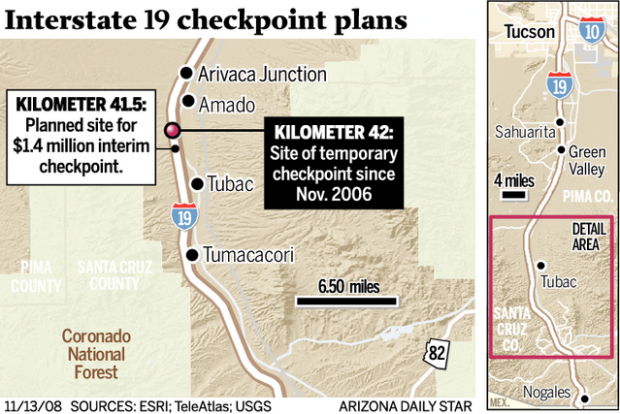
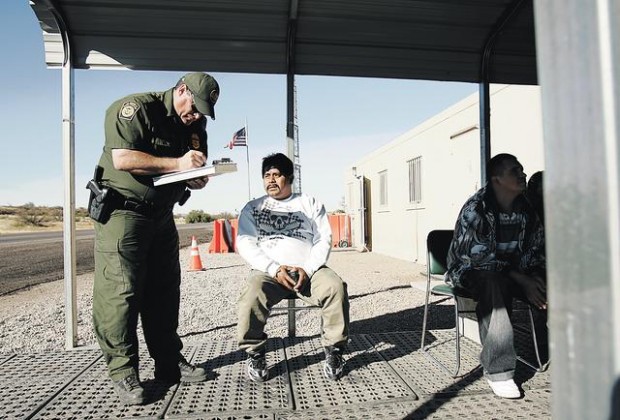
A $1.4 million upgrade of the U.S. Border Patrol's Interstate 19 checkpoint north of Tubac should be completed by late March or early April 2009.
The temporary facility — which will include a canopy over the northbound lanes of I-19 and a pullout lane for commercial vehicles — will likely be used for longer than originally planned.
Rep. Gabrielle Giffords, D-Ariz., succeeded in including language in the fiscal 2009 Department of Homeland Security appropriations bill that prohibits the agency from finalizing plans for a permanent facility until the interim checkpoint has been put up and an evaluation of all fixed checkpoints on the Southwest border from the Government Accountability Office is completed. The GAO report is expected by next summer.
The binding language in the bill may set the Border Patrol's plans for a permanent facility back two to three years, said Mike Scioli, Border Patrol Tucson Sector spokesman.
People are also reading…
"We have been working so hard to get this going and then we get hit with that," Scioli said. "There are more speed bumps to get to the permanent checkpoint now."
It is an "overstatement" to say the language will delay the permanent checkpoint multiple years, said Ron Barber, Giffords' district director. The language doesn't preclude the Border Patrol from planning, only from "finalizing" plans for the design and location of the permanent checkpoint, Barber said. Plus, the language will be re-evaluated next summer when lawmakers discuss the fiscal 2010 appropriations bill, he said.
Giffords doesn't oppose permanent checkpoints but wants to ensure that all decisions surrounding a checkpoint on I-19 are site-specific, he said.
The congresswoman opted for the insertion of the language after reaching a point where she felt Border Patrol officials weren't heeding her verbal requests, Barber said.
In the summer, she saw plans that showed Border Patrol officials were making plans for the permanent checkpoint without taking into account the results of the GAO study. She was also disappointed the Border Patrol failed to keep its promise of opening the interim facility by March 2008, Barber said.
"Obviously, something had to be done to get them to pay attention," Barber said. "It is really important to her that there is accountability from the Border Patrol."
The move drew praise from members of a vocal contingent in the Tubac/Amado area who oppose a permanent checkpoint.
"Anything that slows them down or halts what they are doing until they can develop some empirical evidence that the checkpoints are effective is a good thing," said Harry Peck, an attorney and real estate agent in Tumacacori.
Gary Brasher, a Tubac Realtor, along with others in a group opposed to a permanent checkpoint, advocated for the language. It gives the Border Patrol, community members and the new presidential administration a "cooling off" period and opportunity to review the results of the GAO study without the pressure of a looming timeline for the permanent checkpoint.
"The Border Patrol had an agenda that they were going to see accomplished regardless of what the people and Congress thought," Brasher said. "It is certainly appropriate for Congress to pull the reins in a little bit."
The congressional restriction frustrates supporters of the permanent checkpoint, such as Patti O'Berry, a Green Valley resident.
"It's just another way of trying to avoid a permanent structure," said O'Berry, whose son is a Border Patrol agent. "This is a huge blow."
The checkpoint issue has been a lightning rod for controversy in this Southern Arizona corridor since the Border Patrol began operating a stationary inspection station two years ago north of Tubac. Before that, the agency was required to move the checkpoint every seven to 14 days due to a congressional rule.
Opponents question the effectiveness of the stationary checkpoints, since there is no element of surprise. They also worry the checkpoint pushes smuggling activity into their neighborhoods and contend the Border Patrol should focus its efforts closer to the border.
Border Patrol officials said a permanent checkpoint is a necessity to slow smuggling and that it's no coincidence the Tucson Sector, the only without a permanent checkpoint on the Southwest border, is the busiest smuggling corridor.
The controversy was reignited in letters recently exchanged between Giffords and David Aguilar, national chief of the Border Patrol.
In a letter dated Sept. 24 sent to Aguilar, Giffords and Rep. David Price, D-N.C., chairman of the Homeland Security appropriations subcommittee, questioned why the Border Patrol was conducting environmental assessments and designs for a permanent checkpoint.
The letter also suggested the work toward the permanent checkpoint resulted in a one-year delay in construction of the interim facility.
In a response letter dated Oct. 10, Aguilar disagreed with the accuracy of Giffords' depiction of events and said the agency was trying to avoid duplication of efforts and expenses since the interim checkpoint location is also under consideration for the eventual permanent facility.
"These actions do not commit us to a permanent checkpoint at the interim site; they simply save us time and money should we continue to believe that the interim site is the best location for a permanent checkpoint," Aguilar wrote.
The delay in constructing the interim facility was due to problems in acquiring property rights and the environmental and engineering study processes, not because they were working on a permanent checkpoint, Aguilar wrote.
On StarNet: For a look at more stories about the border area, including a database of border deaths and special reports about immigration, visit azstarnet.com/border
Did you know
For more than a decade, Congress has restricted the U.S. Border Patrol from constructing or operating permanent checkpoints in the Tucson Sector, the only one of nine on the Southwest border without a permanent inspection station.
That ended when U.S. Rep. Jim Kolbe, R-Ariz., the author of the restrictive language, retired. The restrictions were omitted from the fiscal 2007 Department of Homeland Security appropriations bill.
On Nov. 10, 2006, a little more than a month after fiscal 2007 had begun, the Border Patrol began operating a non-moving checkpoint north of Tubac. The agency also said it would move toward a permanent checkpoint.
But now, two years later, there is a new congressional restriction. Rep. Gabrielle Giffords, D-Ariz., had language inserted in the fiscal 2009 appropriations bill that prohibits the agency from finalizing plans for a permanent facility until it constructs an interim facility and a formal evaluation of fixed checkpoints from the Government Accountability Office is finished.